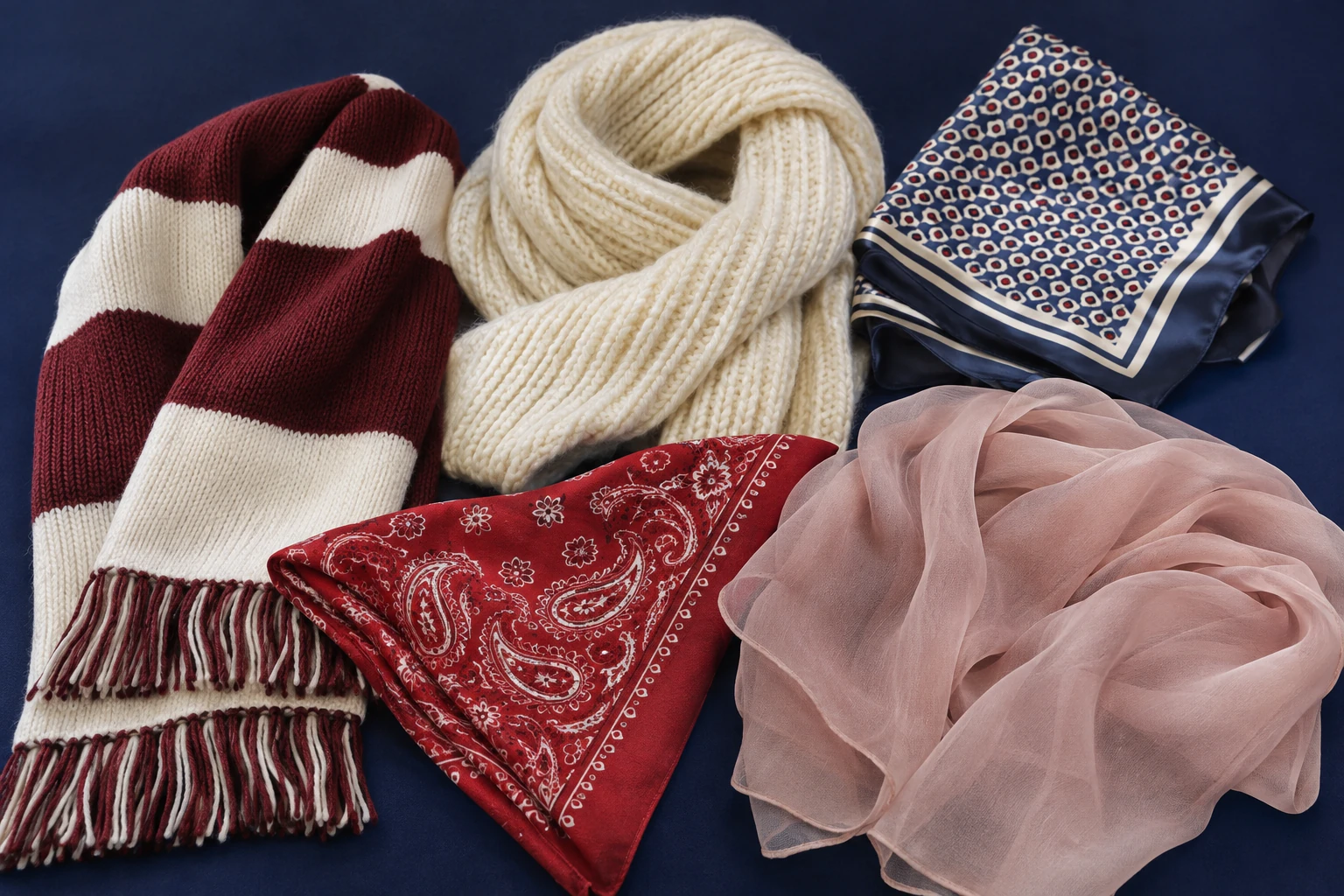
Search for “types of scarves” and most lists put a pashmina next to an infinity scarf next to a silk square, as if they were the same kind of choice. They are not. One is a style name for a soft cashmere shawl, one a shape and one a fibre, and a single scarf can be all three at once.
This guide sorts scarves along clear lines: shape and size, construction, fibre, decoration, edge finish and use. Each type gets a short definition, a typical size in centimetres, how we usually make it and who it suits. It is written for brands, shops, clubs, schools, uniform buyers, event companies and modest-fashion labels that want their own scarves; our custom scarves page shows the full range we make.
What is a scarf?
A scarf is a strip, square or loop of fabric worn around the neck, over the head or across the shoulders, for warmth, cover or style. It has almost no shaping: what it is depends on its size, its fabric and how it is folded or tied.
The same item goes by many names: a long winter knit is also called a muffler, a small square at the throat a neckerchief, a printed cotton square a bandana, and a closed loop an infinity scarf or, when short and snug, a snood. In modest fashion “scarf” often means a hijab. Because the names overlap, sorting by line helps.
How do scarves differ? The six lines every scarf is built on
Every scarf combines one choice on each of six lines. A digitally printed 90 × 90 cm silk twill square with hand-rolled hems is one example; a knitted acrylic fan scarf with a jacquard club name and fringed ends is another.
| Line | The choices | What it decides |
|---|---|---|
| Shape and size | Oblong, skinny, square, neckerchief, triangle, bandana, tube, infinity loop, snood, wrap, shawl, stole, hijab, sarong | How it is worn and where a design or logo can sit |
| Construction | Knitted (rib, cable, jacquard), woven (twill, satin, chiffon, georgette, habotai, voile, challis, poplin), jersey and fleece | Stretch, drape, warmth and which decoration works |
| Fibre | Acrylic, wool and merino, cashmere blends, silk, polyester, viscose and modal, cotton, linen, velvet | Feel, warmth, sheen, care and price |
| Decoration | Knitted-in jacquard, digital, screen, rotary screen, sublimation, heat transfer and discharge printing, embroidery, labels | How the scarf carries a design or brand |
| Edge finish | Knitted fringe, hand-rolled hem, machine-rolled or overlocked hem, tassels, twisted or braided fringe | The look of the ends and edges, and part of the cost |
| Use | Fan and football, uniform and corporate, school and club, fashion and gift, promotion and event, beach, modest fashion | Which of the five choices above make sense |
Construction links the other lines. Knitted scarves (acrylic, wool, merino, cashmere blends and jacquard fan scarves) are knitted and finished in-house in our factory in Sialkot, Pakistan, on flatbed machines; fleece and jersey scarves are cut and sewn in-house from fabric supplied by partner mills. Woven fabrics such as silk, satin, chiffon, georgette, twill, viscose, modal, cotton voile, bandana cotton and linen come from partner mills and are cut, printed, hemmed, finished and branded in-house. For very large runs, around 50,000–100,000 pieces, our team may also use our other units or partner mills, depending on the product. Our guide to knitted vs woven scarves explains both paths step by step.
All types of scarves at a glance
The scarf types in this guide, with the line each belongs to and a typical size. Sizes are “about” figures; every size can be made to your specification.
| Type | Group | Typical size | In one line |
|---|---|---|---|
| Oblong (long) scarf | Shape | About 25–30 × 170–200 cm knitted; 55–70 × 180 cm woven | The classic long rectangle |
| Oversized or blanket scarf | Shape | Wider and longer, to your size | A long scarf that doubles as a wrap |
| Skinny scarf | Shape | About 5–8 × 120–150 cm | Narrow accent scarf |
| Square scarf | Shape | 50 × 50, 53 × 53, 70 × 70, 90 × 90 cm | Folded or tied at the neck, head or bag |
| Neckerchief | Shape and use | About 50–55 cm square, 70 × 70 cm, or a triangle | Small scarf knotted at the throat |
| Triangle scarf | Shape | Short sides about 50–70 cm | Cut as a triangle, no folding needed |
| Bandana | Shape | 51, 56 or 69 cm square | Printed cotton or polyester square |
| Tube bandana | Shape | About 25 × 50 cm tube | Seamless stretch tube, worn many ways |
| Infinity scarf | Shape | About 140–180 cm round, 25–70 cm wide | Long closed loop, wrapped twice |
| Snood | Shape | About 25–35 cm high | Short snug tube at the neck |
| Wrap, shawl and stole | Shape | Usually 50–100 cm wide, 180–200 cm long | Large scarf over the shoulders |
| Hijab | Shape and use | About 70 × 180 cm; also 100 × 200 cm | Head covering for modest fashion |
| Sarong and beach scarf | Shape and use | About 90 × 180 or 110 × 180 cm | Large light wrap for the beach |
| Rib knit scarf | Construction | About 25–30 × 170–200 cm | Stretchy ribbed knit, plain or fringed |
| Cable and chunky knit scarf | Construction | About 25–28 × 180–200 cm | Thick, textured winter knit |
| Jacquard knit scarf | Construction | About 18–25 × 150–170 cm | Pattern or logo knitted in |
| Fleece scarf | Construction | About 20 × 150 cm | Light, brushed, cut and sewn |
| Woven scarf | Construction | Any shape | Twill, satin, chiffon, georgette, voile and more |
| Jersey scarf | Construction | About 70 × 180 cm | Soft knitted fabric, cut and sewn |
| Wool and merino scarf | Fibre | About 25 × 180 cm | Warm natural fibre |
| Cashmere and cashmere-blend scarf | Fibre | About 30 × 180 cm knitted | Soft, warm, gift and luxury |
| Silk scarf | Fibre | Squares, skinny, long | Fine, printed, hand-rolled hems |
| Satin scarf | Construction | Squares, skinny, long | Glossy weave in silk or polyester |
| Viscose and modal scarf | Fibre | About 70 × 180 cm | Soft, fluid drape, takes print well |
| Cotton and linen scarf | Fibre | Bandanas, voile long scarves, wraps | Light, matt, for warm weather |
| Football and fan scarf | Use | About 18 × 150 cm plus fringes | Club colours and names |
| Uniform and corporate scarf | Use | Neckerchiefs, skinny, squares | Brand colours for staff |
| Gift and luxury scarf | Use | Squares, long, knitted | Silk, cashmere blends, gift boxes |
| Promotional and event scarf | Use | Bandanas, fleece, satin | Good value, printed logo |
| Kids’ scarf | Use | About 15 × 120 cm knit; 51 cm bandana | Short, simple ends |
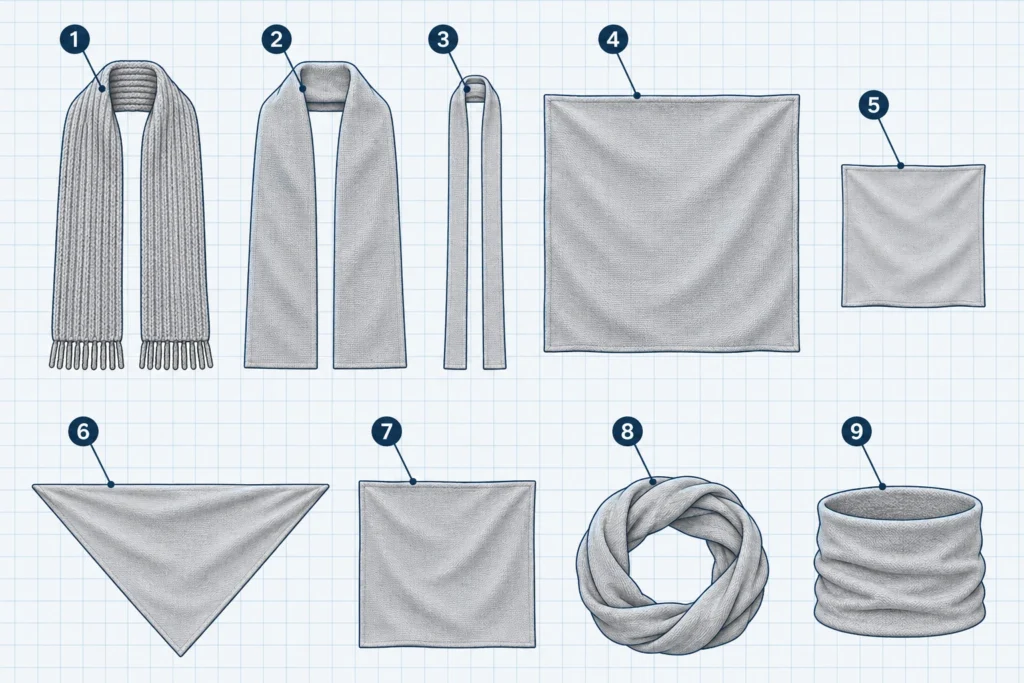
Our scarf sizes and shapes guide gives every format in centimetres with what each size suits.
Scarf types by shape and format
Shape decides how a scarf is worn and how much room there is for a design, and the size sets part of the price.
Oblong or long scarf
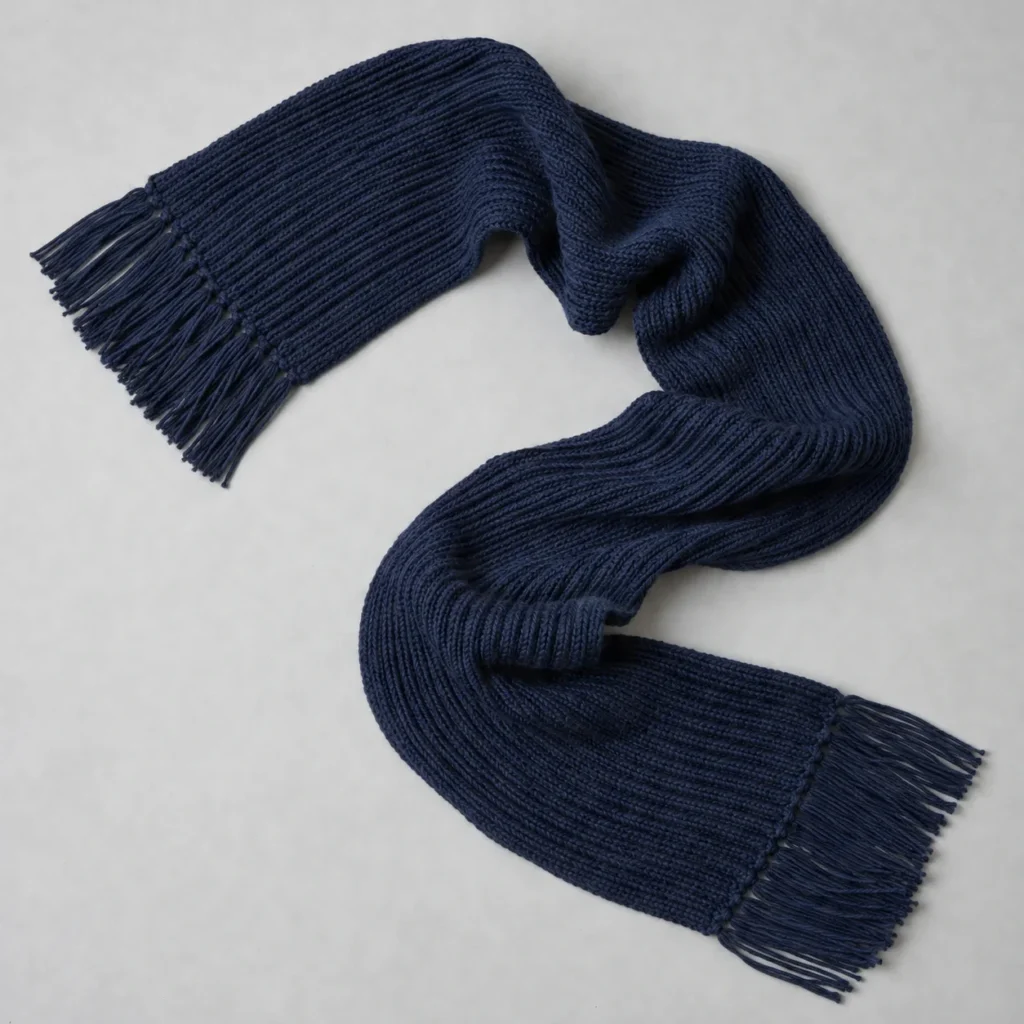
An oblong scarf is a long rectangle wrapped once or twice around the neck, with the ends hanging or knotted. Knitted oblongs are usually about 25–30 × 170–200 cm; our ribbed acrylic knit scarf is about 30 × 180 cm and our chunky rib about 25 × 200 cm. Woven long scarves are wider and lighter, usually about 55–70 × 180 cm, in silk, viscose, modal, chiffon or cotton voile. An oversized or blanket scarf is a wider, longer oblong that doubles as a wrap, made to your size.
Skinny scarf
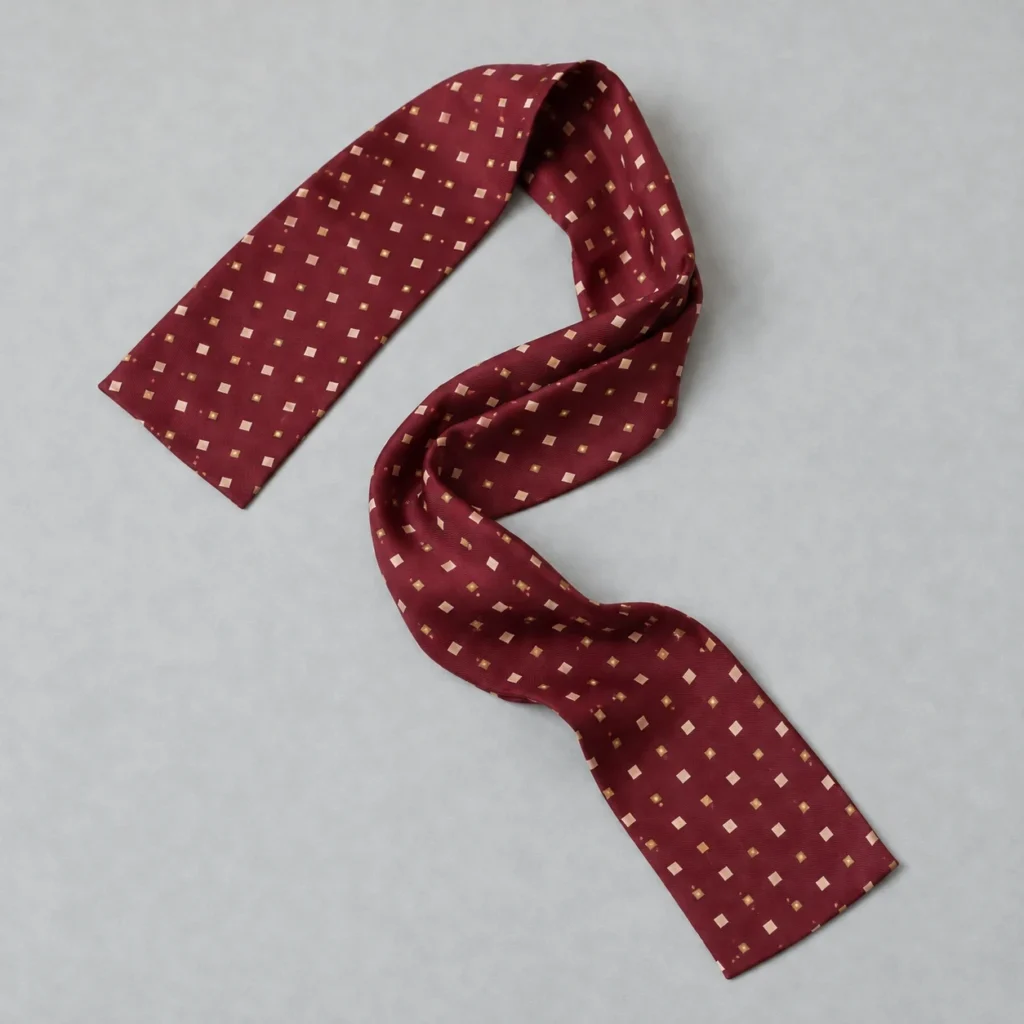
A skinny scarf is a narrow rectangle, usually about 5–8 cm wide and 120–150 cm long, worn as an accent: knotted at the neck, tied to a bag handle or worn in the hair. The narrowest versions are sometimes called twillies. Skinny scarves are usually printed silk twill or polyester satin with narrow hems; our skinny silk twill scarf is about 8 × 120 cm. Fan ranges also have a knitted skinny retro scarf of about 13 × 150 cm.
Square scarf
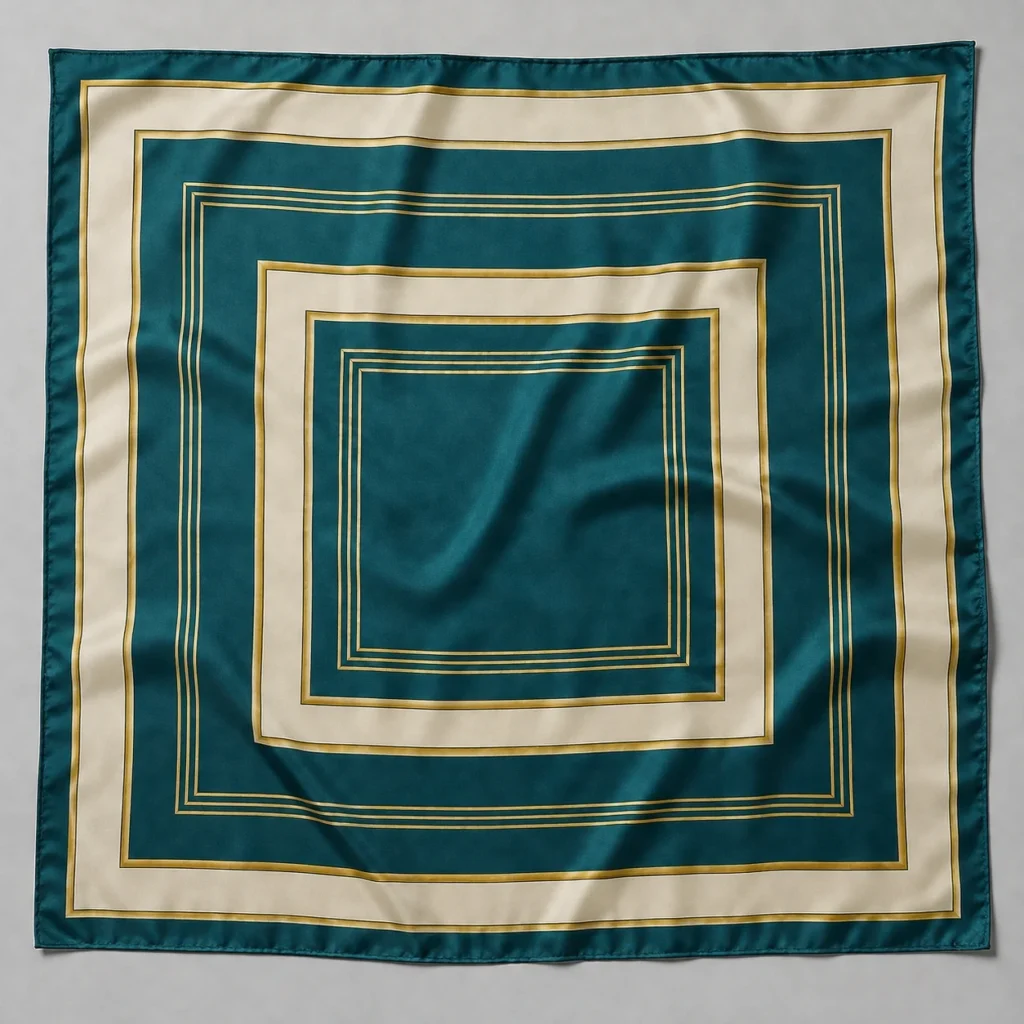
A square scarf is folded into a triangle or a band and tied at the neck, over the hair or on a bag. Common sizes are 50 × 50 cm for a hair scarf, 53 × 53 cm for a neck scarf, 70 × 70 cm for a medium square and 90 × 90 cm for the classic large square. Squares are woven fabrics: silk twill, silk satin, habotai, polyester satin or silk-touch polyester twill, almost always printed. On silk we usually finish the edges with hand-rolled hems; on polyester, with machine-rolled hems. Squares suit fashion labels, gift ranges and hospitality uniforms.
Neckerchief
A neckerchief is defined by how it is worn: a small scarf knotted or slid through a toggle at the throat. It can be a small square of about 50–55 cm, a 70 × 70 cm square or a triangle with short sides of about 50–70 cm. Uniform neckerchiefs are usually polyester twill in a solid brand colour; scout and group neckerchiefs are usually cotton triangles, screen-printed or plain; chef neckerchiefs are plain cotton squares. See our neckerchiefs page.
Triangle scarf
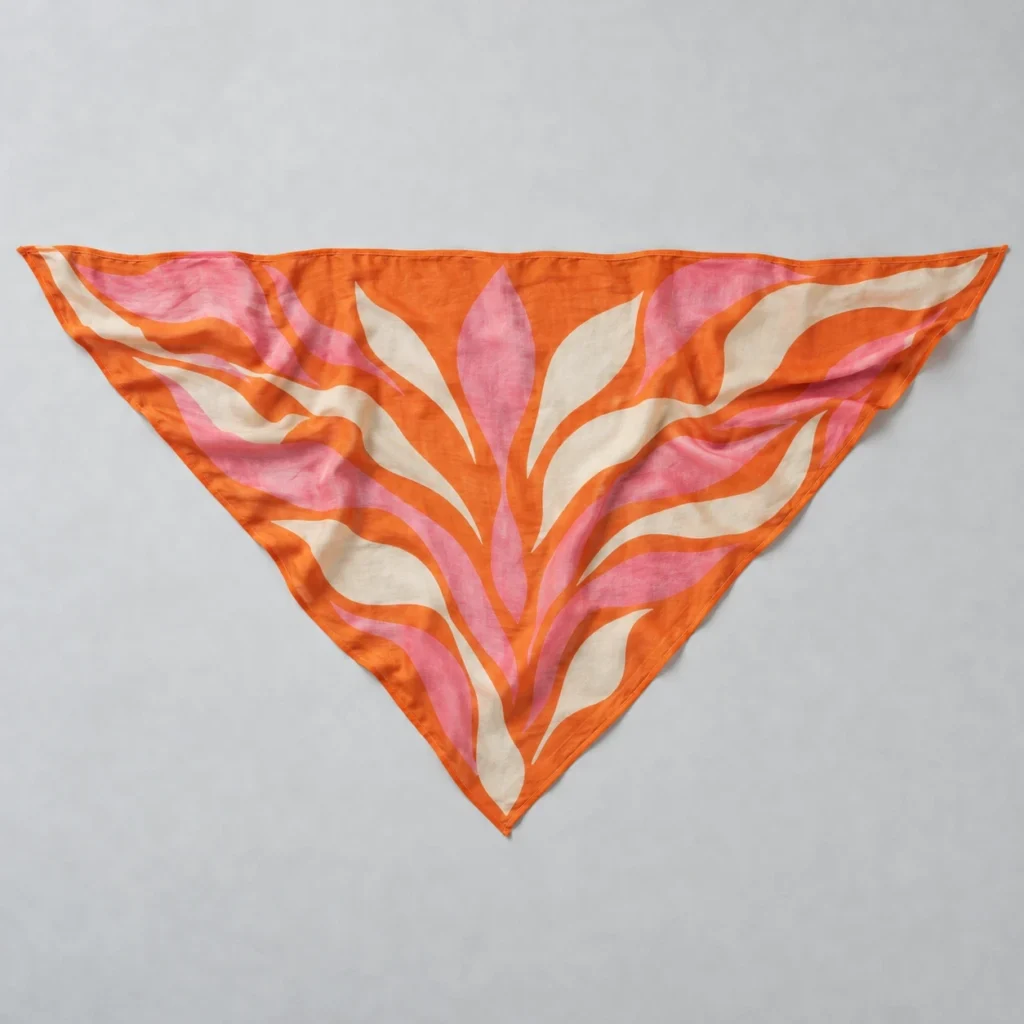
A triangle scarf is cut as a triangle instead of being folded from a square, so it lies flat with one layer and uses less fabric. The short sides are usually about 50–70 cm. Our printed triangle scarf is viscose challis with a placed digital print and narrow hems. A small triangle is also the usual shape for pet bandanas.
Bandana
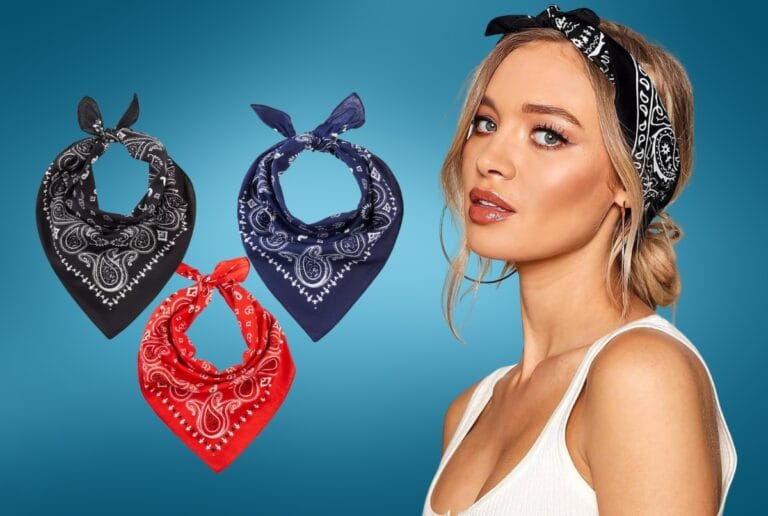
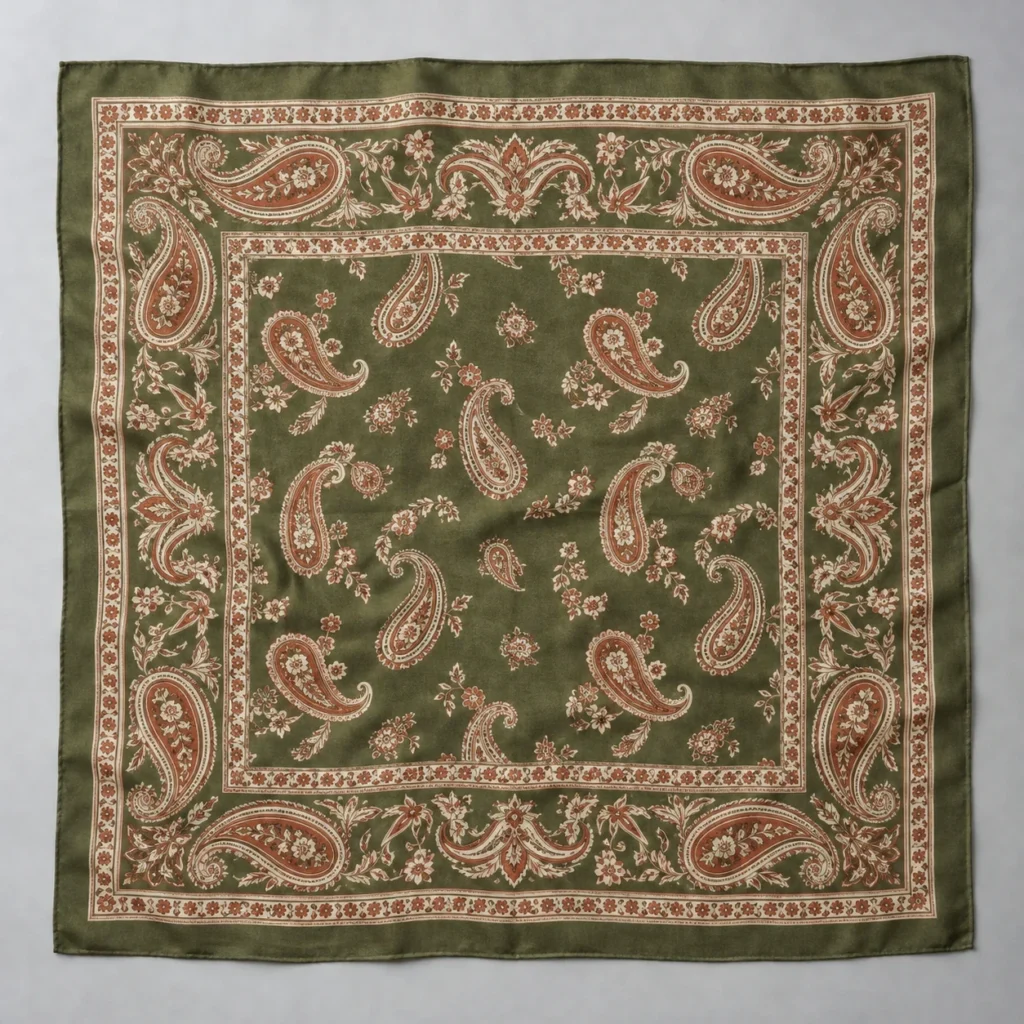
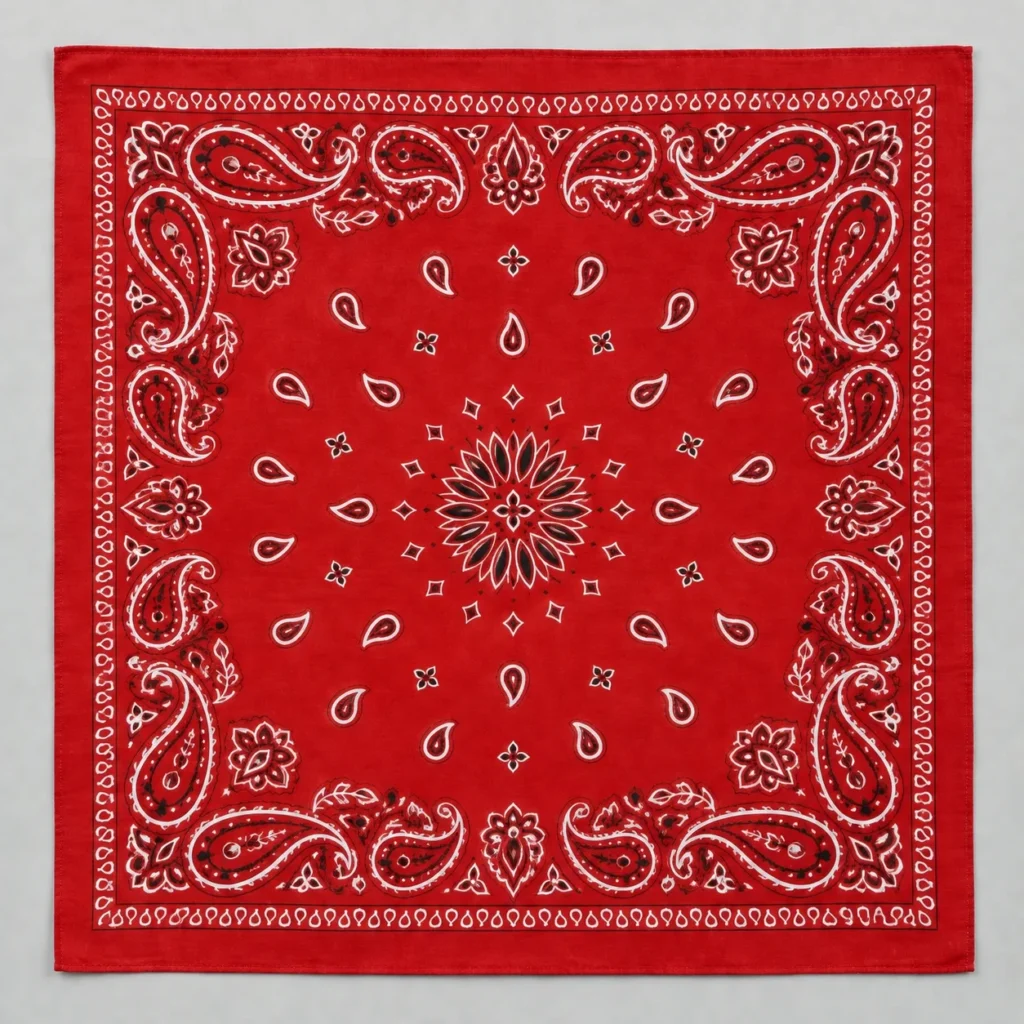
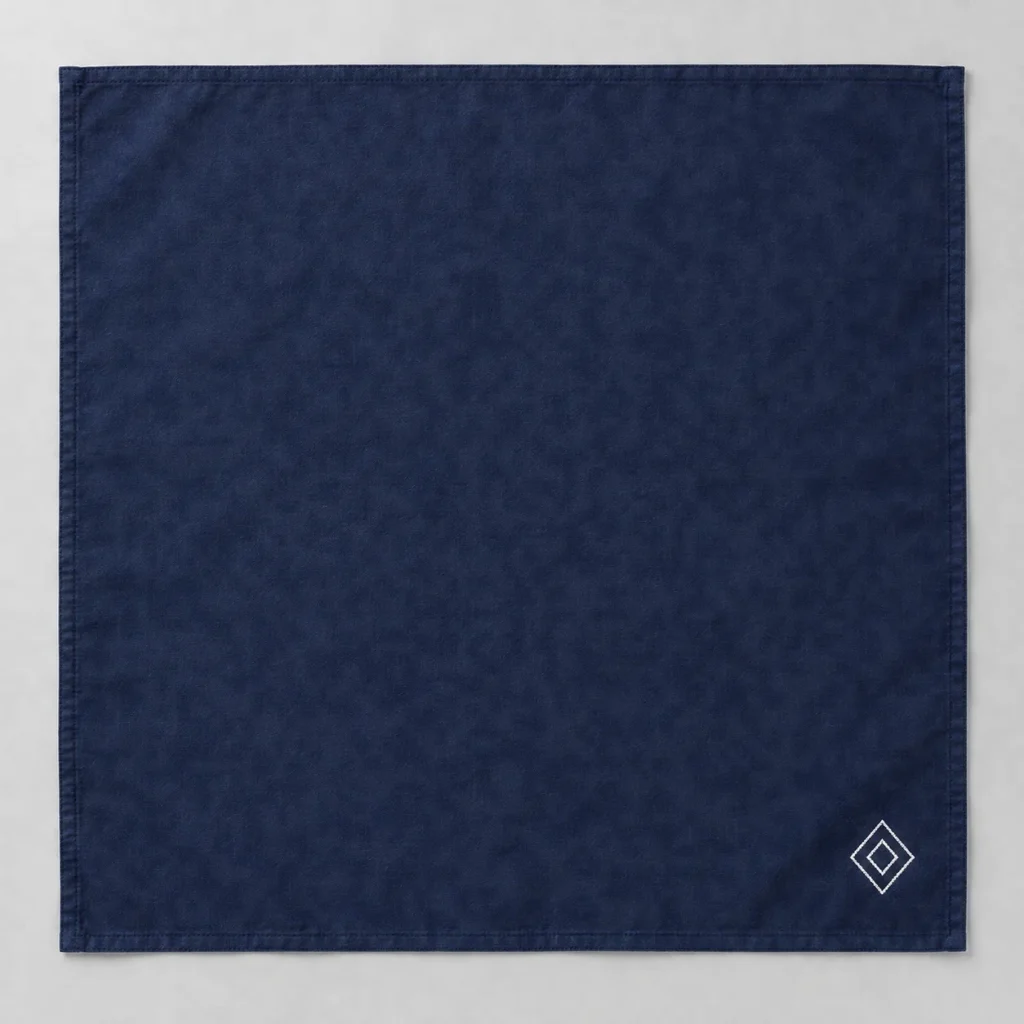
A bandana is a square, traditionally printed cotton, worn as a neck scarf, a headband or a face cover. The common sizes are 51 × 51 cm (20 in) for kids, 56 × 56 cm (22 in) as the standard adult size and 69 × 69 cm (27 in) for a large bandana. Classic bandanas are bandana cotton poplin with a screen-printed paisley, often discharge-printed on dark grounds; polyester twill bandanas are sublimated edge to edge, and logo bandanas can be embroidered in one corner. Our bandana sizes and printing guide goes into detail, and our cotton bandana screen-printing project shows one order from brief to delivery.
Tube bandana
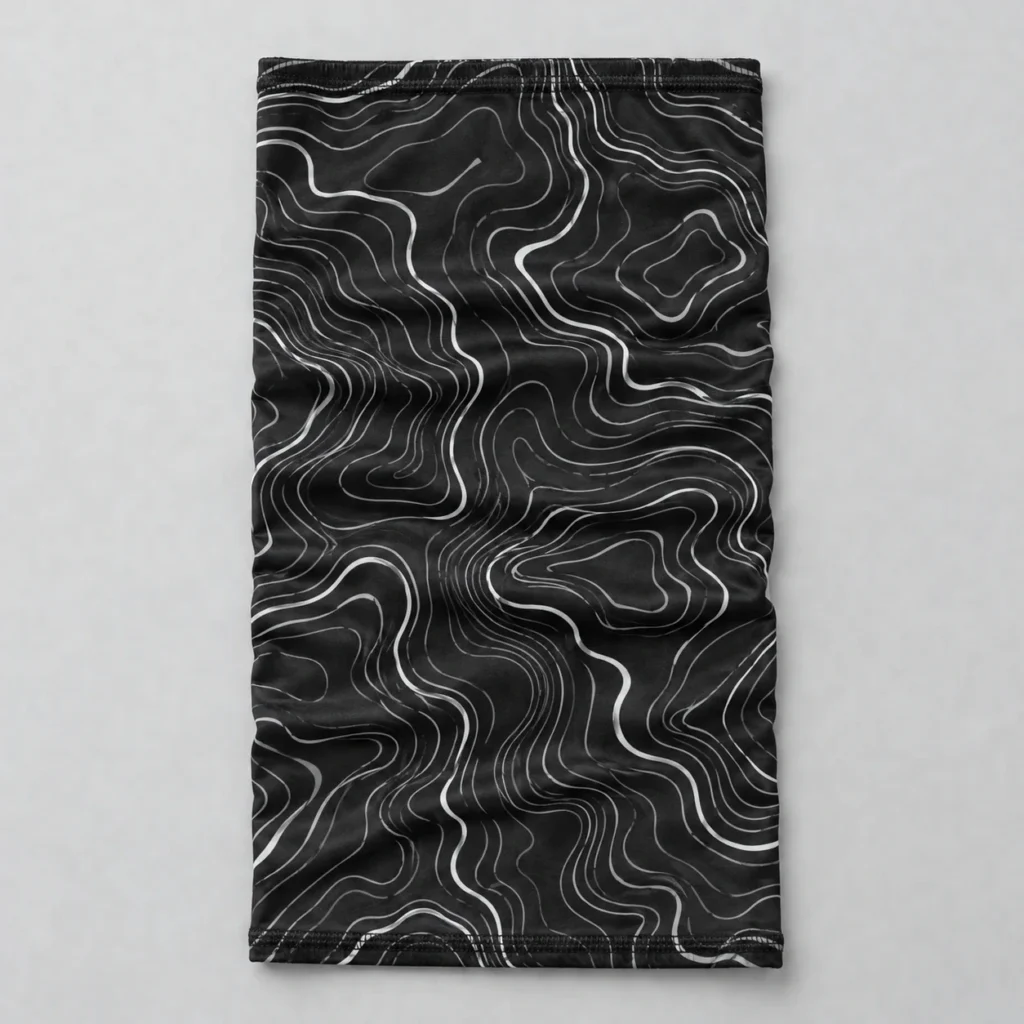
A tube bandana is a seamless stretch tube of about 25 × 50 cm that can be worn around the neck, as a headband or pulled up over the face. Ours is a polyester microfibre knit, sublimated all over and finished with overlocked ends. It suits outdoor, festival and promotional ranges. See our tube bandana.
Infinity scarf
An infinity scarf is a long scarf joined into a closed loop, usually about 140–180 cm round and 25–70 cm wide, so it can be wrapped twice and drapes like a normal scarf without ends to tie. Knitted infinity scarves are linked into a loop in-house; woven ones are joined with a clean, flat seam. Usual fabrics are knits, jersey, fleece, viscose and chiffon. See our infinity scarves page.
Snood
A snood is a short, closed tube, usually about 25–35 cm high, that sits close to the neck in one layer and can be pulled up over the chin. It is knitted in acrylic, wool or merino, or sewn from fleece or jersey; it can be single or double layer, and a fleece lining adds warmth. With no loose ends it stays in place, which suits winter, outdoor and children’s ranges, and it pairs well with a matching beanie. See our snoods page.
Infinity scarf vs snood vs neck gaiter
All three are closed loops; they differ in length, fabric and use.
| Style | Size and fit | Usual fabrics | Typical use |
|---|---|---|---|
| Infinity scarf | Long loop, about 140–180 cm round, wrapped twice, drapes | Knits, jersey, viscose, chiffon | Fashion and everyday wear |
| Snood | Short tube, about 25–35 cm high, one layer close to the neck | Knits, fleece, jersey; lined or double layer | Winter, kids and outdoor ranges |
| Neck gaiter | Thin stretch tube worn over the neck and face | Performance jersey and mesh | Running, cycling, skiing and outdoor work |
A neck gaiter is a sports product rather than a scarf; we make it in our balaclava range, see our neck gaiters.
Wrap, shawl and stole
Wraps, shawls and stoles are large scarves worn over the shoulders as well as at the neck, and the three words overlap. A stole is usually the narrowest, around 50–70 cm wide; shawls and wraps are wider, often up to about 100 cm, and usually around 180–200 cm long. They are usually woven: cashmere and cashmere blends, woven wool, viscose, modal or silk, often with twisted fringe at the ends. “Pashmina” is used as a style name for a soft cashmere or cashmere-blend shawl; it is not a fibre name, so the label states the real composition. See our cashmere scarves page.
Hijab
A hijab is a head covering worn in modest fashion, and the shape follows how it is styled. Rectangular hijabs are usually about 70 × 180 cm, with larger 100 × 200 cm versions made to order; square hijabs, folded into a triangle, and other shapes are made to your size. The fabric matters most: polyester chiffon is light and sheer and is often worn over an under-scarf; viscose, modal and jersey are softer and usually opaque in one layer; silk georgette has a matt, slightly grainy surface that tends to stay in place. Edges are narrow or rolled hems, or tassels. Our hijabs page shows the range and our hijab fabrics guide compares them.
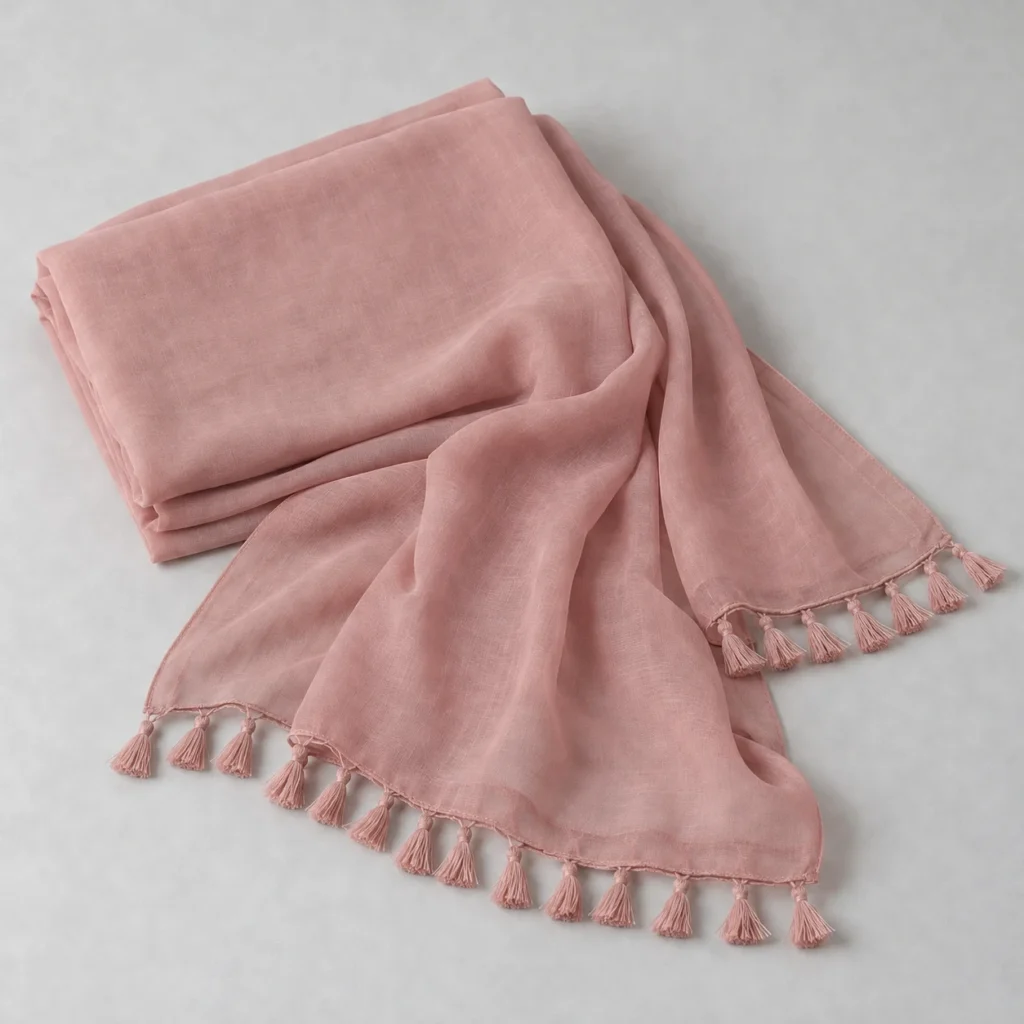
Sarong and beach scarf
A sarong is a large, light rectangle worn as a beach cover-up, a wrap skirt, a shawl or a head wrap. Sizes are usually about 90 × 180 cm or 110 × 180 cm. Viscose is the usual fabric for its soft drape and bright prints; cotton voile, chiffon and linen are the alternatives. Viscose and cotton are digitally or rotary screen printed, and the edges are narrow hems, frayed edges, fringes or tassels. See our beach scarves and sarongs page.
Scarf types by construction: knitted, woven or jersey
Knitting builds the fabric from interlocking loops, so it stretches, feels thicker and keeps warmth in. Weaving crosses lengthwise and crosswise yarns, so the fabric does not stretch, drapes and holds fine print detail. Jersey and fleece are knitted fabrics, cut and sewn like wovens.
Knitted scarves: rib, cable and chunky
A rib knit scarf has columns of stitches that alternate between front and back, so it stretches, springs back and lies fairly flat; a 2×2 rib in acrylic is the standard winter scarf. A cable knit scarf has stitches crossed over each other to form raised twists, which makes it thicker and gives it a heritage look. A chunky knit uses a thick yarn so each stitch is large and visible. All of these are knitted in-house on our flatbed machines in acrylic, acrylic and wool blends, merino or cashmere blends, with plain or fringed ends. See our knitted scarves page.
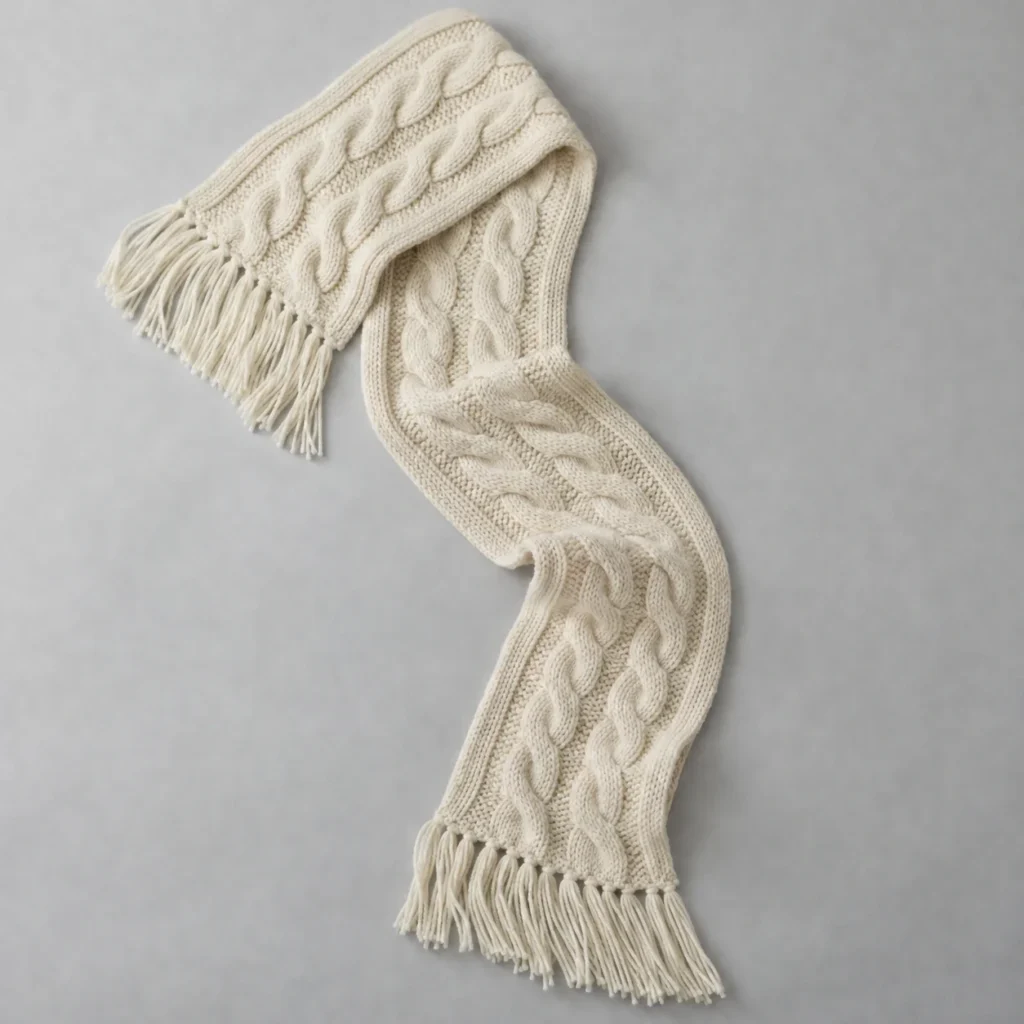
Jacquard knit and fan scarves
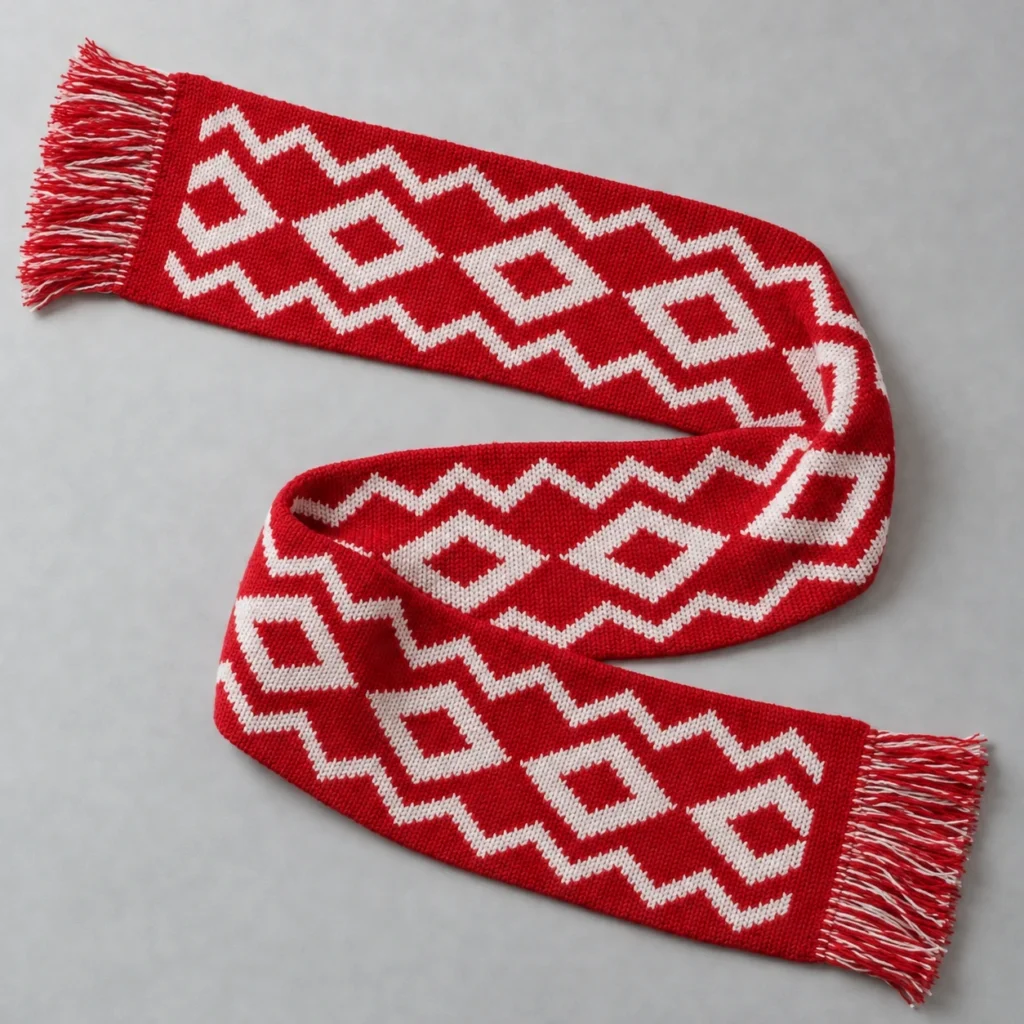
A jacquard scarf has its pattern, name or logo knitted into the fabric in several yarn colours, usually 2–4, so nothing is printed or sewn on. It is the classic football and supporters’ scarf. In a single-layer jacquard, the back shows the design in reversed colours; a double-layer jacquard is knitted as two connected layers, shows the design cleanly on both sides and is thicker and warmer. A bar scarf is the simplest fan scarf: block stripes in club colours with no lettering. Very small text and fine detail blur in a knit, so bold shapes and short words work better. More in our football scarf guide and the fan scarf knit in our Material Library.
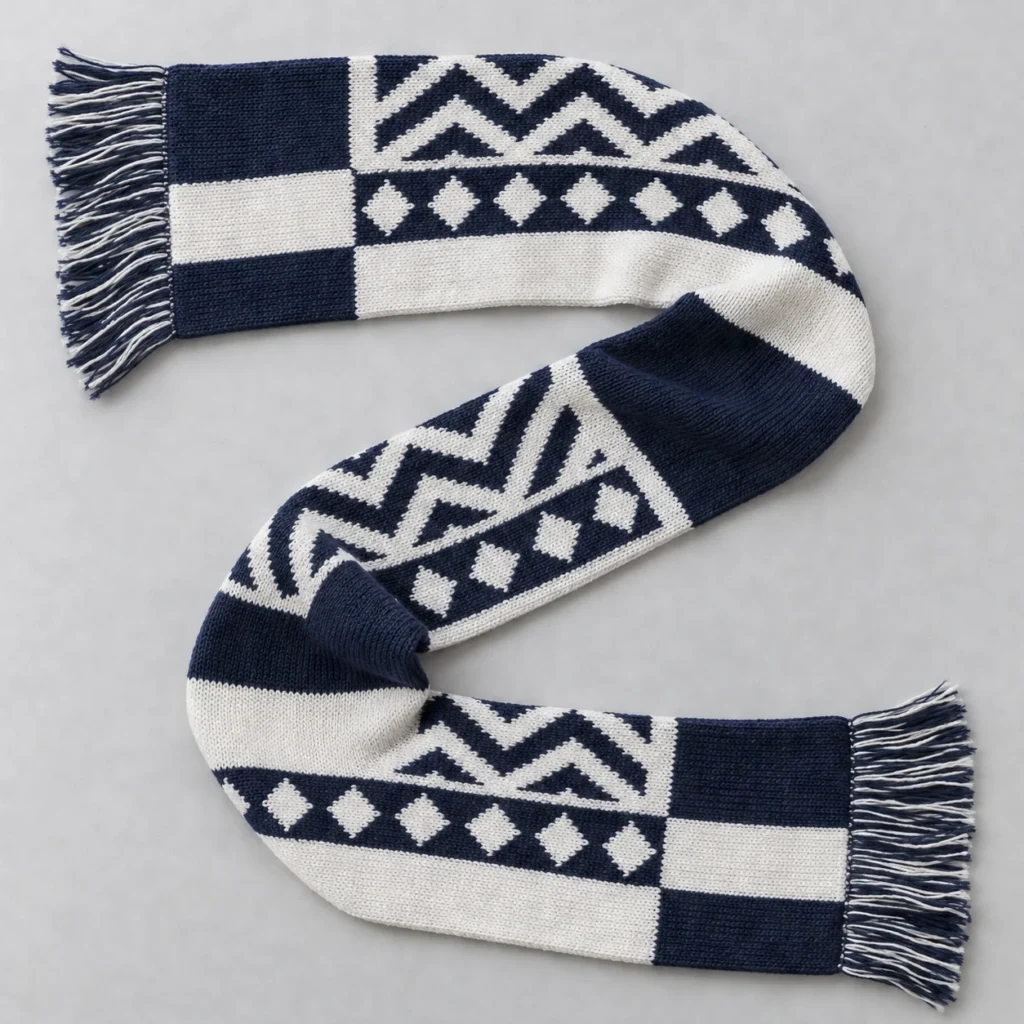
Fleece scarves
A fleece scarf is cut from polyester fleece, a knitted fabric brushed to a soft, lofty surface. It is light and warm for its thickness, frays little, and its smooth face takes sublimation printing well. The edges are overlocked or hemmed. Our fleece fan scarf is about 20 × 150 cm. It suits promotional, kids’ and budget fan scarves. See polar fleece.
Woven scarves: twill, satin, chiffon and more
Most printed scarves are woven. The weave gives the fabric its look and handle, and the same weave can be made in silk, polyester or viscose.
| Weave | What it looks and feels like | Usual scarves |
|---|---|---|
| Twill | Fine diagonal lines, firm and smooth, holds a knot | Silk and polyester squares, neckerchiefs, skinny scarves, bandanas |
| Satin (charmeuse) | Glossy face, dull back, fluid drape | Squares, hair scarves, long scarves, hijabs |
| Chiffon | Sheer, light and floaty | Long scarves, hijabs, summer wraps |
| Georgette | Matt, slightly grainy, bouncy drape, less sheer than chiffon | Long scarves and hijabs |
| Habotai | Light plain weave with a soft, low sheen | Long silk scarves and hair scarves |
| Voile | Light, crisp, slightly open plain weave | Summer scarves, light bandanas, sarongs |
| Challis | Soft, light, fluid plain weave, usually viscose | Printed long scarves, triangles, hijabs, sarongs |
| Poplin | Firm, smooth plain weave in cotton | Bandanas and neckerchiefs |
These fabrics come from partner mills; we cut, print, hem, finish and brand the scarves in-house. Checks and tartans, and patterns woven into cashmere or wool, are woven by the mill to your design.
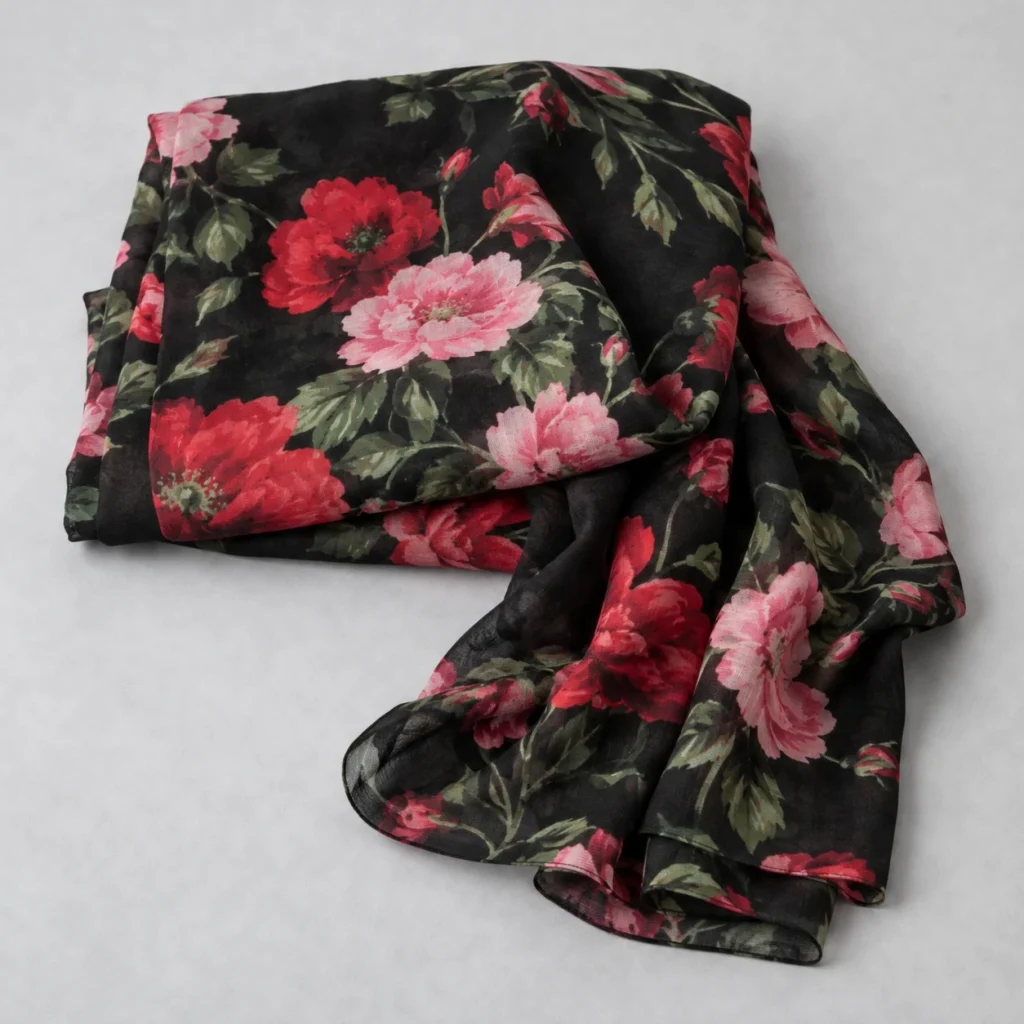
Jersey scarves
A jersey scarf is cut from a soft knitted fabric, cotton, viscose or modal jersey, often with a little stretch. It drapes softly, grips the hair and frays little, so the edges are overlocked or given a narrow hem. Jersey is used for hijabs, infinity loops and snoods. See lightweight cotton jersey.
Scarf types by fibre
The fibre decides warmth, feel, sheen, care and much of the price. Weave names such as satin, chiffon, georgette and twill do not say what a scarf is made of, so a label must always name the fibre: “polyester satin” or “silk satin”, not just “satin”. Our scarf fabrics compared guide goes through each fabric in detail.
| Fibre | Feel and character | Usual scarf types |
|---|---|---|
| Acrylic | Light, soft, bright colours, easy care; can pill | Rib, cable, jacquard and fan scarves |
| Wool and merino | Warm, natural; merino finer and softer | Knitted scarves, woven checks |
| Cashmere blends | Very soft and warm for its weight; delicate | Knitted scarves, wraps, shawls |
| Silk | Fine, smooth, natural sheen | Squares, skinny, long scarves, hijabs |
| Polyester | Durable, lower cost, bright colour | Satin, chiffon and twill scarves, fleece, bandanas |
| Viscose and modal | Soft, smooth, fluid drape | Long scarves, hijabs, sarongs, triangles |
| Cotton | Matt, light and soft | Bandanas, voile scarves, neckerchiefs |
| Linen | Textured, crisp, softens with washing | Summer scarves and wraps |
| Velvet | Deep pile, soft and rich | Evening and gift scarves |
Silk scarves are made from mulberry silk in twill, habotai, satin (charmeuse), chiffon or georgette. Silk weight is measured in momme: typically about 6–8 for chiffon, 5–8 for habotai, 8–10 for georgette, 12–16 for twill and 16–22 for satin. A higher momme is a denser fabric, not a better grade. Read more in our silk momme guide.
Polyester look-alikes, such as polyester satin, polyester chiffon and silk-touch polyester twill, cost less and take sublimation printing in bright, sharp colours. They are labelled as polyester; only real silk may be called silk. See polyester satin.
Cashmere scarves are usually made from a cashmere blend, knitted in-house or woven by partner mills; 100% cashmere and woven cashmere are available on request. A blend is labelled as a blend with its percentages, and “pashmina-style” describes a look, not a fibre. See woven cashmere and blends.
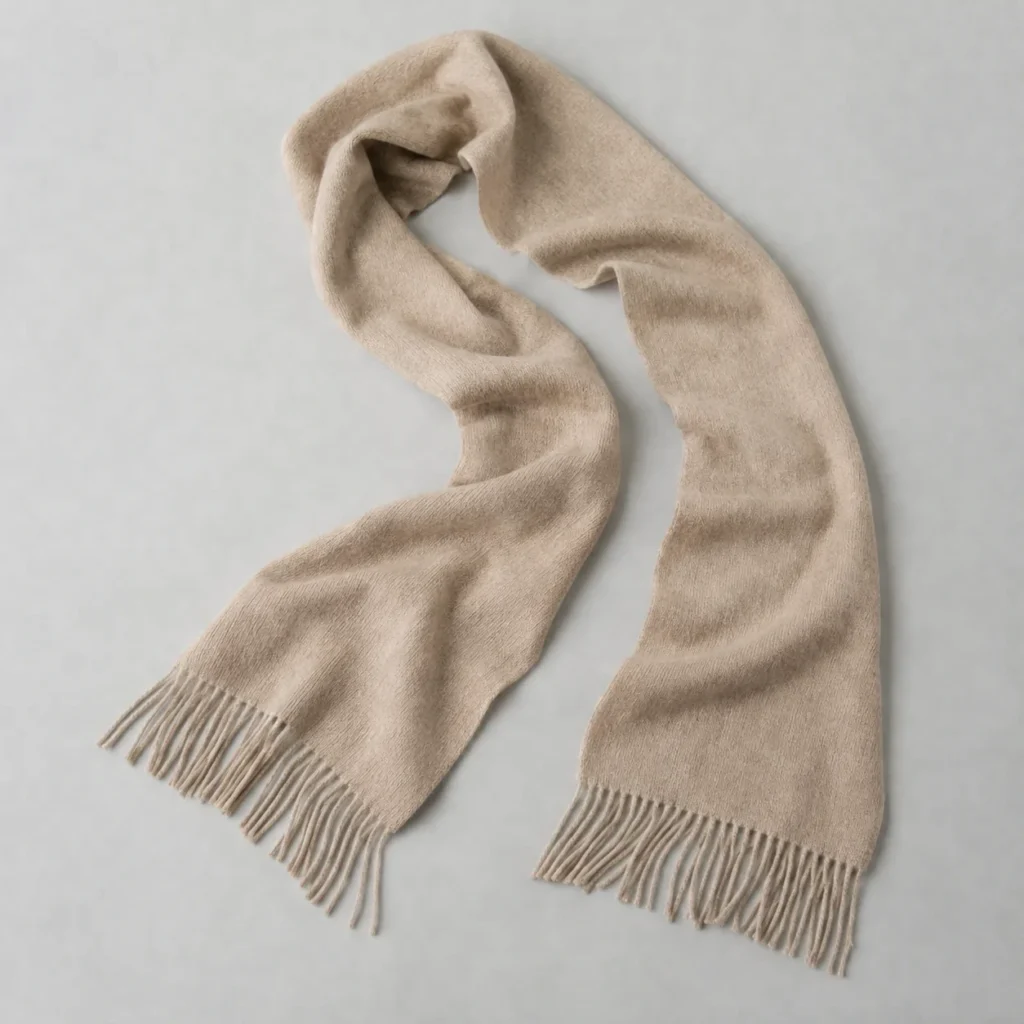
Viscose, modal, cotton, linen and velvet round out the range. Viscose challis and modal give a soft, fluid scarf that takes print well; cotton voile and linen suit warm weather; velvet, including stretch velvet, suits evening and gift ranges and is made to order. Viscose satin is also offered. Recycled and organic fabrics are available on request with the mill’s certificate, and fabrics from OEKO-TEX® certified mills are available on request; the certificate is the mill’s. Our scarf fabrics family lists every fabric record.
Scarf types by decoration
The decoration method follows the construction and the fibre. Knitted scarves carry knitted-in jacquard, embroidery and labels; woven scarves are printed. The main rule: sublimation works only on polyester with a light base, while silk, viscose and cotton are printed digitally or by screen.
| Method | How it works | Works on | Good for |
|---|---|---|---|
| Knitted-in jacquard | Pattern knitted in with 2–4 yarn colours, usually | Knitted acrylic, wool blends | Fan, club and corporate winter scarves |
| Digital printing | Inkjet printing on prepared fabric; many colours, no screens | Silk, viscose, modal, cotton, polyester | Detailed artwork, photos, small runs |
| Screen printing | One screen per colour, ink pressed through | Cotton, silk, polyester | Bold designs in a few colours, exact colour match |
| Rotary screen printing | Cylinder screens printing continuous lengths | Viscose, cotton | Long runs of repeat patterns |
| Sublimation | Dye turned to gas with heat and bonded into the fibre | Polyester only, light base | Edge-to-edge colour on satin, twill, chiffon, fleece |
| Heat transfer | A printed motif pressed onto the fabric | Smooth fabrics, mostly polyester | Small logos and motifs |
| Discharge printing | Removes the dye of a dark ground where printed | Dark cotton | Light prints on black or navy bandanas |
| Embroidery | Logo stitched in thread | Knits, cotton, fleece; thin fabrics after a test | Corner logos, initials, scarf ends |
| Labels and packaging | Woven labels, patches, hang tags, boxes | All scarves | Discreet branding and retail presentation |
On thin fabrics such as chiffon and habotai, a print shows lighter on the back. Many buyers of luxury and gift scarves keep the scarf itself unbranded and put the brand on a woven label, an embroidered tag or the gift box. We only print or knit designs you own or are licensed to use: club crests and band names need the rights holder’s permission. Our scarf printing and finishing guide explains each method and the decoration methods overview compares them across products.
Scarf types by edge finish
Knitted scarves have finished ends; woven scarves need a hem, because a cut woven edge frays.
- Knitted fringe: yarn fringe at both ends of knitted and fan scarves, the traditional football scarf finish. Plain ends are the alternative.
- Hand-rolled hem: the edge rolled and stitched by hand, giving a soft, rounded edge; the usual finish on silk squares and fine wovens. It takes longer than a machine hem.
- Machine hems: a machine-rolled hem with one visible line of stitching, usual on polyester squares and printed scarves, or an overlocked edge wrapped in thread, usual on jersey, fleece and tubes.
- Tassels and twisted or braided fringe: on hijabs, wraps, shawls, sarongs and fashion scarves.
- Other finishes on request: for example raw or frayed edges on viscose and linen, picot or baby hems on light fabrics, and pom-poms on knits; these are confirmed with your quote.
Scarf types by use
Some scarf names describe a buyer or an occasion rather than a construction.
Football and fan scarves
A football or fan scarf is an oblong in club colours, usually about 18 × 150 cm plus fringes, with kids’ versions about 14 × 110 cm. The classic is knitted acrylic jacquard, single or double layer; bar scarves carry stripes only; printed polyester satin and fleece scarves are lighter, lower-cost alternatives for summer tournaments and events, and a half-and-half match scarf carries two club designs. See our football scarves page.
Uniform and corporate scarves
Uniform scarves are worn by airline, hotel, retail and hospitality staff. They are usually neckerchiefs, skinny scarves or small squares in polyester twill or satin, in a brand colour or with a logo pattern, because polyester is easy to care for and usually matches well on reorders. See our business and uniform scarves.
School, club and group scarves
Schools, sports clubs, scout groups and societies usually order striped or jacquard knitted scarves in their colours, or neckerchiefs for uniforms. Stripes are knitted in, a name or crest is knitted in as jacquard, and a woven label carries the details. These scarves are often ordered with matching beanies; see our types of beanies guide.
Fashion, gift and luxury scarves
Fashion and gift scarves are defined by fibre, finish and presentation: silk squares with hand-rolled hems, cashmere-blend knits, printed long scarves in silk or viscose, or velvet scarves for evening. Branding is often discreet, on a woven label or a hang tag, and gift boxes finish the order. See our luxury and gift scarves and the labels and packaging options.
Promotional and event scarves
For promotions and events, bandanas, fleece scarves, tube bandanas and sublimated polyester satin scarves print in full colour at a lower unit price, with a logo printed in or embroidered in a corner.
Beach scarves
Beach scarves and sarongs are large, light printed wraps that cover the shoulders and head on sunny days, so size and print placement matter more than on a neck scarf.
Modest fashion scarves
Modest-fashion brands order hijabs, under-scarves and long scarves. The practical questions are fabric (drape, grip and how sheer it is), size and edge finish. Most are plain-dyed; printed chiffon and satin hijabs are also made.
Kids’ scarves
Children’s scarves are shorter and simpler: our kids knit scarf is about 15 × 120 cm with plain ends, our kids football scarf about 14 × 110 cm with short fringes and our kids bandana 51 × 51 cm. Long loose ends and cords can catch, so a short scarf or a snood is often the more practical choice for young children. Your market’s labelling and safety rules are confirmed with your quote.
Scarves by season
What changes with the season is the construction, the fibre and the size.
- Winter: knitted wool, merino, cashmere-blend and acrylic scarves, chunky and cable knits, double-layer jacquard fan scarves, fleece scarves and snoods.
- Autumn: mid-weight scarves such as rib knits, wool blends, printed viscose and modal long scarves, and infinity loops.
- Spring: light printed scarves in cotton voile, modal, viscose and silk habotai, in pastel and floral designs, and silk squares worn at the neck or in the hair.
- Summer: silk and polyester chiffon, cotton voile, linen, bandanas and sarongs; light scarves that cover the head and shoulders on sunny days and can be used as head wraps or beach cover-ups.
A range that covers the year usually combines a knitted winter line with a printed woven line, with colours that follow the season.
Which type of scarf should you choose?
Start from who will wear it and when, then choose the shape, construction and fibre, decoration and edge finish.
| If the scarf is for… | Usual types | Construction and fibre | Decoration and finish |
|---|---|---|---|
| Football and fan merchandise | Fan scarf, bar scarf, skinny retro | Knitted acrylic jacquard; polyester satin or fleece for summer | Jacquard name and crest, knitted fringe |
| Winter retail | Oblong, chunky, cable, snood, infinity | Knitted acrylic, wool blend, merino | Woven label, stripes, fringe |
| Luxury and gifts | Silk square, long silk scarf, cashmere-blend knit, wrap | Silk twill or satin; cashmere blend | Digital print, hand-rolled hems, woven label, gift box |
| Uniforms and hospitality | Neckerchief, skinny scarf, small square | Polyester twill or satin | Brand colour or logo repeat, machine-rolled hems |
| Schools, clubs and scouts | Striped knit, jacquard scarf, neckerchief | Knitted acrylic; cotton or polyester twill | Knitted stripes, jacquard, screen print |
| Promotions and events | Bandana, tube bandana, fleece scarf, satin scarf | Cotton poplin or polyester | Screen print or sublimation, corner embroidery |
| Summer and beach | Sarong, long scarf, triangle, bandana | Viscose, cotton voile, linen, chiffon | Digital or rotary screen print, narrow hems, tassels |
| Modest fashion | Rectangular and square hijabs, under-scarves | Chiffon, georgette, viscose, modal, jersey | Plain-dyed or printed, rolled hems or tassels |
| Children | Kids knit scarf, kids fan scarf, snood, kids bandana | Soft acrylic, fleece, cotton | Short or no fringes, label or embroidery |
Unsure which fabric suits your use? Send a reference scarf or a photo and we suggest the fabric and finish with your quote. To build a whole range under your own brand, read our private label scarf line guide.
Ordering custom scarves from Mr Balaclava
We make these scarf types to order in Sialkot, Pakistan, from 50 pieces per design, with a capacity of around 100,000 pieces a month. A design is one style in one colourway with one artwork. Catalogue scarves start at about $1.30–19.50 per piece at 50 pieces depending on fabric and size; unit prices fall as quantities rise; your quote confirms the price.
What to send with your request
- The type and shape: oblong, square, bandana, loop, hijab or other, and the size in cm.
- Your preferred fabric, or the season and use, and we suggest one.
- Your design and the decoration method you have in mind, as vector or high-resolution files.
- Edge finish: fringe, hem type or tassels.
- Quantity per design, labels, packaging and your delivery date.
You can approve a pre-paid physical sample, made in about 5–7 days and paid 100% in advance, or a free pre-production sample made after the order and the 30% advance, approved by photos, videos or a video call; see our sample types. Standard production takes approximately 14 days after sample approval. Payment is 30/30/40, and shipping cost is by weight, agreed with you for each order and confirmed before shipment. Mr Balaclava’s name never appears on your products.
Frequently asked questions
What are the main types of scarves?
By shape: the oblong, skinny, square and triangle scarf, the neckerchief, the bandana, the infinity scarf, the snood, and wraps, shawls and stoles. “Silk scarf” or “cashmere scarf” describes the fibre, not a separate shape.
What is the difference between a silk scarf and a satin scarf?
Silk is a fibre; satin is a weave with a glossy face. A satin scarf can be silk satin (charmeuse) or polyester satin. Silk satin feels finer and is digitally or screen printed; polyester satin costs less and takes sublimation printing. The label must name the fibre.
What is the difference between an infinity scarf and a snood?
Both are closed loops. An infinity scarf is long, about 140–180 cm round, and is wrapped twice so it drapes like a normal scarf. A snood is a short tube, about 25–35 cm high, that sits close to the neck in one layer and can be pulled up over the chin.
What size is a standard scarf?
It depends on the type. A knitted winter scarf is usually about 25–30 × 170–200 cm, a woven long scarf about 55–70 × 180 cm, a classic silk square 90 × 90 cm, a neck square about 53 × 53 cm and a standard bandana 56 × 56 cm. We make every type to your own size as well.
Can I mix scarf types or colours in one order?
Yes. The minimum is 50 pieces per design, and each style or colourway is its own design, so a knitted scarf in two colours starts at 100 pieces and can ship with bandanas or beanies in the same order. Fewer than 50 per design is not possible, but a pre-paid sample lets you check a design first; see our minimum order quantity.
Browse the scarf catalogue, see how to tie a scarf like a balaclava, or send us your brief for a quote.