
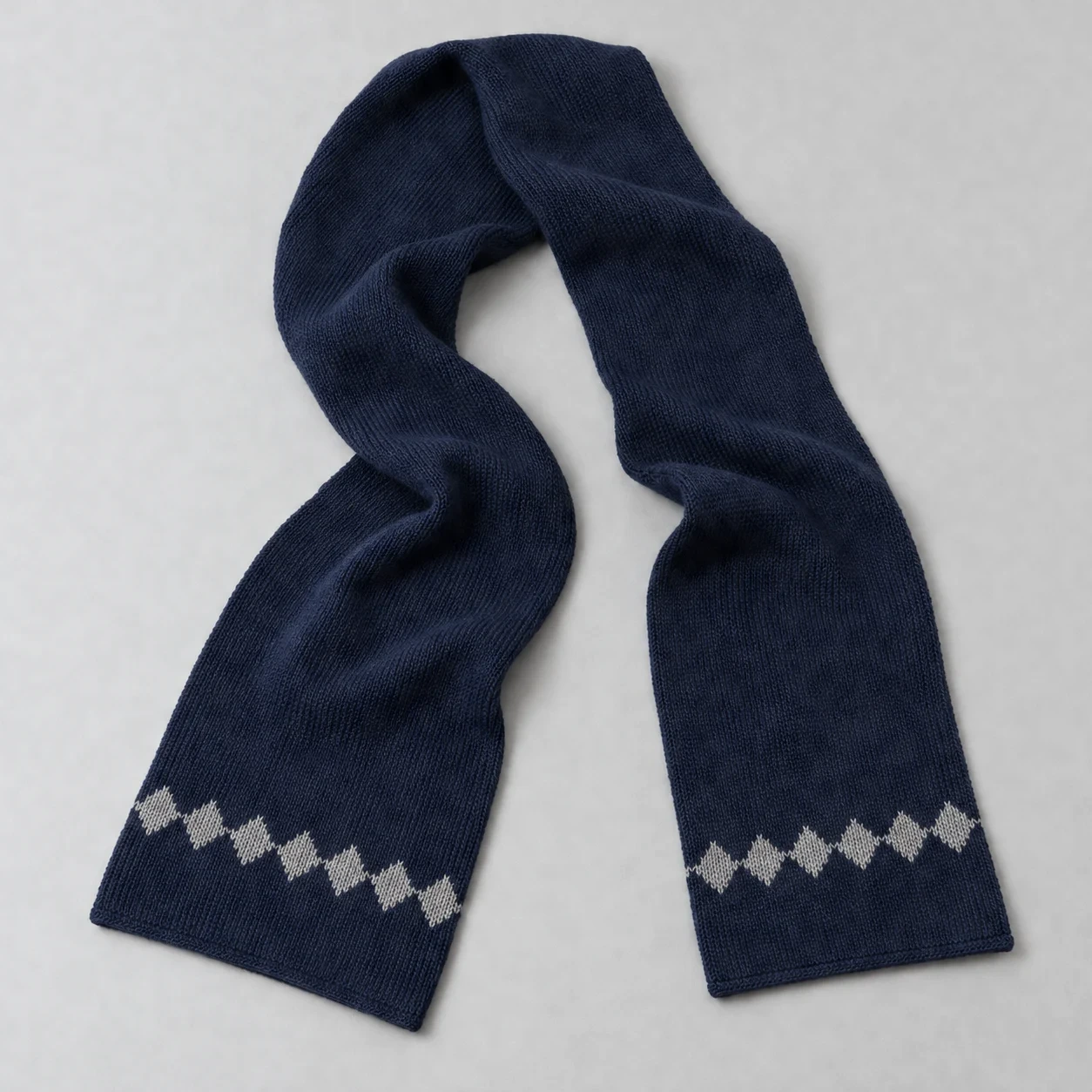
This guide is for brands, shops, clubs, schools and promotional companies deciding between a knitted and a woven scarf for a custom order. It follows both types through the factory, step by step, and explains what each construction does to warmth, drape, print detail, decoration and price.
If you are still choosing a style, start with our overview of the different types of scarves, which sorts scarves by shape, construction, fabric and finish. Here we stay with construction, because it is the first decision: it fixes which yarns or fabrics you can use, how the logo goes on and how the ends are finished.
What is the difference between knitted and woven scarves?
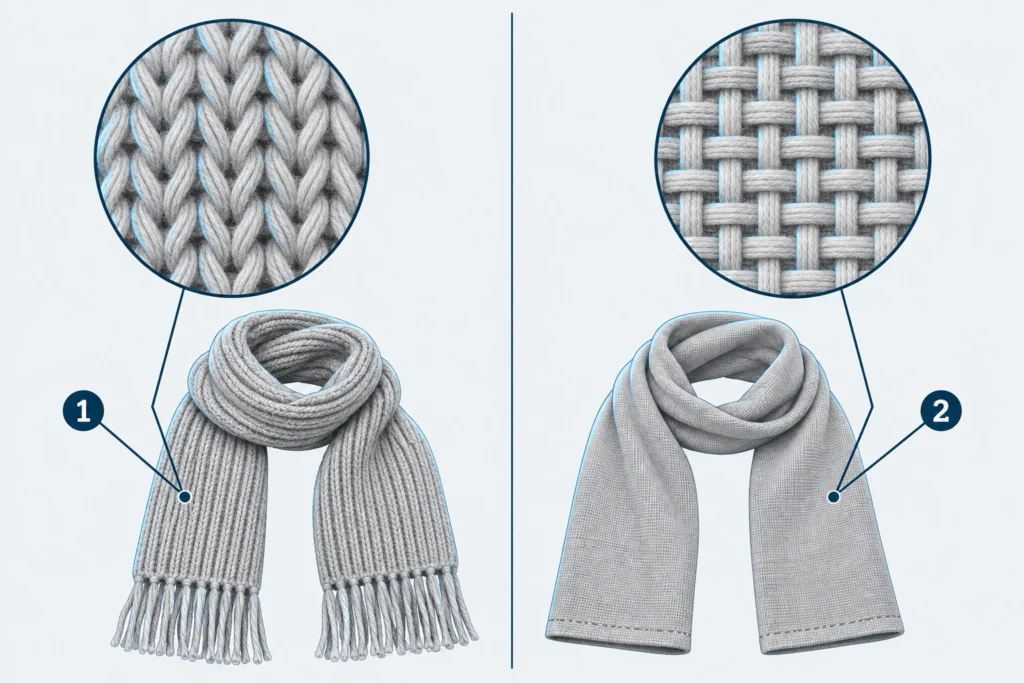
A knitted scarf is made of interlocking loops of yarn, so it stretches and holds warm air. A woven scarf is made of two sets of threads crossing at right angles, so it is thinner, flatter and drapes rather than stretches.
In weaving, lengthwise threads (the warp) are held tight on a loom while crosswise threads (the weft) pass over and under them. In knitting, one yarn is pulled through itself in rows of loops. That one difference explains most of what follows. There is also a third, smaller group: scarves cut and sewn from fabrics that are knitted by the roll, such as jersey and fleece.
- Knitted scarves: rib, cable, plain, striped and jacquard scarves, including fan and football scarves. Knitted and finished in-house in Sialkot on our flatbed machines.
- Woven scarves: silk, satin, chiffon, georgette, twill, viscose, modal, cotton voile, bandana cotton, linen and woven wool or cashmere. The fabric is woven by partner mills; we cut, print, hem, finish and brand in-house.
- Cut-and-sewn knit fabrics: jersey hijabs, fleece scarves and tube bandanas, cut from partner-mill fabric and finished in-house.
How is a knitted scarf made?
A knitted scarf is knitted from yarn as one long panel on a flatbed machine, then its ends are finished, fringes or tassels are added, and the scarf is steamed, labelled and inspected.
1. Yarn and colours
Yarn comes first, because it sets warmth, softness, care and price. Acrylic is the usual choice for colourful, easy-care scarves and fan scarves; wool blends, merino and cashmere blends add warmth and a softer, more natural hand. Colours are matched to your references, ideally Pantone codes. Our acrylic rib knit is the base of many plain and striped scarves.
2. The knitting programme
Stripes, cables and knitted-in logos are written into a knitting programme. For a jacquard design, your artwork becomes a knit file: a grid in which every square is one stitch in one yarn colour. We show you a mockup of the knitted design before sampling.
3. Flatbed knitting
The scarf is knitted on flatbed machines in our factory in Sialkot, Pakistan. A flatbed machine has two straight beds of needles and can switch stitch and yarn colour row by row, so it knits rib, cable, plain knit, stripes and jacquard. The stitch decides the look: rib gives stretch and vertical lines, cable gives raised twists, and plain knit gives a smooth face.
4. Single-layer or double-layer jacquard
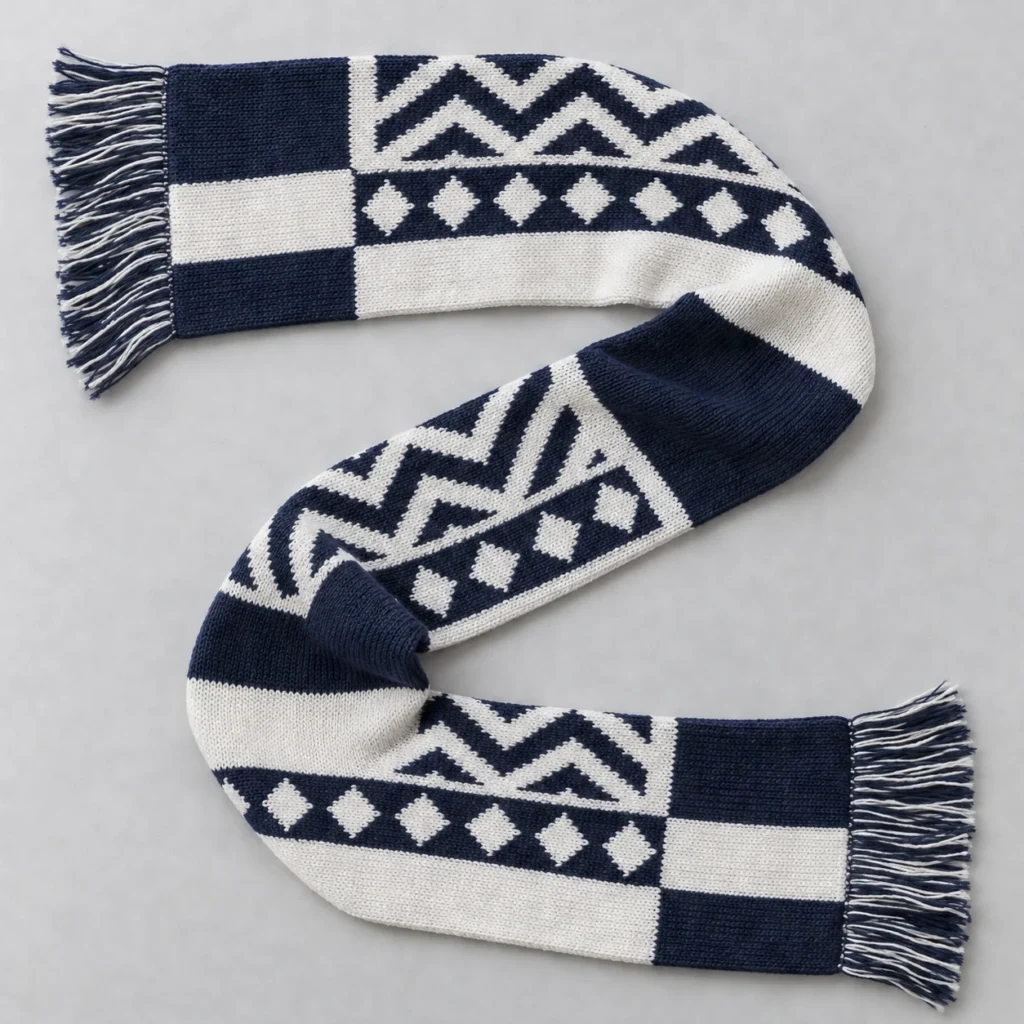
Fan and logo scarves are usually jacquard. A single-layer jacquard shows the design on the face and in reverse colours on the back; it is lighter and costs less. A double-layer jacquard knits two faces at once, so the design reads cleanly on both sides and the scarf is thicker and warmer. Our fan scarf knit page and our football scarf guide compare the two in detail.
5. Ends, fringes and finishing
The ends are finished plain or with a yarn fringe or tassels. On double-layer scarves the open ends are usually closed first, by linking or a short seam, and loose yarn ends are trimmed. Fan scarves traditionally have fringes at both ends; children’s scarves are kept short, with plain ends or short fringes and no long loose ends that could catch. Each scarf is then steamed so the stitches settle evenly and the size stays consistent across the order.
6. Labels and packing
A woven label is usually sewn at one end, with a care label, a hang tag and the packing you choose. Mr Balaclava’s name never appears on your products. Our knitted scarves page shows the styles we knit, from rib and cable to merino and cashmere-blend scarves.
How is a woven scarf made?
A woven scarf starts as fabric woven by a mill. The fabric is then printed or dyed, cut to size, hemmed or fringed at the edges, labelled and inspected.
We do not weave fabric ourselves. Silk, satin, chiffon, georgette, twill, viscose, modal, cotton voile, bandana cotton, linen and woven wool or cashmere come from partner mills, and everything after that happens in-house in Sialkot. Checks, tartans and other woven-in patterns are made by the mill on the loom.
1. Fibre and weave
Two choices define the fabric: the fibre (silk, polyester, viscose, cotton, wool) and the weave. Twill has a fine diagonal line and holds a knot, as on mulberry silk twill squares. Plain weaves such as habotai, voile, challis and poplin are light and even. Satin has a glossy face and a matte back. Chiffon and georgette are sheer, made from twisted yarns. Our guide to scarf fabrics compared covers every option.
2. Printing or dyeing
Printed scarves are usually printed on the fabric before cutting, so the design is placed for each scarf. The method follows the fibre: sublimation works only on polyester with a light base; silk, viscose, modal and cotton are digitally or screen printed; rotary screen printing suits long runs of repeat patterns, as on viscose challis; and discharge printing gives soft light prints on dark cotton. Plain scarves are made from fabric dyed to your colour instead.
3. Cutting
The printed or dyed fabric is cut into squares, oblongs or triangles. Prints are placed so that borders, corners and logos land where the design needs them, which is checked on the sample.
4. Hems and edges
Woven fabric frays at a cut edge, so every edge is finished. Silk and fine wovens are usually given hand-rolled hems: the edge is rolled tightly and stitched by hand, which gives a soft, rounded edge. Polyester scarves usually get machine-rolled or narrow hems, and some fabrics an overlocked edge. Viscose and woven wool can have fringes or tassels on request.
5. Labels and finishing
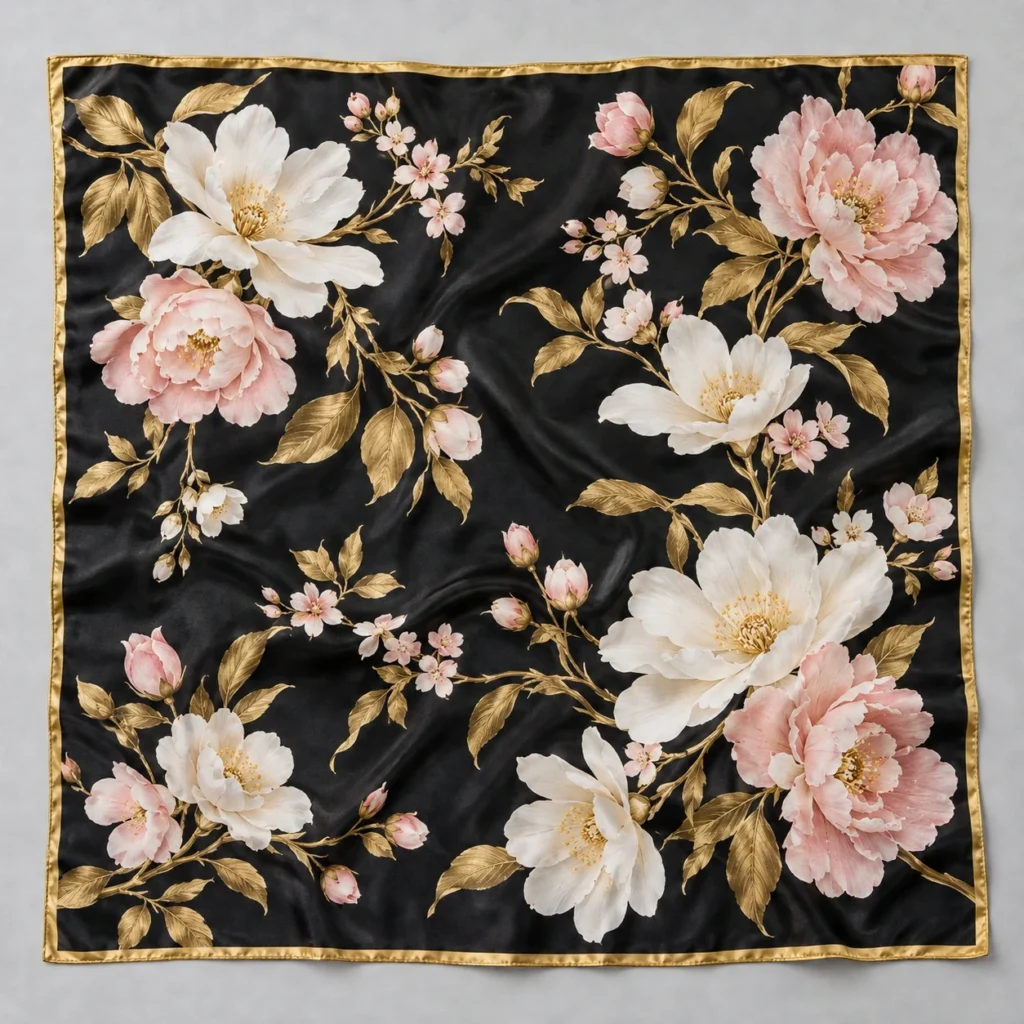
Scarves are usually pressed flat, then given a small woven or satin label, a care label, a hang tag and packing to your brief. Our printed scarves page shows the printed woven styles in polyester, viscose, modal and cotton.
Where do jersey and fleece scarves fit?
Jersey and fleece are knitted fabrics, but they are bought by the roll from partner mills and then cut and sewn like a woven fabric. They sit between the two groups.
Jersey stretches and clings lightly, which suits hijabs that stay in place without pins. Polyester fleece is light, soft and warm for its weight, and because it is polyester it takes full-colour sublimation, as on our fleece fan scarf. Knitted fabrics fray very little, so their edges are usually overlocked or left with a narrow hem rather than rolled.
Knitted vs woven scarves: how do they compare?
Knitted scarves are warmer, thicker and stretchier; woven scarves are lighter, flatter and better at fine print detail. The table compares them side by side.
| Point | Knitted scarf | Woven scarf |
|---|---|---|
| Structure | Loops of yarn | Warp and weft threads crossing |
| Warmth | Usually warmer; the loops hold air | Usually lighter; wool and cashmere wovens are the warm exception |
| Weight and bulk | Thicker, often several times heavier | Thin and light; folds small |
| Drape and stretch | Stretches; soft and springy | Little stretch; drapes and holds a knot (twill) |
| Logo and design | Knitted-in jacquard, embroidery, labels, patches | Printed, from bold spot colours to photographic detail |
| Edges and ends | Plain ends, yarn fringe or tassels | Hand-rolled, machine-rolled or narrow hems; fringes on some fabrics |
| Typical size | About 25–30 × 170–200 cm; fan scarves about 18 × 150 cm plus fringes | Squares 50–90 cm; long scarves about 55–70 × 180 cm |
| Typical use | Winter retail, fan scarves, corporate winter gifts | Fashion, uniform, gift and printed promotional scarves |
| Price level | Moderate for acrylic, higher for merino and cashmere blends | Low for polyester and cotton, higher for silk |
Our guide to scarf sizes and shapes lists the standard measurements for every format in centimetres.
How does the construction limit the decoration?
On a knit, the design is either knitted in or added on top as embroidery, a label or a patch; flat prints do not sit well on loops of yarn. On a woven fabric, the design is usually printed, and the fibre decides which print method works.
Decoration on knitted scarves
- Knitted-in jacquard: names, crests, slogans and stripes are part of the fabric, usually in 2–4 colours. Bold shapes and lettering work well; very fine detail, gradients and photographs are simplified to suit the stitches.
- Embroidery: flat embroidery at one end suits plain rib and merino scarves.
- Labels and patches: a woven label, or a leather-look or rubber patch, sewn at one end.
Decoration on woven scarves
- Sublimation: full colour, edge to edge, on polyester only, with a light base. It does not work on silk, viscose, cotton or wool.
- Digital printing: fine detail and many colours on silk, viscose, modal and cotton, with no screens to set up.
- Screen and rotary screen printing: strong spot colours and long repeat runs.
- Embroidery and labels: a small corner logo or monogram, tested first on thin fabrics, or a discreet woven label.
On sheer fabrics such as chiffon and light habotai, a one-sided print shows through on the back in a lighter tone. Our scarf printing and finishing guide explains each method, hem and fringe, and the decoration methods table covers all our products. We only use designs you own or are licensed to use; club crests and band names need the rights holder’s permission.
How is the quality of a scarf checked?
Quality is checked twice: first on the sample you approve, and again before dispatch, when the scarves are compared with the approved sample.
For knitted scarves we look at size, stitch evenness, jacquard colours and clarity, fringe length and loose yarn ends. For woven scarves we look at print colour and placement, show-through on sheer fabrics, straight cutting, even hems and label position. Our quality control page explains how inspection works across all products.
How long does it take to make custom scarves?
A pre-paid physical sample takes about 5–7 days. Standard production takes approximately 14 days after sample approval, for knitted and woven scarves alike.
Seven days is possible on request; complex or very large orders of 100,000–200,000 pieces can take up to one month. Capacity is around 100,000 pieces a month, and for very large runs our team may also use our other units or partner mills, depending on the product. Special yarns, dyed-to-match fabric, hand-rolled hems and custom labels can add time, so the schedule is confirmed for each order. Express shipping by DHL, FedEx or UPS then usually takes 3–6 working days.
How to choose: knitted or woven?
Start with the season, the decoration and the price point; the construction usually follows from those three.
| Use or goal | Construction that usually suits | Why |
|---|---|---|
| Winter retail or staff winter gift | Knitted rib, cable or merino | Warm, soft and easy to brand with a label or embroidery |
| Football, club or fan scarf | Single- or double-layer jacquard knit | Name and colours knitted in, fringed ends |
| Detailed artwork or a photo print | Woven polyester satin or twill (sublimation), or silk (digital) | A flat woven surface holds fine detail |
| Fashion or gift silk scarf | Woven silk twill or satin square | Drape, sheen and hand-rolled hems |
| Uniform neckerchief | Woven polyester twill | Holds a knot and usually keeps its colour through washing |
| Hijab or modest-wear range | Woven chiffon, viscose or modal, or knitted jersey | Drape, grip and coverage, usually tested on a sample |
| Low-cost event giveaway | Sublimated fleece or polyester satin | Full colour at a lower unit price |
Ordering knitted or woven scarves from Mr Balaclava
Custom scarves start at 50 pieces per design, knitted or woven, with production of approximately 14 days after sample approval. One order can mix knitted and woven designs, each from 50 pieces.
What to send with your brief
- The style, or a reference scarf or photo
- Knitted or woven, and the yarn or fabric if you know it
- Size in centimetres and the ends or edges you want
- Your artwork as a vector file, with colours as Pantone references if you have them
- Labels, hang tags and packaging
- Quantities per design, your deadline and the delivery country
Choose a pre-paid physical sample, made in about 5–7 days, or a free pre-production sample made after the order and the 30% advance payment and approved by photos, videos or a video call. Our guide to sample types explains both.
Frequently asked questions
Are football scarves knitted or woven?
Classic football scarves are knitted, usually as single- or double-layer acrylic jacquard with fringed ends. Printed fan scarves are usually sublimated polyester satin, a lighter “summer” option, or polyester fleece; both are cut and sewn rather than knitted.
Can a woven scarf have a knitted-in logo?
No, knitted-in jacquard is a knitting technique. A woven scarf can have a pattern woven in by the mill, such as a check, or a printed, embroidered or labelled logo added in our factory.
Which is warmer, a knitted or a woven scarf?
A knitted scarf is usually warmer, because the loops trap air and the fabric is thicker. A woven wool or cashmere scarf can be warm too, but silk, viscose, cotton and polyester wovens are mainly about drape and print.
Do you weave the fabric yourselves?
No. Woven fabrics come from partner mills, and we cut, print, hem, finish, label and pack them in-house in Sialkot. Knitted scarves are knitted and finished in our own factory.
Can I order the same design as a knitted and a woven scarf?
Yes, but each version is its own design with its own minimum of 50 pieces. The artwork is adapted for each: simplified to a few colours for the knit, and kept in full detail for the print.
Ready to compare styles? Browse our custom scarves catalogue, see how we work on our manufacturing process page, and when your brief is ready, ask for a quote.
