
This guide is for brands, shops, uniform buyers, gift and promotional companies and modest-fashion labels choosing the fabric for a custom scarf range. It compares the yarns and fabrics we use for scarves on warmth, drape, sheerness, printing, care and price, and explains how to name each one correctly on a label.
Fabric is one of four choices that define a scarf, alongside shape, construction and finish; our overview of the different types of scarves covers all four. If you are still deciding between a knit and a woven, read knitted vs woven scarves first, because the construction narrows the fabric list before anything else.
What fabrics are scarves made from?
Scarves are made from a fibre turned into a fabric. The main fibres are acrylic, wool, cashmere, silk, polyester, viscose, modal, cotton and linen; the main constructions are rib and jacquard knits, and twill, satin, chiffon, georgette and plain weaves.
Many fabric names describe the construction, not the fibre. Satin, chiffon, georgette, twill, voile, challis, jersey and fleece can each be made from more than one fibre, which is why a “satin scarf” can be silk or polyester at very different prices. When you compare quotes, compare both parts: the fibre and the construction.
- Fibres: acrylic, wool and merino, cashmere, silk, polyester, viscose, modal, cotton, linen.
- Knitted constructions: rib, cable, plain knit, jacquard, jersey, fleece, stretch velvet.
- Woven constructions: twill, satin, chiffon, georgette, habotai, challis, voile, poplin.
Scarf fabrics at a glance
The table compares the fabrics we offer for scarves in relative terms. Warmth and drape depend on weight and construction too, so the sample is where the final choice is made.
| Fabric | Warmth | Drape and sheerness | Printing | Care | Price level |
|---|---|---|---|---|---|
| Acrylic knit | Warm | Soft and springy; not sheer | Knitted-in jacquard, embroidery, labels | Easy | Low |
| Wool and merino knit | Warmer | Soft; merino finer and smoother | Knitted-in jacquard, embroidery, labels | Gentle wash | Medium |
| Cashmere blend, knitted or woven | Very warm for its weight | Light, soft, gentle nap | Labels, embroidered monogram; woven-in patterns by the mill | Delicate | High; 100% cashmere highest |
| Silk twill | Light | Holds a knot; usually not sheer | Digital or screen, fine detail | Gentle | High |
| Silk habotai | Very light | Soft; print shows through on the back | Digital or screen | Gentle | Medium to high |
| Silk satin (charmeuse) | Light | Very fluid, glossy face | Digital, rich colour | Gentle | Highest of the silks |
| Silk chiffon and georgette | Very light | Sheer; georgette a little less and grippier | Digital, or solid-dyed | Delicate | High |
| Polyester satin | Light | Fluid, slightly firmer than silk satin | Sublimation, digital, screen | Easy | Low |
| Polyester chiffon | Very light | Sheer and floaty, crisper than silk | Sublimation, digital | Easy | Low |
| Silk-touch polyester twill | Light | Holds a knot; not sheer | Sublimation, screen | Easy, frequent washing | Low |
| Viscose challis or viscose satin | Light | Soft and fluid | Digital, screen, rotary screen | Gentle | Low to medium |
| Modal | Light | Very soft, silky drape | Usually solid-dyed; digital on the woven version | Gentle | Medium |
| Cotton voile | Light, cool | Crisp; slightly sheer | Digital or screen | Easy | Low |
| Bandana cotton poplin | Light | Crisp, softens with washing; not sheer | Screen, discharge, digital | Easy | Lowest |
| Linen | Light, cool | Crisp, textured, creases readily | Usually digital or screen | Easy; creases | Medium |
| Jersey | Light | Stretchy, clings lightly | Usually solid-dyed | Easy | Low |
| Polyester fleece | Warm | Soft and bulky; not sheer | Sublimation, embroidery, labels | Easy | Low |
| Velvet | Moderately warm | Heavy, soft pile | Sublimation on polyester stretch velvet; labels | Gentle | Medium |
Which fabrics make the warmest scarves?
Knitted wool, merino and cashmere blends are the warmest, followed by acrylic knits and polyester fleece. Woven wool and cashmere are warm too; silk, viscose, cotton and polyester wovens are mainly chosen for drape and print.
Acrylic
Acrylic yarn is soft, light and wool-like, holds strong colours and is easy to wash, which is why many fan scarves and promotional winter scarves are acrylic. It costs less than wool and can pill with friction; anti-pilling acrylic is a common upgrade.
Wool and merino
Wool is warm and springy and feels more natural than acrylic; merino is a finer wool that tends to feel smoother against the neck. Wool blends with acrylic or nylon bring the price down and make care easier. Wool needs a gentle wash because it can felt. Checks and tartans in woven wool are woven in by the mill.
Cashmere and cashmere blends
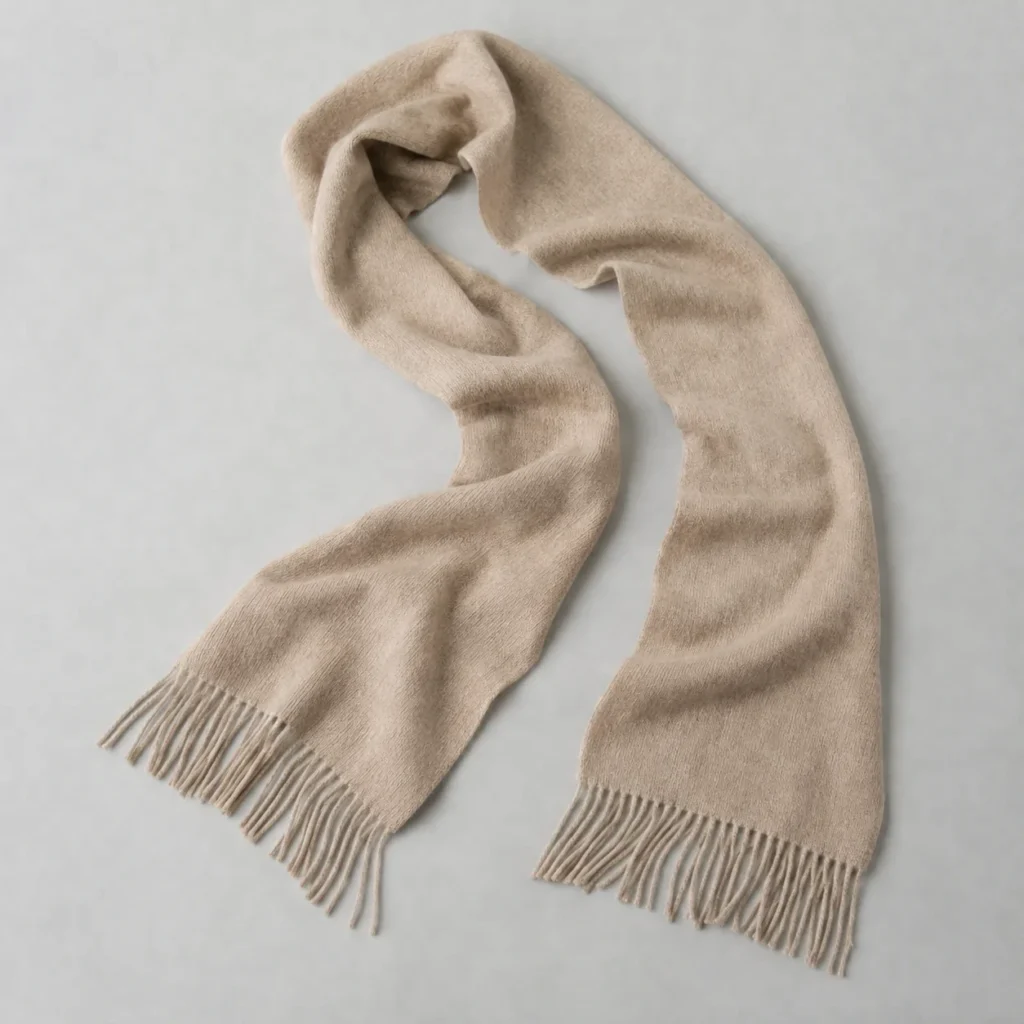
Cashmere is very soft, light and warm for its weight, and it is also delicate and usually the most expensive scarf fibre. Our catalogue knit is a cashmere-wool blend; 100% cashmere, and woven cashmere and cashmere blends, are available on request. The composition is stated on the quote and on the care label, and no grade or origin claim is made unless the mill documents it.
“Pashmina” is a style and market name for a fine, light cashmere wrap, often blended with silk. It is not a separate fibre, so the label states the real content, such as “100% cashmere” or the cashmere-silk blend, and the scarf can be described as pashmina-style. Our cashmere scarves page shows the options.
Fleece
Polyester fleece is light, soft and warm for its weight, costs little and takes sublimation in full colour on light grounds. It suits youth teams, events and giveaways more than fashion ranges.
Which silk is right for a scarf?
Twill for classic printed squares that hold a knot, habotai for light and lower-cost silk scarves, satin (charmeuse) for the most lustre and drape, chiffon for sheer layered scarves, and georgette for a sheer silk that grips and stays in place.
Our silks are mulberry silk, and silk weight is given in momme (mm): the higher the momme, the denser the fabric. Compare momme within one weave rather than across weaves, because a 16 momme satin and a 16 momme twill feel quite different.
| Silk | Typical momme | Look and feel | Typical scarf |
|---|---|---|---|
| Habotai | About 5–8 | Very light plain weave, low sheen | Light neck, hair and long scarves |
| Chiffon | About 6–8 | Sheer, airy, slightly grainy | Layered long scarves and hijabs |
| Georgette | About 8–10 | Matte crepe surface, bouncy drape | Long scarves and hijabs that stay in place |
| Twill | About 12–16 | Fine diagonal line, soft sheen, firm | Classic printed squares and neckerchiefs |
| Satin (charmeuse) | About 16–22 | Glossy face, matte back, fluid | Large squares and gift scarves |
Our mulberry silk twill is the classic square fabric, and silk satin (charmeuse) gives the deepest lustre, as on our large silk satin square. Our guide to silk momme and scarf fabrics goes deeper into each weave. Silk is digitally printed or screen printed; it cannot be sublimated.
Silk satin vs polyester satin: what is the difference?
Satin is a weave, not a fibre. Silk satin is woven from silk; polyester satin is woven from polyester. They look alike on a shelf, but they differ in feel, printing, care and price.
- Feel: silk satin is cooler, softer and more fluid; polyester satin is glossy and slightly firmer.
- Printing: polyester satin takes sublimation, which gives bright, full-colour, edge-to-edge prints at a low cost. Silk satin is printed digitally or by screen.
- Care: polyester washes easily and dries quickly; silk needs gentle care.
- Price: polyester satin usually costs a fraction of silk satin of the same size.
The same applies to chiffon and twill. Polyester chiffon is sheer and floaty like silk chiffon, a little crisper and much easier to care for. Our silk-touch twill is 100% polyester with a soft, silk-like hand; it holds a knot, survives frequent washing and is a common choice for uniform neckerchiefs.
What about viscose, modal, cotton and linen scarves?
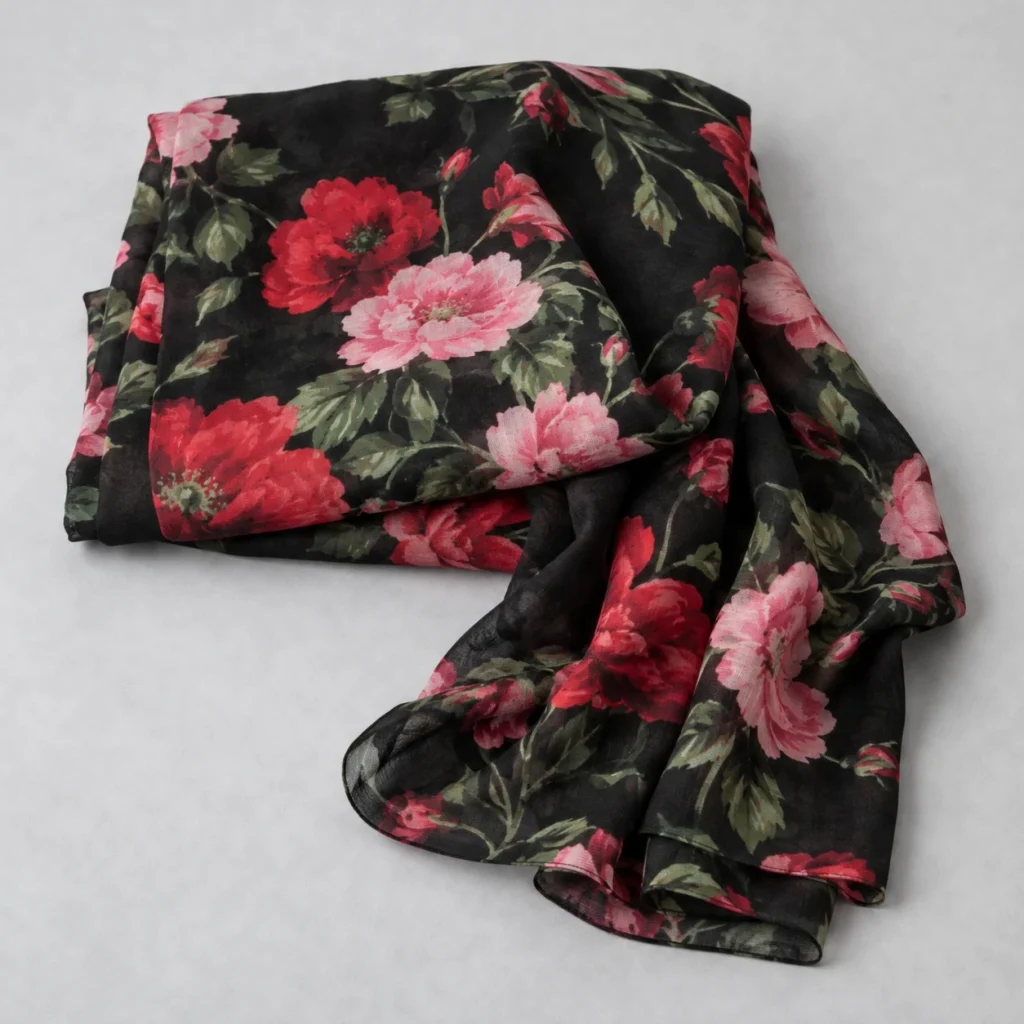
Viscose and modal are soft and fluid, cotton is matte and easy-care, and linen is crisp and textured. None of them can be sublimated; they are digitally or screen printed, or dyed in solid colours.
- Viscose challis: a soft, matte, fluid plain weave that drapes in a way close to silk at a lower price. Viscose challis takes rotary screen prints for long repeat runs and digital prints for detail, and suits long fashion scarves, beach wraps and hijabs. Viscose satin adds a soft sheen.
- Modal: very soft and smooth, with a silky drape; usually dyed in solid colours for long scarves and hijabs, as woven fabric or jersey.
- Cotton voile: a fine, crisp, slightly sheer plain weave that feels cool, for summer and beach scarves.
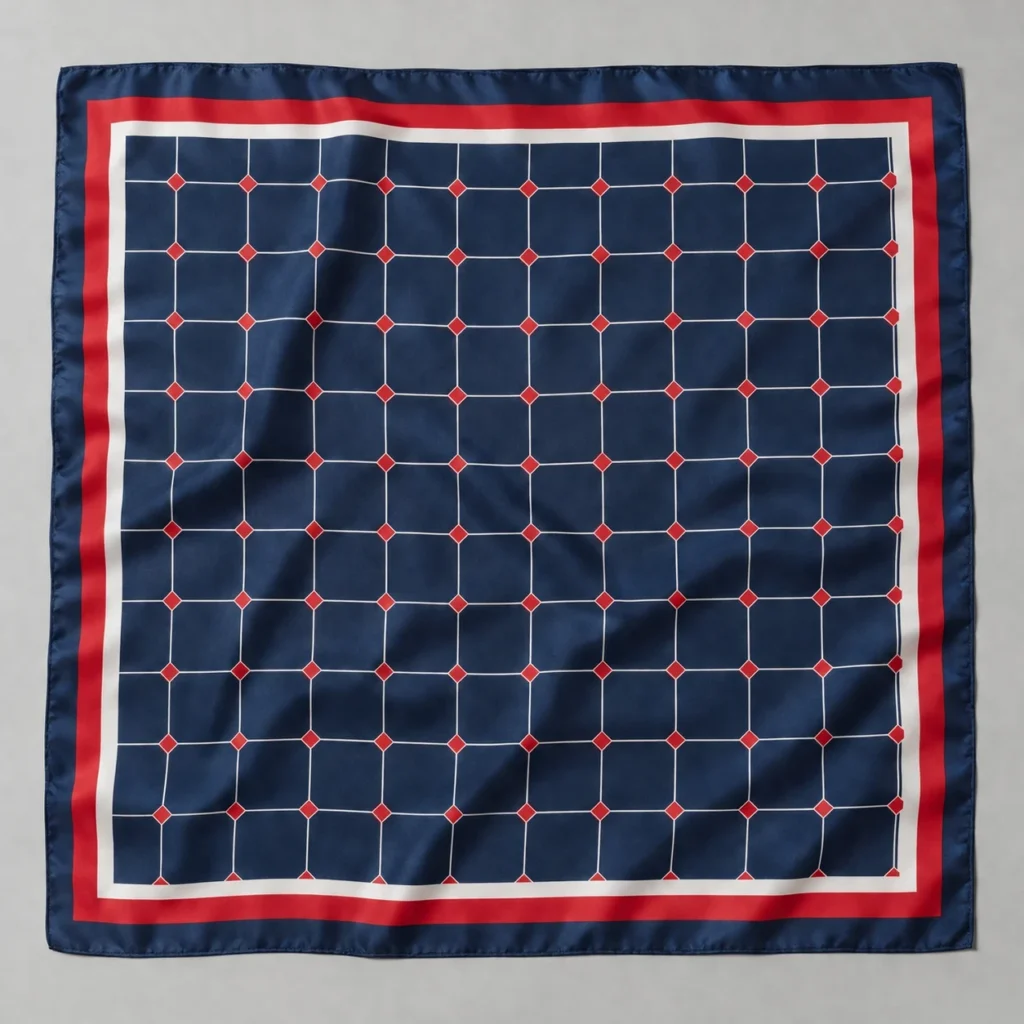
- Bandana cotton poplin: a firm plain weave that softens with washing. Bandana cotton is the classic for screen-printed paisley and logo bandanas, with discharge printing for light designs on dark grounds; our bandana sizes and printing guide covers the details.
- Linen: crisp and textured and creases readily, for summer scarves; viscose-linen blends soften the hand.
Where do jersey, fleece and velvet fit?
They are knitted fabrics cut and sewn into scarves. Jersey suits hijabs and tubes, fleece suits warm promotional scarves, and velvet suits gift and evening ranges.
Lightweight cotton jersey with a little stretch wraps closely and stays in place without pins, which makes jersey a common choice for hijabs; our hijab fabrics guide compares jersey with chiffon, georgette, viscose and modal on drape, grip and coverage. Our scarf velvet is usually a stretch velvet in polyester with a short, soft pile, with other velvets on request; stretch velvet takes sublimation, and the colour looks lighter or darker with the direction of the pile.
Can scarves be made from recycled or organic fabrics?
Yes, on request. Recycled polyester satin and chiffon, and organic cotton, are sourced from mills that supply a certificate for the fabric, and the certificate is the mill’s.
Fabrics from OEKO-TEX® certified mills are available on request; the certificate is the mill’s. ISO 9001 certification and Sedex membership are held by Eco Jersey Limited, which powers Mr Balaclava. Our guide to fabric certificates explains what to ask for.
What should a scarf label say about the fabric?
The label names the fibre and its percentage, not just the weave or a market name. Many markets also expect care information on a scarf.
- Silk only for real silk: call a scarf silk only when it is woven from silk. A polyester scarf with a silky hand is labelled polyester, for example “100% polyester” on a silk-touch twill.
- Satin, chiffon and twill are weaves: write “silk satin” or “polyester satin”, “silk chiffon” or “polyester chiffon”, so the buyer knows the fibre.
- Cashmere and wool content: a cashmere blend is labelled with its percentages, such as wool and cashmere. Rules on what may be called cashmere differ by market, so 100% cashmere is labelled only with the mill’s documentation.
- Pashmina: a style name. In the US, for example, it is not an accepted fibre name, so the label states the cashmere or cashmere-silk content.
- Care labels: care symbols to ISO 3758 are common. Silk, viscose and cashmere usually need gentle care, while polyester and cotton are easy-care.
- Sheer silk and viscose: for some markets, such as the US, buyers often test light, sheer scarves to the local flammability rules; tell us your market and we include it in the quote discussion.
Care labels, woven brand labels and hang tags are added in our factory; Mr Balaclava’s name never appears on your products. Our scarf printing and finishing guide covers labels, hems and print methods.
How to choose a scarf fabric
Start from the use, the decoration and the price point; the table shows the fabrics that usually suit each.
| Use or goal | Fabrics that usually suit | Why |
|---|---|---|
| Warm winter scarf or staff gift | Acrylic, wool blend or merino knit | Warmth and easy branding with a label or embroidery |
| Gift or fashion scarf with a high-end feel | Silk twill or satin, cashmere blend | Drape, sheen or softness |
| Photo or full-colour artwork at a low price | Polyester satin, twill or chiffon | Sublimation prints edge to edge |
| Uniform neckerchief | Silk-touch polyester twill | Holds a knot, easy to wash |
| Bandana | Bandana cotton poplin; polyester twill for sublimation | The classic hand, or full-colour prints |
| Hijab or long fashion scarf | Viscose, modal, chiffon, georgette, jersey | Drape, grip and coverage |
| Summer and beach scarf | Cotton voile, viscose challis, linen | Light and cool on warm days |
| Event or youth giveaway | Polyester fleece or satin | Warm or bright at a low unit price |
Ordering scarves in your fabric from Mr Balaclava
Custom scarves start at 50 pieces per design, in any of the fabrics above, with production of approximately 14 days after sample approval. Catalogue scarves start at about $1.30–19.50 per piece at 50 pieces depending on fabric and size; unit prices fall as quantities rise, and your quote confirms the price.
What to send with your brief
- The fabric, or the feel and use you want if you are unsure
- The fibre content you need on the label, such as 100% silk or a cashmere blend
- Size, shape and the edge finish
- Your artwork, colours and print method if you know it
- Labels, care labels, hang tags and packaging
- Quantities per design, your deadline and the delivery country
Choose a pre-paid physical sample, made in about 5–7 days, or a free pre-production sample made after the order and the 30% advance payment and approved by photos, videos or a video call. Express shipping by DHL, FedEx or UPS usually takes 3–6 working days.
Frequently asked questions
What is the warmest scarf fabric?
Cashmere and wool, usually knitted, are the warmest scarf fabrics for their weight. Acrylic knits and polyester fleece are warm at a lower price; silk and the light wovens are chosen for drape rather than warmth.
Is a satin scarf made of silk?
Not necessarily. Satin is a weave, and many satin scarves on the market are polyester satin. A silk satin scarf is labelled as silk, usually costs much more and is printed digitally rather than sublimated.
Is pashmina the same as cashmere?
Pashmina is a style name for a fine, light cashmere wrap, often a cashmere-silk blend. It is not a separate fibre, so we state the real composition on the quote and the label.
Which fabric shows a photo print most clearly?
Smooth, light-coloured polyester satin or twill, sublimated, usually shows photographic detail clearly at a low cost. On silk, digital printing gives fine detail; on sheer chiffon the print shows through on the back in a lighter tone.
Can I order 100% cashmere or 100% silk scarves?
Yes. Our silk scarves are mulberry silk, and 100% cashmere is available on request, alongside cashmere-wool and cashmere-silk blends. The exact composition is confirmed on your quote.
Want to see each fabric up close? Browse our scarf fabrics in the Material Library, see the finished styles in our custom scarves catalogue, and when your brief is ready, ask for a quote.