
Silk scarves are described by weave and by weight, and the weight is given in momme. Two silk squares of the same size can feel completely different: one light and airy, the other dense and smooth with a deep sheen. Knowing what momme measures makes it much easier to compare quotes and samples.
This guide explains what momme is, which weights are typical for each silk weave, and when polyester or viscose is the better choice for a printed scarf. Every fabric links to its page in our scarf fabrics collection in the Material Library, and the finished products are on our silk scarves and printed scarves pages.
What is silk momme?
Momme (written mm) is the traditional unit for the weight of silk fabric. One momme equals about 4.34 grams per square metre, so a 12 momme silk weighs about 52 g/m² and a 16 momme silk about 69 g/m².
The unit comes from Japan and expresses how much silk there is in a given area of fabric. A higher momme means more silk per square metre: the fabric is denser, more opaque, more durable and drapes with more weight. A lower momme is lighter, more transparent and more delicate. Momme says nothing about the weave, so compare momme between silks of the same weave rather than across weaves.
What momme is typical for each silk weave?
For scarves, silk chiffon is typically about 6–8 momme, habotai about 5–8, georgette about 8–10, twill about 12–16 and satin (charmeuse) about 16–22. The weight for your order is confirmed with the quote.
| Silk | Typical momme | About g/m² | Look and feel | Typical scarf |
|---|---|---|---|---|
| Silk habotai | 5–8 | 22–35 | Light, smooth plain weave | Light neck and hair scarves, linings |
| Silk chiffon | 6–8 | 26–35 | Sheer and floating | Evening wraps, bridal stoles, hijabs |
| Silk georgette | 8–10 | 35–43 | Sheer, crinkled crepe surface, better grip | Hijabs, wraps, evening scarves |
| Mulberry silk twill | 12–16 | 52–69 | Fine diagonal weave, firm, holds a knot | Classic printed squares |
| Silk satin (charmeuse) | 16–22 | 69–95 | Glossy face, matte back, fluid drape | Luxury squares, evening and hair scarves |
Silk twill, habotai, satin, chiffon or georgette: which suits your scarf?
Choose twill for classic printed squares that hold a knot, habotai for light silk scarves, satin for the most lustre and drape, chiffon for sheer layered wraps, and georgette when you need a sheer silk that grips and stays in place.
Mulberry silk twill
Twill is woven in a fine diagonal line. It has a soft lustre, a firm, smooth hand and enough body to hold a knot, and it shows detailed digital prints with sharp lines and rich colour. It is the classic fabric of the printed silk square. See Mulberry Silk Twill.
Silk habotai
Habotai, also called China silk or pongee silk, is a light, smooth plain weave. It is thinner and airier than twill and takes digital prints and dyes evenly, so it suits light neck scarves, hair scarves and linings. See Silk Habotai.
Silk satin (charmeuse)
Satin has a glossy face and a matte back. It has the most lustre and the most fluid drape of the silks, which makes it the choice for luxury squares, evening scarves and hair scarves. See Silk Satin (Charmeuse).
Silk chiffon
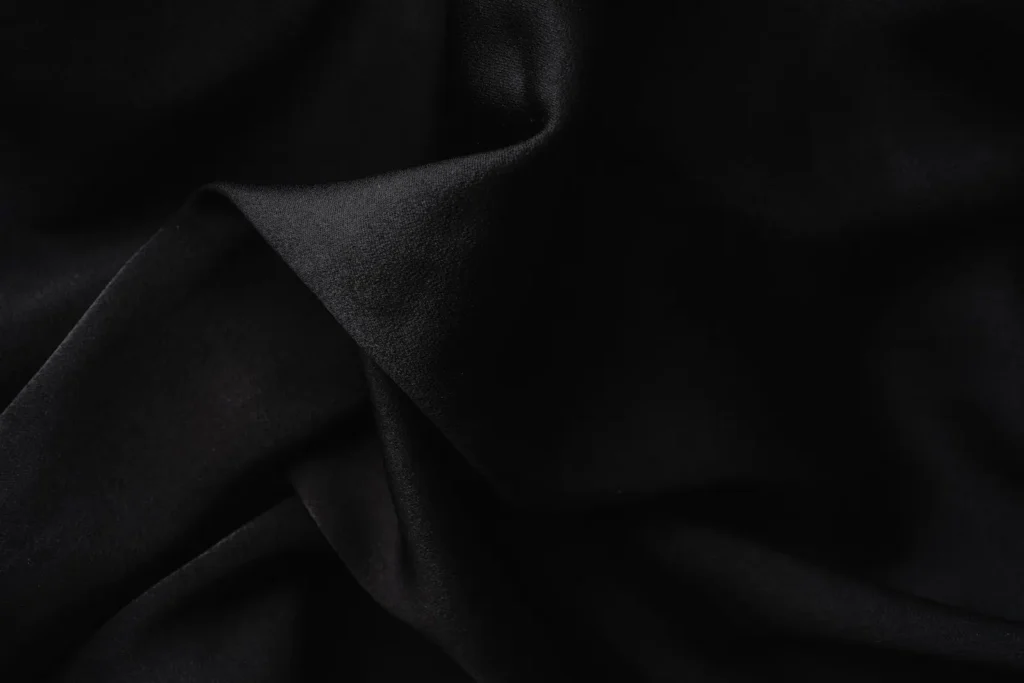
Chiffon is sheer and very light, woven from tightly twisted yarns. It floats and layers well and is used for evening wraps, bridal stoles and hijabs, dyed in solid colours or printed digitally. See Silk Chiffon.
Silk georgette
Georgette is also sheer but has a crinkled, crepe-like surface. It is heavier and less transparent than chiffon and grips better, so it holds a drape and stays in place. See Silk Georgette.
Silk, polyester satin or viscose: which is best for printed scarves?
Silk gives the most natural lustre and the softest hand and suits luxury and gift ranges. Polyester satin and polyester twill give a similar look at a lower price, wash easily and are the only scarf fabrics here that take sublimation. Viscose is soft and breathable, drapes like silk and takes bright digital and rotary-screen prints.
| Fabric | Feel | Care | Printing | Typical use |
|---|---|---|---|---|
| Silk twill or silk satin | Natural lustre, soft and smooth | Gentle care | Digital (acid dyes) or screen | Luxury squares, gift scarves |
| Polyester satin | Glossy, like silk satin | Durable, easy to wash | Sublimation, digital, screen | Printed squares, uniform neckerchiefs, promotional scarves |
| Polyester twill (silk-touch) | Soft, silk-like, holds a knot | Survives frequent washing | Sublimation, screen, digital | Squares, bandanas, uniform and event scarves |
| Viscose challis | Soft, cool and fluid | Gentle care | Digital, rotary screen | Fashion scarves, hijabs, shawls, beach wraps |
The choice often comes down to the price point and the way the scarf will be used. A gift scarf sold in a box can justify silk; a uniform neckerchief that is washed every week is better in polyester twill; a summer fashion scarf printed in many colours suits viscose. For gift ranges and packaging, see our luxury and gift scarves.
Which printing method works on which scarf fabric?
Digital printing works on silk, satin, chiffon, viscose, cotton, linen and polyester. Sublimation works only on polyester. Rotary and flat screen printing print one colour per screen and suit repeat patterns and larger runs.
| Method | How it works | Scarf fabrics | Best for |
|---|---|---|---|
| Digital printing | Ink printed directly onto the fabric | Silk, satin, chiffon, viscose, cotton, linen, polyester | Photographic designs, many colours, small runs |
| Sublimation | Dye turns into a gas and bonds with the fibres | Polyester only (satin, twill, chiffon) | Edge-to-edge colour on polyester scarves |
| Rotary or flat screen | One screen per colour | Most woven scarf fabrics | Repeat patterns, larger runs, solid colours |
| Discharge printing | Removes the dye to print light designs | Dark cotton | Light prints on dark bandanas and cotton scarves |
Silk is printed digitally with acid dyes or screen printed. It is never sublimated, because sublimation dye only bonds with polyester. If you want the sublimated look and price, choose polyester satin or polyester twill. On sheer fabrics such as chiffon, the print shows through on the back in a lighter tone.
How are silk scarves finished?
Silk squares are usually finished with hand-rolled hems. Machine-rolled hems, narrow hems and overlocked edges are also available, and long scarves can be finished with fringes or tassels.
Branding is usually a small woven or satin label at a corner, or a printed signature or monogram within the design. Luxury ranges are often packed flat in tissue or a gift box.
What we confirm with your quote
- The silk weave and its momme, or the alternative fabric.
- The exact composition, stated on the quote and the care label.
- The printing method for your artwork, checked on a sample.
- Hems, labels and packaging.
Frequently asked questions
Is a higher momme always better?
Not always. A higher momme means a denser, more durable and more opaque silk, but chiffon and georgette are meant to be light. Compare momme within the same weave: a 16 momme twill is heavier than a 12 momme twill, but it should not be compared with an 8 momme chiffon.
What momme is a silk square scarf?
A classic printed silk square is made in silk twill of about 12–16 momme, which holds a knot and shows fine print detail. For a lighter square, habotai of about 5–8 momme is an option.
Can silk scarves be sublimated?
No. Sublimation only works on polyester. Silk is printed digitally or by screen; for a sublimated scarf, choose polyester satin or polyester twill.
Do you weave the silk yourselves?
No. Woven fabrics such as silk, satin, chiffon and viscose come from partner mills; we cut, print, hem, brand, inspect and pack the scarves in our factory in Sialkot.
What is the minimum order for printed silk scarves?
Orders start at 50 pieces per design. Standard production lead time is approximately 14 days after sample approval, and the confirmed schedule is agreed for each order.
Compare every woven fabric on the scarf fabrics page, browse silk scarves and printed scarves in our B2B catalog, or send us your design for a quote.