
Ask ten people what a balaclava is and you will get ten pictures: a black ski mask with one opening, a striped three-hole knit, a thin liner under a motorcycle helmet, a fleece hood with a long neck, a fluffy fashion piece with cat ears. They are all balaclavas. What separates them is not one feature but several, and most guides mix those features into one short list.
This guide sorts every type of balaclava along six clear lines: the face opening, how it can be worn, how it is made, the material, the use and the style. Each section links to a detailed guide. It is written for anyone choosing balaclavas, and especially for brands, shops, clubs and event companies that want their own. If you are new to the garment itself, start with what a balaclava is and how it is used.
What are the main types of balaclavas?
The main types are grouped by six features. A single balaclava sits in one group of each: for example, a three-hole, fixed, flat-knitted, acrylic, winter-streetwear balaclava.
| Feature | The types | What it decides |
|---|---|---|
| Face opening | One-hole, two-hole, three-hole, one eye opening plus mouth, open face, narrow ninja slit, mesh-covered eye opening | How much of the face is covered, breathing, fit with goggles and glasses |
| How it is worn | Fixed, hinged, fold-down mouth, convertible, detachable face piece, hooded, ninja-style, hair opening, extended neck or turtleneck | How many ways one piece can be worn, helmet fit, coverage of the neck |
| Construction | Knitted (flat or circular knitting) or cut-and-sew from fabric | Stretch, seams, warmth, and which decoration methods work |
| Material | Acrylic, wool and merino, cotton, polyester/spandex jersey, fleece, mesh, special fabrics on request | Warmth, breathability, feel, care and price |
| Use | Skiing and snowboarding, motorcycle and cycling, cold work, tactical, summer and dust, everyday winter | Thickness, seams, openings and fabric |
| Style | Classic plain, streetwear, all-over printed, knitted pattern, faux fur, crochet, animal and novelty | How it looks and how it is branded |
Names add to the confusion. In the United States the same piece is usually called a ski mask, and the two words often describe the same product; we compare them in balaclava vs ski mask. The glossary near the end of this guide pins down the other names you will meet.
Types of balaclavas by face opening
The face opening is the first choice and the one buyers ask about most. It decides how much of the face is covered, how easily you breathe and talk, and how the balaclava works with goggles, glasses and helmets.
- One-hole (full face): one opening for the eyes, sometimes wide enough for the bridge of the nose. It covers the most skin and is the usual choice for skiing, motorcycling and cold commutes.
- Two-hole: the term is used in two ways. In our catalogue it means two separate eye openings and no mouth opening; some sellers use it for one eye opening plus a mouth opening. Always check which one is meant.
- Three-hole: two eye openings and a mouth opening. The classic rib-knit ski mask look, popular in winter streetwear and retail.
- One eye opening plus a mouth opening: a wide eye slot with a separate mouth opening, common on printed and sublimated sports styles.
- Open face: covers the head, ears and neck and leaves the face open from forehead to chin. It breathes easily, tends to fog goggles less and is the usual helmet liner.
- Ninja-style slit: a single narrow horizontal opening for the eyes, often with a wrapped face panel.
- Mesh-covered eye opening: the eye area is covered with breathable mesh so a printed face design can run across it, as on many character and animal styles.
Openings also show how a range is built. Of the 169 balaclavas with an opening listed in our own catalogue, about two-thirds are one-hole, about one in five are three-hole and about one in ten are two-hole. Custom openings, such as a separate nose opening, are made to order.
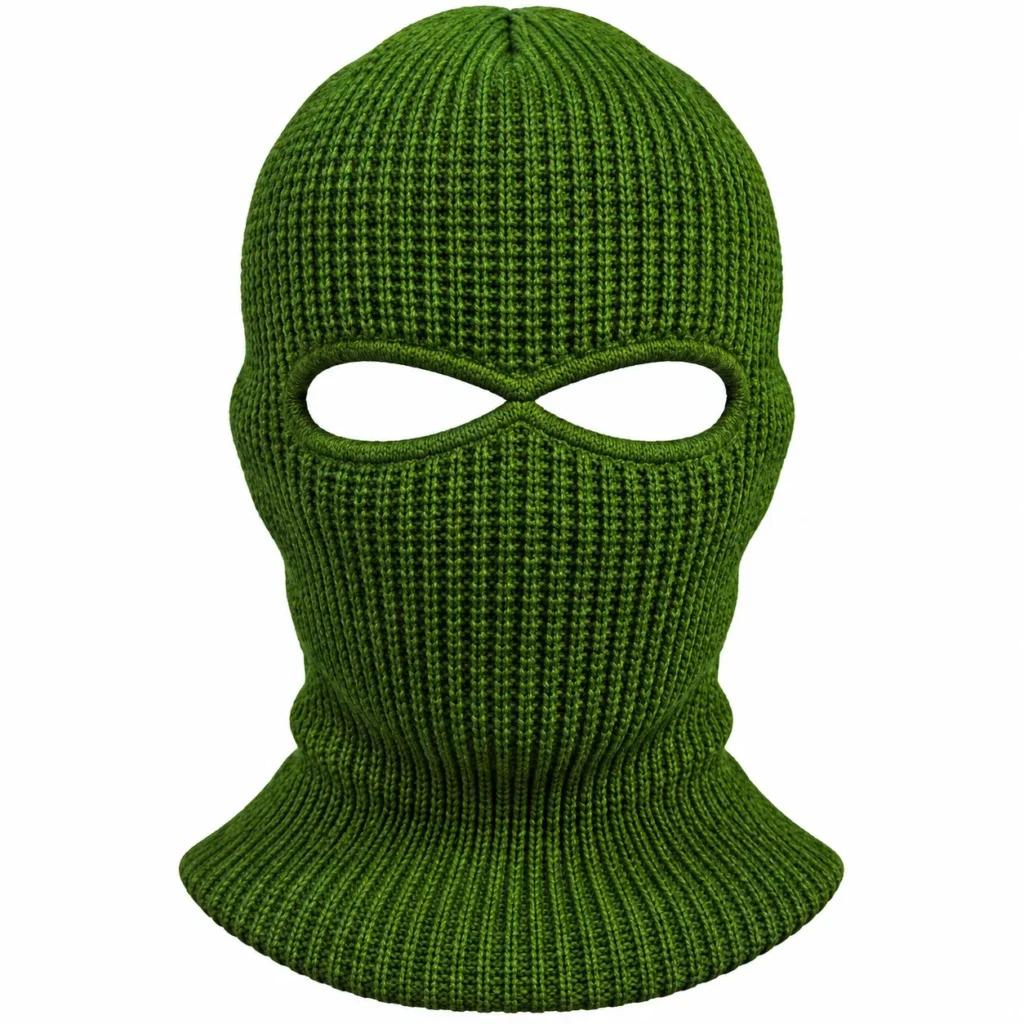
For a full comparison of breathing, fogging, glasses and helmet fit, read our guide to balaclava face openings.
Types by how they are worn: fixed, hinged, convertible and hooded
Most balaclavas are fixed: they are worn one way. Others are built so one piece can be worn several ways, or so they cover more of the head and neck.
Hinged and convertible balaclavas
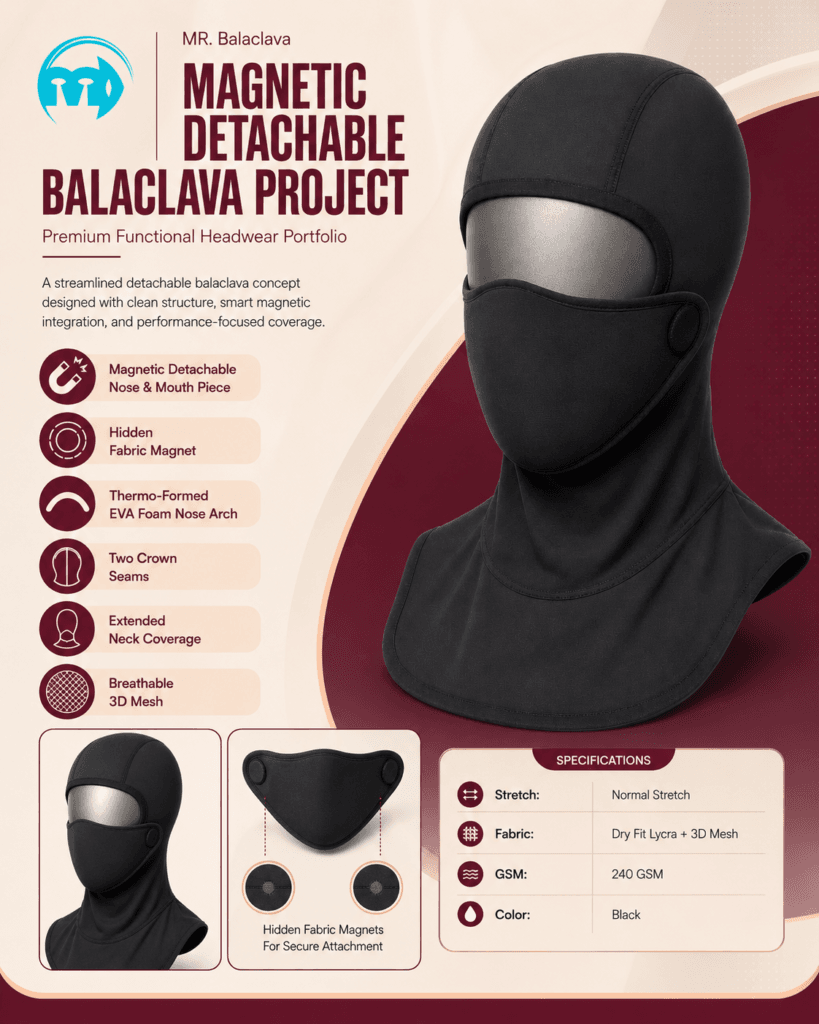
A hinged balaclava has a face panel joined at the sides, so the lower part folds down under the chin or flips up over the head without bunching. A fold-down mouth panel does the same for the mouth only. A detachable face piece, held by magnets or snaps, comes off completely and turns the balaclava into an open hood. A simpler convertible style is a stretchy tube that rolls down into a neck warmer or up into a beanie.
These styles suit people who move between cold and warm conditions in one day, such as riders, skiers and outdoor workers. They need more pattern pieces and more sewing than a fixed style, which usually shows in the price. We made a convertible balaclava with a magnetic detachable face piece for an outdoor brand; our convertible balaclava page shows the three constructions.
Hooded and ninja-style balaclavas
A hooded balaclava is sewn into a roomy hood that covers the head, ears and shoulders, often with a drawstring and a neck flap. It is worn as streetwear or over other layers outdoors, and is different from a thin, close-fitting helmet liner. A ninja-style balaclava pairs a fitted head cover with a separate or layered face panel and a narrow eye opening. See our hooded balaclavas and ninja-style balaclavas, and our explainer on the balaclava hoodie.
Hair openings, extended necks and turtlenecks
A balaclava with a hair opening has a finished hole at the back or crown for a ponytail, bun or braids. An extended version has a longer back panel that covers long hair and locs under a full-face helmet, like the extended balaclava we made for a motorcycle and lifestyle brand. An extended neck or bib reaches the collarbone and tucks into a jacket, and a turtleneck balaclava has a high folded neck that wraps the neck and chin like a built-in scarf.
Types by how they are made: knitted or cut-and-sew
Every balaclava is either knitted from yarn or cut and sewn from fabric. This is the difference most guides skip, and for a buyer it matters most, because it decides the stretch, the seams, the feel and which decoration methods work.
- Knitted: knitted from yarn on knitting machines, either knitted to shape on a flatbed machine or knitted as a tube. The openings are shaped or finished in the knit, and there is usually only one short closing seam, often with a seamless top. Rib, jersey, cable and waffle stitches give different looks, and a jacquard pattern or logo can be knitted into the fabric.
- Cut-and-sew: made from a finished fabric, such as stretch jersey, fleece or mesh, cut into pattern pieces and sewn. Our standard pattern uses four panels, front, left, back and right, with a trim around the eye opening and a hem at the neck. Flat seams lie flat under a helmet, and the fabric can be printed edge to edge before sewing.
In our factory in Sialkot, Pakistan, flat knitting and cut-and-sew are done in-house; jacquard and circular knitting are done with partner mills we work with closely. The detailed comparison, step by step, is in knitted vs cut-and-sew balaclavas.


Types by material
Knitted balaclavas are made from yarns; cut-and-sew balaclavas are made from fabrics. Keeping the two apart makes the choice much easier.
| Material | Made as | Typical feel and behaviour | Typical use |
|---|---|---|---|
| Acrylic rib knit | Knitted | Soft and springy, holds bright colours, good value; can pill with friction | Winter streetwear, retail, promotions |
| Merino and wool | Knitted or cut-and-sew jersey | Warm, handles moisture well, a premium feel; needs gentle care | Skiing, premium winter ranges |
| Cotton | Knitted or cotton jersey | Soft and breathable, less warm, dries slowly | Everyday wear, mild weather, sensitive skin |
| Polyester/spandex stretch jersey | Cut-and-sew | Thin, four-way stretch, dries quickly, takes all-over sublimation | Motorcycle, sport, printed and character styles |
| Fleece | Cut-and-sew | Warm and soft, often brushed inside | Cold weather, thermal and outdoor styles |
| Mesh | Cut-and-sew, often as panels | Very airy; used at the mouth, nose or sides | Summer, breathing zones, helmet liners |
Our yarns include 100% acrylic, acrylic and wool blends, merino and wool, cotton, chenille and luxury blends on request; our fabrics include stretch jerseys, microfibres, several fleeces, meshes and bonded wind-resistant layers. Fabrics from OEKO-TEX® certified mills are available on request; the certificate is the mill’s. Each one has a page in our Material Library, and balaclava materials compared explains which to choose.
Types by use
A balaclava built for one activity combines the right opening, construction and fabric for it. These are the main use types.
| Use | Usual type | What matters most |
|---|---|---|
| Skiing and snowboarding | One-hole or open face, fleece, merino or stretch jersey | A thin crown under the helmet, a nose area that keeps breath away from the goggles, a neck that tucks into the jacket |
| Motorcycle and cycling | Thin one-hole or open face in stretch jersey or mesh | Flat seams at helmet pressure points, breathability, a long neck |
| Extreme cold and outdoor work | Layered fleece or merino with a wind-resistant outer, hinged or fold-down mouth | Warmth, a breathing zone at the mouth, coverage down to the collarbone |
| Tactical and airsoft | One-, two- or three-hole, hinged or half face in dark or camouflage colours | Low profile, flat seams, room for headsets, tonal logos |
| Summer, sun and dust | Lightweight stretch jersey with mesh vents | Light, quick-drying fabric that covers the face, ears and neck on sunny, windy and dusty days |
| Everyday winter and streetwear | Knitted one-, two- or three-hole | Colour, knit texture, branding |
For specific activities, see our guides on ski balaclavas under a helmet, how a motorcycle balaclava should fit and full-face tactical balaclavas, or browse sports balaclavas, thermal balaclavas and summer balaclavas in the catalogue.

Fire-resistant balaclavas
Fire-resistant balaclavas are a separate, regulated category used in motorsport, industry and firefighting. We can make them in FR fabric supplied with the mill’s test certificate. Where your market requires certified protective equipment, the finished product has to be tested and certified for that market, and the certificate is issued in the selling brand’s name. Ordinary acrylic and polyester can melt with heat, so they are never a substitute. Read more on our flame-resistant balaclavas page.
Types by style: classic, printed, knitted pattern and novelty
Style is where a balaclava becomes a product with its own identity. The main styles are:
- Classic plain: one colour, usually black, navy or grey, branded with a small embroidered logo, patch or woven label.
- All-over printed: camouflage, graphics, flags and photographic designs printed edge to edge on polyester stretch fabric by sublimation. See sublimated balaclavas.
- Knitted pattern: stripes, flames, Fair Isle patterns and logos knitted into the fabric as jacquard, or contrast tipping on the openings. See knitted balaclavas.
- Fashion: chunky rib and cable knits, faux fur trims or full faux fur (we use faux fur only), crochet, contrast stitching and designer yarns. See fashion balaclavas and faux fur and turtleneck balaclavas.
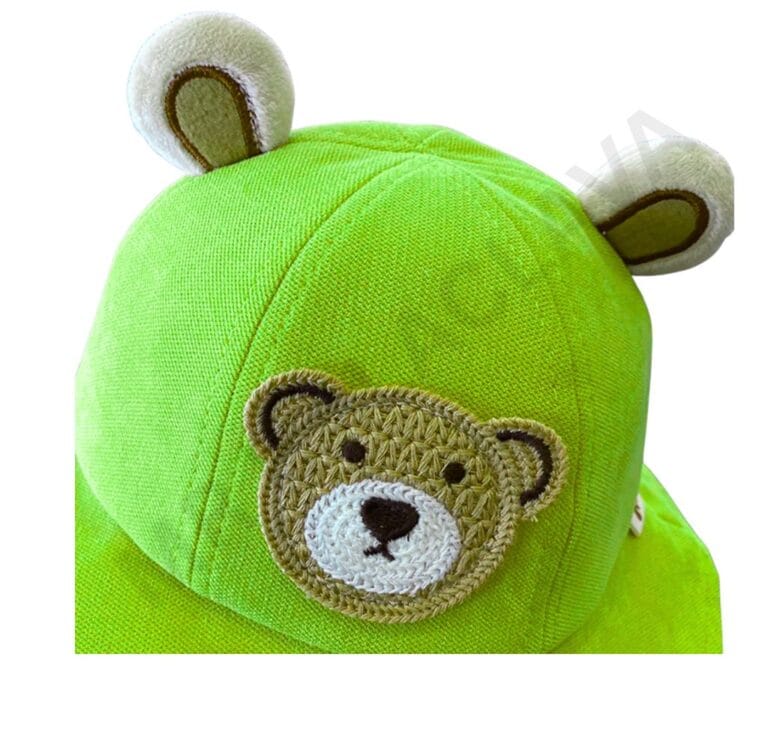
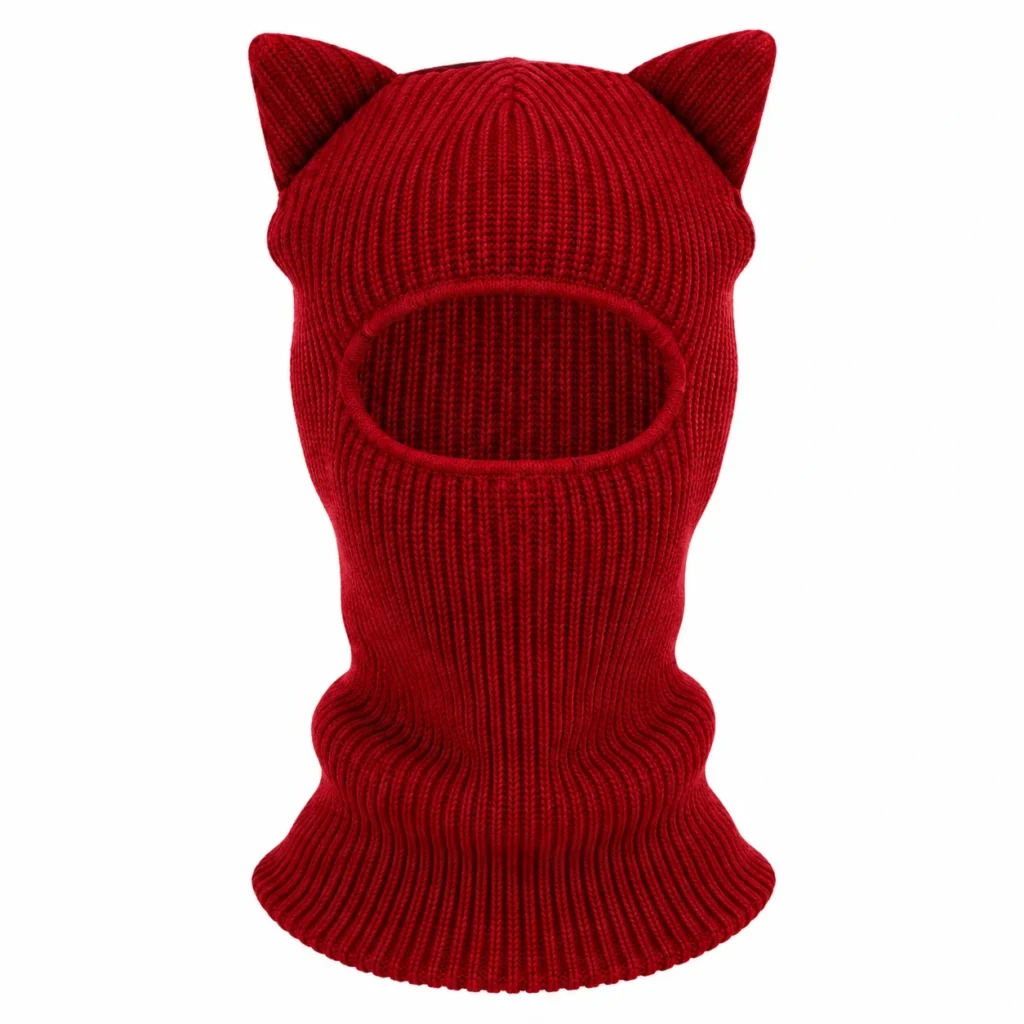
- Animal and novelty: knitted cat, bear or rabbit ears and devil horns, printed animal faces, and scary, funny or cartoon designs for events and costumes. We only print designs you own or are licensed to use. See animal balaclavas.
Trends change quickly; our article on luxury balaclava trends looks at the designer side of the market.
How are balaclavas branded?
The decoration method follows the construction and the material. Knitted acrylic takes jacquard, embroidery and patches well, but not sublimation or screen printing. Polyester stretch jersey takes sublimation, screen printing, DTF and heat transfer. Labels, hang tags and packaging work on every type.
Sublimation dyes the design into the polyester fibres, so it needs a polyester fabric with a light base and suits photographic, all-over designs. Embroidery suits bold logos on knits and fleece. Heat transfers suit small runs and multi-colour or reflective logos. Our guide to balaclava logo and decoration methods compares them all, and the decoration methods table in the Help Center gives a quick overview.
Which type of balaclava should you choose?
Start from where and how it will be worn, then choose the opening, the construction and the material in that order.
| If the balaclava is for… | Opening | Construction and material | Branding |
|---|---|---|---|
| A winter streetwear or retail range | Three-hole, two-hole or one-hole | Knitted acrylic or acrylic/wool | Jacquard, embroidery, patch, woven label |
| Skiing under a helmet | One-hole or open face | Cut-and-sew fleece, merino or stretch jersey | Embroidery, heat transfer, sublimation on polyester |
| Motorcycle riders | One-hole or open face | Thin cut-and-sew stretch jersey, mesh zones, flat seams | Sublimation, heat transfer, reflective details |
| Warm-weather work or sport | One wide eye opening | Lightweight stretch jersey with mesh vents | Sublimation, screen print |
| Events, costumes and promotions | One-hole or mesh-covered eyes | Polyester stretch jersey or knitted novelty | All-over sublimation, knitted-in details |
| Extreme cold | One-hole, hinged or fold-down mouth | Layered fleece or merino with a wind-resistant outer | Embroidery, woven label |
What about sizes?
Most balaclavas are made in one adult size with stretch. Our adult size fits a head circumference of about 54–61 cm; our kids size fits about 49–54 cm, for children of about 4 to 12 years, and has its own pattern rather than being a smaller copy. Children’s headwear should not have cords or drawstrings at the hood or neck, which the rules in the EU and US restrict. Styles can also be graded to your own size chart.
Balaclava names and what they mean
Many names describe the same garment, and some describe a different one. This glossary keeps them apart.
| Name | What it usually means |
|---|---|
| Balaclava | A head covering that covers the head, neck and all or part of the face. The name is usually traced to the town of Balaklava in Crimea and the Crimean War of 1854. |
| Ski mask | The usual American name, often for the same product, especially the knitted one-hole or three-hole style. |
| Full-face balaclava | A balaclava that covers the whole face apart from the eye opening, usually one-hole. |
| Helmet liner | A thin, close-fitting balaclava, usually open face or one-hole, worn under a helmet. |
| Shiesty | American slang for a thin, usually black one-hole balaclava; a football version has a mouth opening. |
| Neck gaiter | A tube for the neck and lower face only, without a crown. It is not a balaclava, but many ranges sell both. |
| Cagoule, Sturmhaube, pasamontañas | The usual names in French, German and Spanish. In French, “cagoule” means a balaclava, not a rain jacket as in British English. |
For the history behind the word, see when the balaclava was invented and what the word balaclava means. Neck gaiters are compared with balaclavas in balaclava or neck gaiter and sold in our neck gaiter collection.
Ordering custom balaclavas of any type
Mr Balaclava makes all of these types to order in Sialkot, Pakistan, from 50 pieces per design, with a monthly capacity of around 100,000 pieces. A design is one style in one colourway with one artwork, so a range of three designs starts at 150 pieces.
What to send with your request
- The type: opening, wear option (fixed, hinged, hooded…) and the use.
- Your preferred material, or the conditions it is for, and we suggest one.
- Colours (Pantone references if you have them) and your logo or artwork.
- Sizes: adult, kids or your own size chart.
- Quantity per design, labels and packaging, and the date you need the goods.
You can approve a pre-paid physical sample, made in about 5–7 days, or a free pre-production sample made after the order and approved by photos, videos or a video call. Standard production takes approximately 14 days after sample approval. Shipping is priced by weight: up to 100 kg door to door by express courier with duties paid by us, heavier orders by air or sea cargo to your nearest airport or port; the online shipping estimate is confirmed before shipment. Mr Balaclava’s name never appears on your products, and Eco Jersey Limited, which powers Mr Balaclava, is ISO 9001 certified and a Sedex member.
Frequently asked questions
What is the difference between a balaclava and a ski mask?
Usually none: “ski mask” is the common American name for a balaclava. Some people use “ski mask” only for the knitted three-hole style, but the construction and materials are the same.
Which type of balaclava is warmest?
Warmth depends more on the material and the layers than on the type. A one-hole balaclava in fleece or merino, or a layered style with a wind-resistant outer, usually keeps more heat in than a thin stretch-jersey liner. For very cold conditions, a breathing zone at the mouth helps stop the fabric from getting damp.
Which balaclava is best under a helmet?
A thin, close-fitting one-hole or open-face balaclava in stretch jersey or merino, with flat seams and a smooth crown, usually fits best under a ski or motorcycle helmet. Thick knits and loose hoods tend to press at the temples.
What does “seamless” mean on a balaclava?
Usually that the balaclava is knitted to shape or as a tube, with a seamless top or only one small seam. It rarely means there are no seams at all. Cut-and-sew balaclavas always have seams; flat seams keep them comfortable.
Can I order fewer than 50 pieces?
Our minimum order is 50 pieces per design, which is low for custom headwear. If you want to try a design first, a pre-paid physical sample is the way to hold it in your hand before ordering.
Can I wear a balaclava anywhere?
Rules on covering the face in public places differ between countries and cities, and some places restrict face coverings in public buildings, on transport or at gatherings. Check the local rules where the balaclavas will be worn or sold.
Browse the balaclava catalogue, see how we make custom balaclavas, or send us your brief for a quote.