
The bandana is one of the easiest products to brand: a square of fabric with a print, worn as a neckerchief or a headband, carried at festivals or added to a merchandise pack. Getting it right still takes a few decisions: the size, the fabric, the printing method, where the logo goes and how the bandanas are packed.
This guide takes those decisions one at a time. You can see finished styles on our bandanas page.
What sizes do custom bandanas come in?
The standard bandana sizes are 51 × 51 cm (20 in), 56 × 56 cm (22 in) and 69 × 69 cm (27 in). Any other size can be made to your specification.
| Size | Centimetres | Typical use |
|---|---|---|
| 20 in | 51 × 51 cm | Smaller neck and head wear, merchandise packs |
| 22 in | 56 × 56 cm | The classic adult bandana, folded as a neckerchief or headband |
| 27 in | 69 × 69 cm | Oversized bandanas and larger neckerchiefs |
A bandana is folded before it is worn, so the size you see on the table is not the size people see. Folded into a triangle, a 56 cm square ties comfortably around an adult neck; a 69 cm square leaves longer ends and more fabric at the front.
Bandana, neckerchief or triangle scarf: what is the difference?
A bandana is a printed square, usually 51–69 cm, worn folded. A neckerchief is a square of about 50 × 50 to 70 × 70 cm, often part of a uniform. A triangle scarf is cut as a triangle, up to about 180 × 90 cm, so it can be tied without folding.
The difference lies mostly in use and fabric. Bandanas are traditionally cotton with a bold print. Uniform neckerchiefs are often polyester twill or satin in a plain colour or a simple corporate pattern, because they wash easily and keep their colour; see our business and uniform scarves. Triangle scarves range from small cotton kerchiefs to large printed head and neck scarves.

Cotton or polyester: which fabric is best for bandanas?
Cotton is best for the classic bandana: it is soft and absorbent, gets softer with every wash and takes screen and discharge prints with the vintage look buyers expect. Polyester twill is best for full-colour designs, because it takes sublimation, survives frequent washing and keeps its colour.
| Fabric | Feel | Printing | Best for |
|---|---|---|---|
| Bandana cotton (poplin) | Soft, matte, absorbent; softens with washing | Screen, discharge, digital, embroidery | Classic paisley and logo bandanas, workwear, festivals |
| Polyester twill (silk-touch) | Smooth and silk-like, holds a knot | Sublimation, screen, digital | Full-colour logo bandanas, uniform neckerchiefs, events |
| Cotton voile | Light, slightly sheer, crisp and breathable | Digital, screen | Summer bandanas and light head scarves |
Cotton-polyester blends are an option for a lower cost. Sublimation does not work on cotton, so a full-colour photographic design on cotton is printed digitally instead.
Which printing method should you use for custom bandanas?
Screen printing is the classic method for cotton bandanas in a few solid colours. Discharge printing gives soft, light prints on dark cotton. Digital printing handles many colours and photographs on cotton or polyester, and sublimation gives edge-to-edge full colour, but only on polyester.
| Method | Fabric | Look | Best for |
|---|---|---|---|
| Screen printing (flat or rotary) | Cotton, polyester | Bold solid colours, one screen per colour | Classic paisley and logo bandanas, repeat orders |
| Discharge printing | Dark cotton | Light design with a soft feel | White or light prints on black, navy or red bandanas |
| Digital printing | Cotton, polyester | Many colours, photos and gradients | Detailed artwork in smaller runs |
| Sublimation | Polyester only | Full colour edge to edge, no feel on the fabric | Team, event and full-colour logo bandanas |
| Embroidery | Cotton, polyester twill | Raised stitched logo | A small logo in one corner |
Heat transfer is a further option for a small logo on a plain bandana. If you are unsure, send the artwork and the fabric you prefer, and we suggest the method with the quote.
Where should the logo go on a bandana?
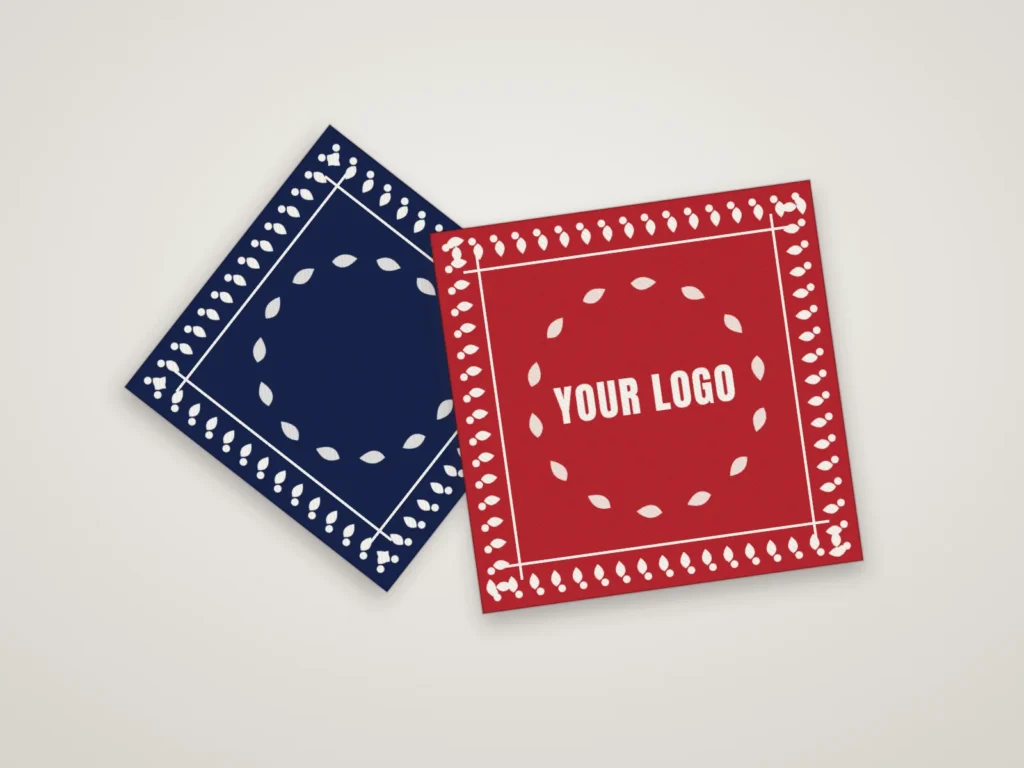
The most visible place is one corner, because a bandana folded into a triangle shows that corner at the front. All-over designs repeat the logo in the border or across the whole square.
Think about how the bandana will be worn. Folded as a neckerchief, the front corner shows; folded into a headband, a band across the middle shows; tied at the back of the head, one side of the triangle shows. In a classic paisley layout, the logo can sit in the border or in the centre medallion. The placement is confirmed with you on the sample.
Can you make bandanas for kids and pets?
Yes. Bandanas are made in any size to your specification, so kids’ and pet bandanas are simply cut smaller than the adult squares, or as triangles.
For children, the smallest standard size, 51 × 51 cm (20 in), is a common starting point. Pet bandanas are often cut as triangles so that they tie around the neck without folding; give us the sizes you need, for example small, medium and large. Tell us the market you sell in, so the fabric, size and labelling can be confirmed with the quote.
How are bandanas finished and packed?
Bandanas are finished with narrow hems or overlocked edges and packed folded, with a printed or woven label, a hang tag, a polybag and a barcode if you sell them in shops. Mr Balaclava’s name never appears on your products.
For gifts and merchandise packs, a belly band around the folded bandana carries your brand without a separate box.
What to send with your bandana request
- Size: 51, 56 or 69 cm, or your own measurements.
- Fabric: cotton, polyester twill or cotton voile.
- Artwork, colours and the printing method if you know it.
- Logo placement and any label or tag.
- Quantity per design, packing and the date you need the bandanas.
What is the minimum order and lead time for custom bandanas?
The minimum order is 50 pieces per design. Standard production lead time is approximately 14 days after sample approval, and the confirmed schedule is agreed for each order.
Before production you can order a pre-paid physical sample, made in about 5–7 days, or approve a free pre-production sample by photos, videos or a video call after the order and the 30 % advance payment. Express shipping by DHL, FedEx or UPS takes 3–6 working days.
Frequently asked questions
What fabric is a classic bandana made from?
Cotton, usually a light plain weave such as poplin or lawn. It is soft, absorbent and gets softer with washing.
Can you sublimate cotton bandanas?
No. Sublimation only works on polyester. For a full-colour design on cotton, choose digital printing; for a sublimated bandana, choose polyester twill.
Can you print a light design on a dark bandana?
Yes. Discharge printing removes the dye from dark cotton to print light designs with a soft feel; screen printing with light ink is the alternative.
Are bandana fabrics certified?
Fabrics from OEKO-TEX® certified mills are available on request; the certificate is the mill’s. Eco Jersey Limited, which powers Mr Balaclava, is ISO 9001 certified and a Sedex member.
See all styles in our bandanas catalog, compare bandana cotton in the Material Library, or send us your artwork for a quote.