The face opening is the first thing a buyer chooses and the first thing a wearer notices. It decides how much of the face is covered, how easily the wearer breathes and talks, whether goggles fog, and whether the balaclava sits flat under a helmet. This guide is for brands, shops, clubs and event companies planning a balaclava range, and it explains every common opening in plain terms.
Openings are one of several ways to sort balaclavas; construction, material, configuration and use are the others, and our complete guide to the different types of balaclavas covers them all. Here we stay with the face: one-hole, two-hole, three-hole, one eye opening plus a mouth, open face, the narrow ninja slit and openings made to your own sketch.
What are the main balaclava face openings?
There are four main openings: one-hole (one opening for the eyes), two-hole (two separate eye openings), three-hole (two eye openings and a mouth opening) and open face (the whole face left free). Variations such as a wide eye opening, a mesh-covered eye opening or a narrow ninja slit are built on these four.
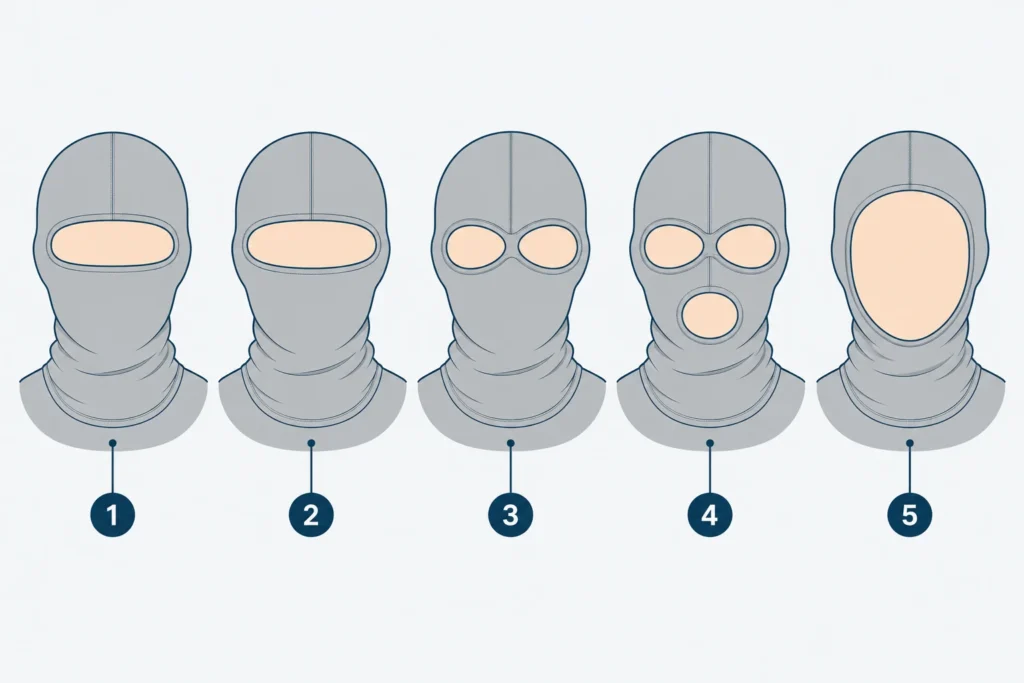
In our catalogue, of 169 balaclavas with a stated opening, about two-thirds are one-hole styles (standard, wide or mesh-covered), about a fifth are three-hole and about a tenth are two-hole. One style has a single eye opening plus a mouth opening. Every other opening is made to order.
What is a one-hole balaclava?
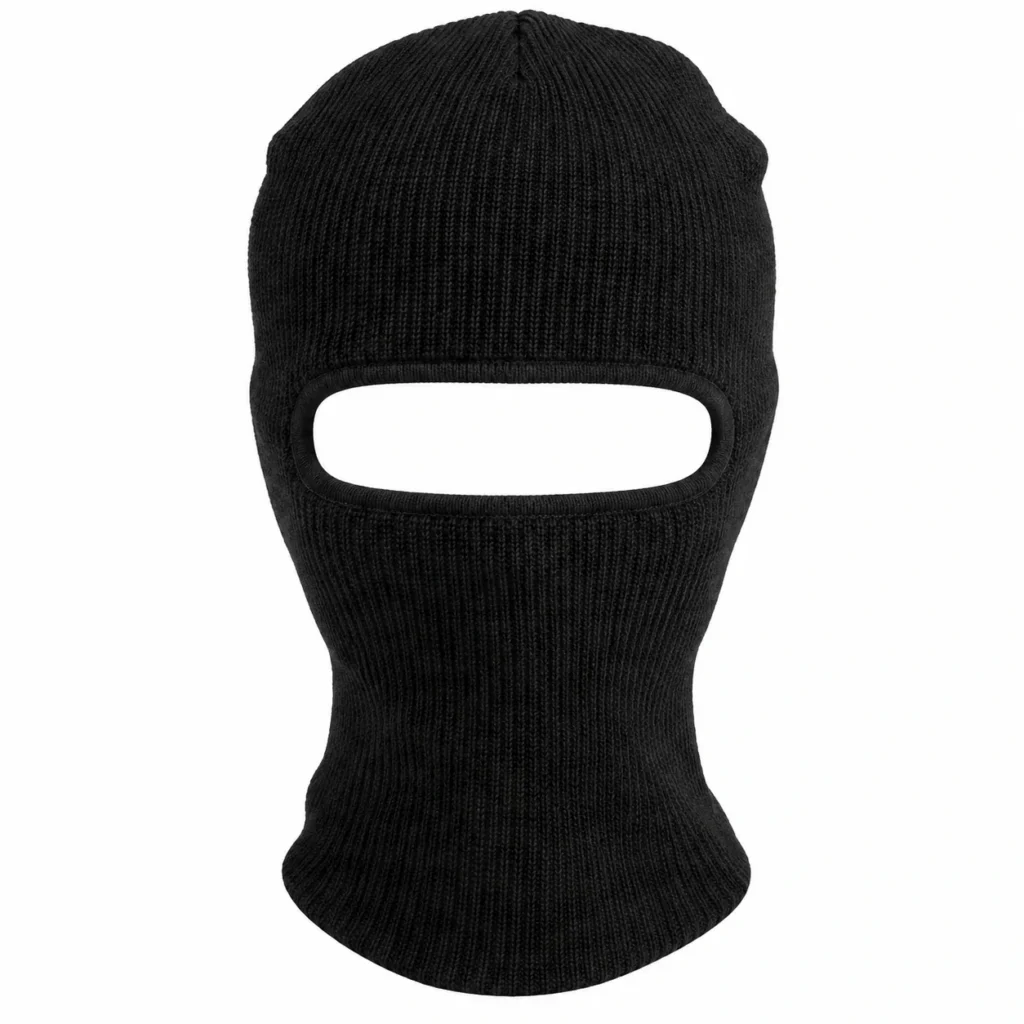
A one-hole balaclava covers the head, face and neck and leaves one horizontal opening for the eyes. It is what most people picture as a “ski mask” (see how the two names overlap), and our full face balaclava page shows how we build it.
The opening can be a standard eye opening that sits close around the eyes, or a wide eye opening that runs further towards the temples and leaves room for goggles or glasses. On one of our cut-and-sew sublimated patterns the wide eye opening measures about 17 × 5.5 cm; the exact size is set on your sample. The nose and mouth are covered, so the wearer breathes through the fabric.
Mesh-covered eye opening
A mesh eye style is a one-hole balaclava with a breathable mesh sewn over the eye opening, as on our sublimated “mesh eye” animal styles. The view through mesh tends to be a little less clear, so these usually suit costume, festival, fashion and promotional use rather than riding or skiing.

What is a two-hole balaclava?
On our site, a two-hole balaclava has two separate eye openings and no mouth opening. Be careful with the term: online it is used inconsistently, and some sellers use it for one eye opening plus a mouth opening, or even for a single eye opening.
Because the word means different things to different people, we confirm openings with a mockup and a sketch, not with the name alone. The strip of fabric over the nose bridge gives a more masked, graphic look; see our two-hole jacquard knit project for a US streetwear label.

What is a three-hole balaclava?
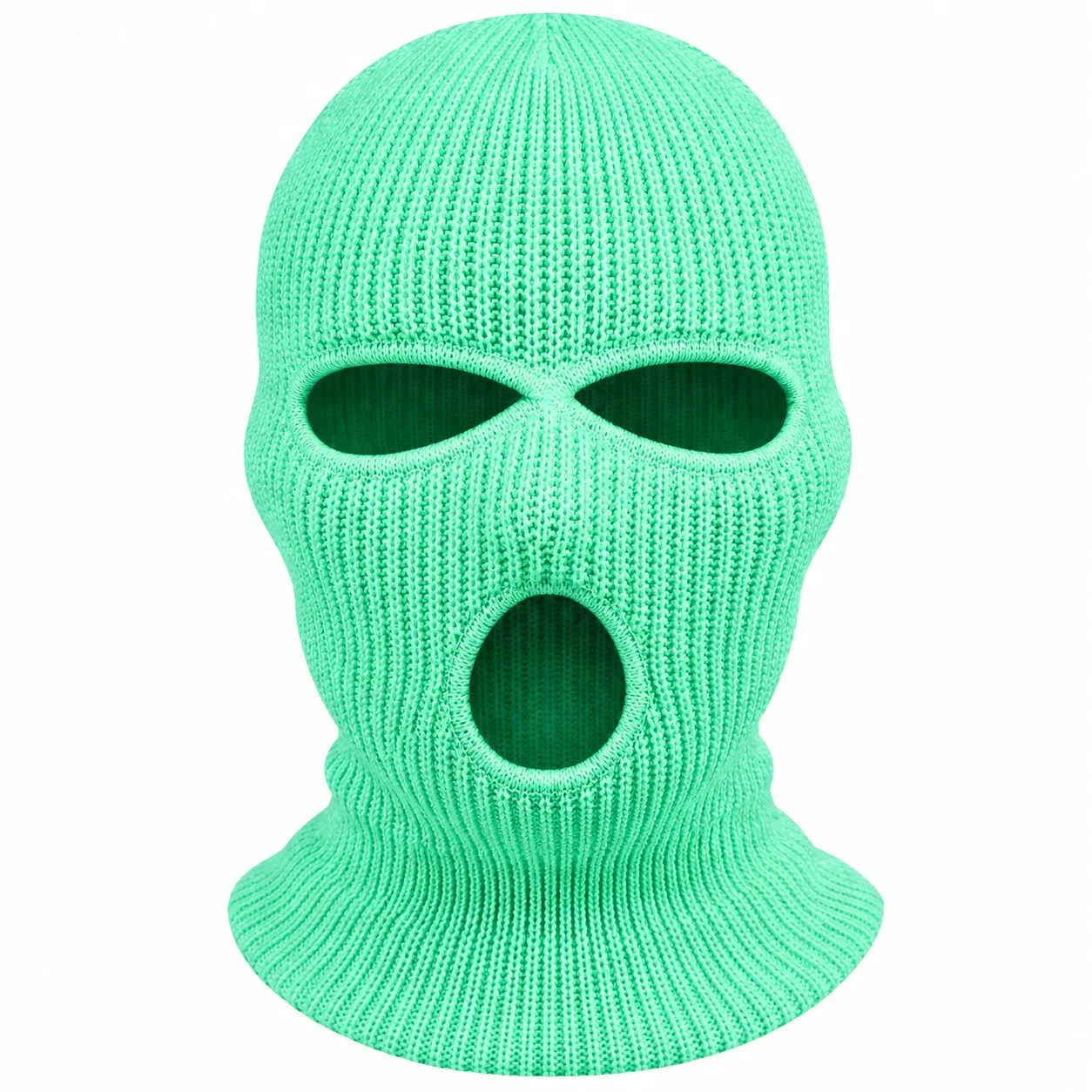
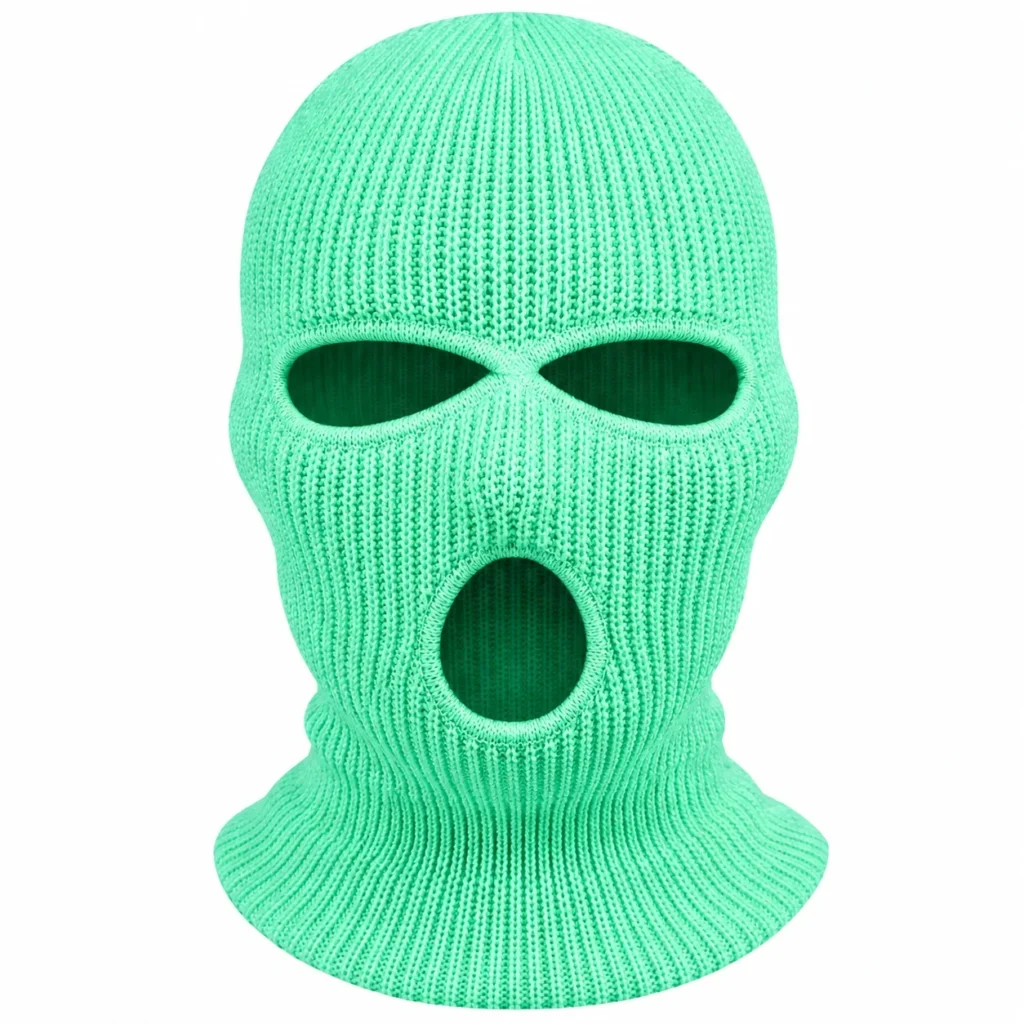
A three-hole balaclava has two eye openings and a mouth opening. It is the classic rib-knit look in streetwear and winter retail, and it is the easiest covered style to talk, drink and breathe in.
Most three-hole styles are knitted: our knitted balaclava page explains the yarns and stitches, and the knitted balaclava collection holds most of our three-hole designs. Printed stretch-jersey versions with a round mouth opening exist too. The trade-off is warmth: the open mouth lets cold air in, so three-hole styles tend to suit city wear and moderate cold. A custom three-hole knitted project shows a brand version.
Can a balaclava have one eye opening and a mouth opening?
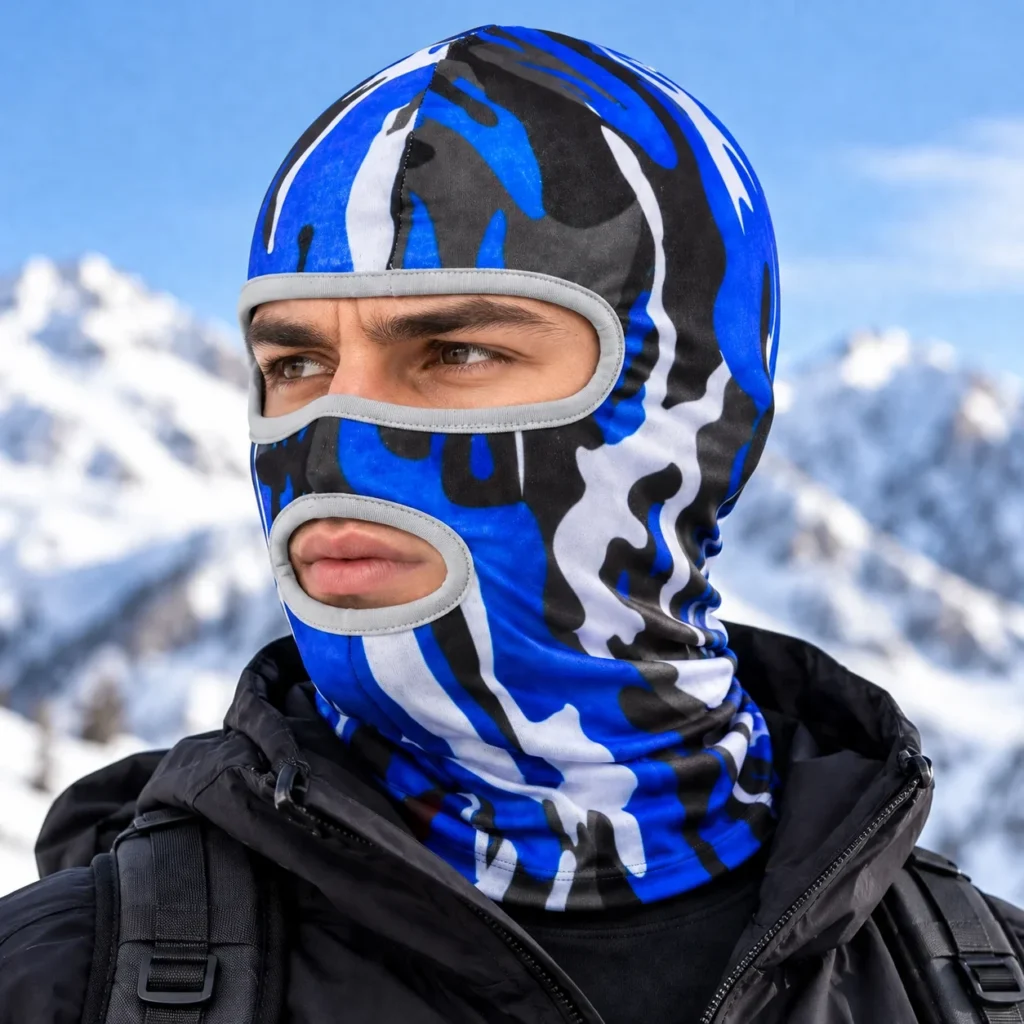
Yes. It keeps the wide view of a one-hole and adds a mouth opening; some people call it a two-hole.
In our catalogue it appears on a sublimated camo style. Buyers also ask for a four-hole version with a separate nose opening; that and other custom openings can be made to order from your sketch and checked on the sample.
What is an open face balaclava?
An open face balaclava covers the top of the head, the ears, the sides and the neck, and leaves the face free from forehead to chin. Because nothing sits over the nose and mouth, breath goes straight out, so it tends to fog goggles and glasses less than covered styles.
That makes open face the usual choice as a helmet liner, for cycling and for work under hard hats. Adult styles can have an adjustable drawstring around the face; for children’s styles, avoid cords and drawstrings at the hood and neck, because EU EN 14682 and US rules restrict them. See our open face balaclava page for fabrics and options; open face styles are made to your specification.
What about ninja slits and drop-down mouths?
A ninja-style balaclava has one narrow horizontal eye slit, often with a separate face panel that overlaps the hood for a wrapped look. A hinged or drop-down mouth panel lets the wearer uncover the mouth without taking the balaclava off.
The ninja slit is mostly a streetwear or low-profile style; our ninja-style balaclava page explains the constructions. Hinged panels, fold-down mouths and detachable face pieces are covered on the convertible balaclava page.
How do the openings compare?
In short: covered styles keep more of the face warm, open styles breathe and see better. The table compares each opening on the points buyers ask about most.
| Opening | What is covered | Breathing | Goggles and glasses | Under a helmet | Typical fabrics | Typical uses |
|---|---|---|---|---|---|---|
| One-hole | Head, face, nose, mouth and neck; eyes open | Through the fabric; mesh or perforated mouth zones help | Good with a wide opening and a snug nose area | Usually good when thin with flat seams | Acrylic knit, stretch jersey, fleece | Skiing, riding, streetwear, cold work |
| Wide one-hole | As one-hole, with more room at the temples | Through the fabric | Usually easier for goggle frames and glasses arms | Usually good | Stretch jersey, fleece, knit | Ski and snowboard, motorcycling |
| Mesh eye | Whole face, eyes behind mesh | Through the fabric | Not intended for goggles | Not intended for riding | Sublimated polyester with mesh | Costume, festival, fashion, promotion |
| Two-hole | As one-hole, plus a strip over the nose bridge | Through the fabric | Depends on the eye shape; check on the sample | Possible if thin | Acrylic rib knit, printed jersey | Streetwear, winter retail |
| Three-hole | Head and face; eyes and mouth open | Easy through the mouth opening | Often fogs less than a closed mouth | Openings can shift under a full-face helmet | Acrylic rib knit, printed jersey | Streetwear, winter retail, cold-weather sport |
| Open face | Head, ears and neck; face open | Free | Tends to fog least | The usual helmet-liner choice | Stretch jersey, fleece, merino, knit | Helmet liners, cycling, work, layering |
How is each opening made?
The opening is shaped differently in a knitted balaclava and a cut-and-sew balaclava, and the method affects how the edge looks and how well it keeps its shape. Our guide to knitted and cut-and-sew balaclavas explains both methods in full.
- Knitted openings: on a flat-knitted balaclava (knitted to shape on the machine, in-house in our Sialkot factory) the openings are formed in the knit and then finished, so the edge is knitted or bound rather than cut. Many of our knits have reinforced eye and mouth openings, which helps them hold their shape after repeated stretching.
- Cut-and-sew openings: on balaclavas cut from stretch jersey, fleece or mesh, the opening is cut from the pattern and the edge is bound with a strip of fabric or finished with elastic. Binding tends to give a clean, flat edge; elastic tends to grip more closely around goggles or the face.
- Mesh and vents: cut-and-sew construction also allows a mesh panel over the eye opening or mouth, laser-cut perforations or small breathing holes at the mouth.
Fabric matters too; our comparison of balaclava materials covers what each fabric is like to wear.
Which opening suits goggles and glasses?
For goggles and glasses, a wide one-hole or an open face usually works well. Fogging happens when warm breath escapes upwards through the eye opening, so the aim is to let it out forwards.
Three things tend to help: a snug fit over the nose bridge; a breathing zone at the mouth, such as a polyester mesh panel, a 3D spacer mesh insert or a perforated area; and an eye opening wide enough for the goggle frame to sit on the face, not on a fold of fabric. Our guide to ski balaclavas for goggles goes into goggle fit in more detail, and the breathable 3D mesh balaclava project shows a mesh construction we have produced.
None of these removes fogging completely. Glasses wearers also need room for the arms at the temples, so we check the eye opening with the frames or helmet types you name on the sample.

Which opening suits a motorcycle helmet?
Under a motorcycle helmet, riders usually want a thin one-hole or open face balaclava with flat seams. That matches what riders ask us for: thin, breathable fabric, flat or flatlock seams and no pressure points.
A single flat seam over the crown tends to sit more comfortably than several thick seams, and three-hole openings can shift as the helmet slides on. Our motorcycle and cycling balaclava page covers helmet fit for riders, the motorcycle balaclava fit guide explains sizing under a helmet, and the motorcycle balaclava collection shows current styles.
For riders, reflective details, such as a small reflective heat-transfer print or trim, can usually be added as an option and are confirmed with your quote. They do not replace proper high-visibility gear.
Does the opening change how the balaclava can be decorated?
Yes, a little: the opening decides where a logo can go. A one-hole style leaves the whole lower face free for a print or logo; a three-hole style leaves a smaller area around the mouth.
Common placements are the forehead, beside the eye, the chin and the back of the neck. Sublimation prints edge to edge on light polyester, as in our sublimated balaclava collection, while knitted styles take jacquard (a pattern knitted into the fabric), embroidery or patches. Our guide to balaclava logo and decoration methods compares them. We only print designs you own or are licensed to use.
How do you choose the right opening?
Choose the opening from the use first, then the look. The list below matches common uses to the opening that usually suits them.
- Skiing and snowboarding: wide one-hole or open face, with a breathing zone at the mouth if goggles are worn.
- Motorcycling and motorsport: thin one-hole or open face, flat seams, long neck to tuck into the jacket.
- Cycling and running: open face or one-hole in a thin, breathable fabric.
- Streetwear and fashion: three-hole or two-hole knits, or a one-hole in a printed or sublimated fabric.
- Cold outdoor work: one-hole with a long neck, or open face under a hard hat.
- Events, costume and promotion: mesh eye or one-hole sublimated styles with an all-over print.
If you are unsure, a one-hole is often the most versatile single style. For how to put each style on and wear it, see how to wear a balaclava.
Ordering a balaclava with your chosen opening
We make every opening to order: one-, two- and three-hole, eye plus mouth, open face, ninja, hinged and custom shapes. The minimum order is 50 pieces per design, and standard production takes approximately 14 days after sample approval.
What to send us
- The opening you want, with a sketch or reference photo, as names alone are often read differently.
- The use (helmet, goggles, glasses, streetwear) so we can set the eye width and fabric.
- Fabric or feel (knit, stretch jersey, fleece, mesh), colours and your logo with its placement.
- Sizes: Adult (head 54–61 cm), Kids (49–54 cm, about 4–12 years, with its own pattern), or your own size chart.
- Quantity per design and any labels or packaging.
You can approve the opening on a pre-paid physical sample (about 5–7 days) or on a free pre-production sample made after the order and the 30% advance payment; our guide to sample types explains both. Mr Balaclava’s name never appears on your products.
Frequently asked questions
Is a one-hole or three-hole balaclava better for skiing?
For skiing with goggles, a wide one-hole is usually the more practical choice, because it covers the nose and mouth from the wind and gives the goggle frame a clean edge to sit on. A three-hole lets breath out more easily but leaves the mouth exposed to cold air. Some skiers choose an open face under the helmet and a separate neck gaiter.
What does “2-hole balaclava” mean?
It depends on who uses it. We use it for two separate eye openings and no mouth opening; others use it for one eye opening plus a mouth opening. Always send a sketch or photo with your enquiry so the opening is confirmed on the mockup.
Can you make a four-hole balaclava with a nose opening?
Yes, custom openings such as a separate nose opening can be made to order. We draw the opening on the mockup, make it on the sample, and adjust the size and position before production.
Can I order the same design with different openings?
Yes. A different opening usually needs a different pattern, so each opening is normally counted as its own design for the 50-piece minimum. Your quote confirms how the quantities are split.
Browse all openings in our balaclava catalogue, see how we build them on the custom balaclava manufacturer page, or send us your opening and quantity for a quote.