This guide is for brands, shops, clubs and event companies that want their logo or artwork on a balaclava. It explains each decoration method we offer, which fabric it needs, what kind of design it suits, how it tends to wear, and where on the mask it can go. If you are still choosing the style itself, start with our guide to the different types of balaclavas.
The short version: the fabric comes first, the method second. A knitted acrylic balaclava and a polyester stretch-jersey balaclava take very different kinds of decoration, so a logo that works on one may not work on the other. The sections below show how to match the two, with examples from orders we have made in Sialkot, Pakistan.
Which decoration methods can you use on a balaclava?
We offer sublimation, screen printing, flat and 3D embroidery, patches (woven, rubber, silicone/PVC and leather), DTF and heat transfer, jacquard knit-in, woven and printed labels, hang tags and packaging.
Each method has a fabric it suits. Prints that bond with the fibre need polyester; stitched and knitted methods need a fabric with some body; surface prints need a fabric that does not stretch too far. Our balaclava materials comparison explains the fabrics themselves.
What is sublimation, and when does it suit a balaclava?
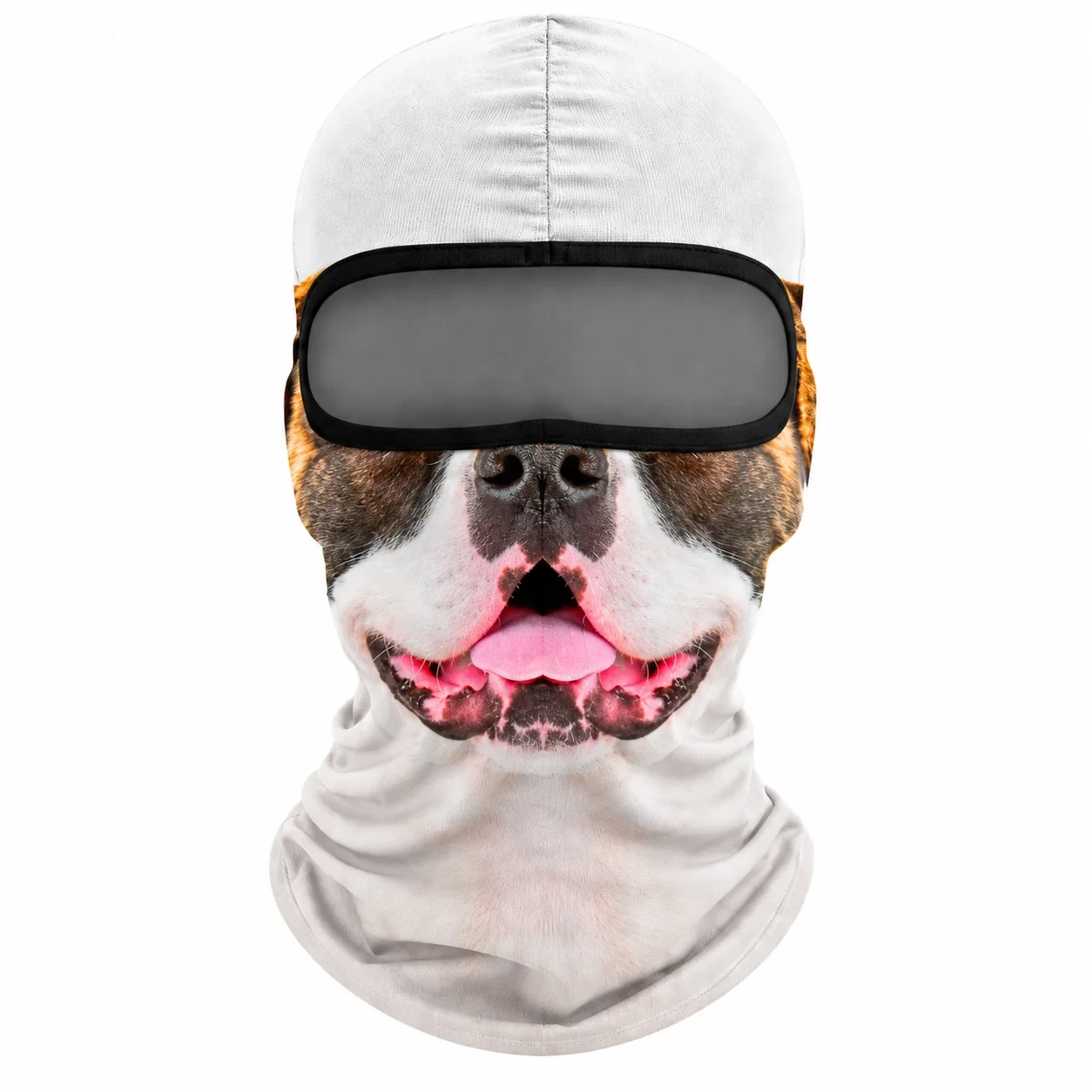
Sublimation turns dye into a gas with heat so it bonds with polyester fibres, and the print becomes part of the fabric. It suits photo-like artwork, gradients, camouflage and all-over designs on light polyester or polyester-elastane fabrics.
Because the dye goes into the fibre rather than sitting on top, a sublimated print is unlikely to crack or peel, and the fabric usually keeps its stretch and breathability. That is why it is the usual method for animal faces, scary and funny prints, team colours and camo. See our sublimated balaclavas for developed styles, or read the sublimation glossary entry for the process in one paragraph.
What are the limits of sublimation?
- Polyester only. It does not work on cotton, wool or acrylic. Our stretch jersey (88% polyester / 12% spandex) and polyester microfibre are typical bases.
- Light base only. The dye is see-through, so it cannot print a light colour on a black or dark fabric. Black areas are printed; a black blank cannot be sublimated.
- Stretch can show a lighter tone. Where the fabric stretches most, such as over the nose and cheeks, a little of the white base can show through. We place the artwork on the flat print template so the key details sit where the stretch is lower.
- Full coverage is panel by panel. On our sublimated model the artwork runs over the front and both side panels, while the back panel and crown are often left plain.

A real example: a sublimated animal face mask we made in Lycra for a US client, 5,000 pieces. Another is a sublimated yellow, black and grey camo balaclava in nylon Lycra with a wide eye opening and extended neck.
When does screen printing work on a balaclava?
Screen printing pushes ink through a mesh screen onto the fabric, one screen per colour. It suits bold logos and graphics in a few flat colours on cotton jersey and blends, and is less suited to very stretchy fabric.
The ink sits on the surface, so a screen print can feel slightly raised and can wear with stretching and washing over time, especially where the mask stretches most. It is often good value for one- or two-colour logos at larger quantities, because the screens are made once and reused. Our printed balaclavas in cotton jersey are the usual base.
On a stretch fabric it needs a test print first. We made a screen-printed fingerprint graphic in white on a black Dry Fit Lycra balaclava with an extended neck, 300 pieces for a UK client; the print and fabric were checked on the sample before production.

Flat or 3D embroidery: what suits a balaclava?
Embroidery stitches the logo into the fabric with thread. Flat embroidery suits small, clear logos up to about 12 cm on knits, fleece and cotton; 3D (puff) embroidery adds a raised logo and suits thicker fabrics such as knits and fleece.
Embroidery looks premium and tends to last well, which is why it is the method buyers ask for most. It is less suited to very fine text, thin lines and gradients, which the stitches cannot follow. Tonal logos, such as white on white or black on black, are a popular low-key look, and a raised 3D version of the same logo adds texture without adding colour.
Thin stretch jersey needs care. Dense embroidery on a thin fabric can pucker, so we add a backing (stabiliser) and keep the logo small, usually on the forehead or one side. On fleece the stitches sit on a topping film so they do not sink into the pile. One example is a wind-resistant embroidered streetwear balaclava in SHY stretch jersey, 1,000 pieces for a UK brand.

What is a jacquard knit-in logo?
Jacquard is a pattern knitted into the fabric: each colour is its own yarn, so the logo is part of the knit rather than printed on it. It suits knitted winter ranges, bold logos, stripes and simple graphic faces.
A knitted-in logo has no printed layer to peel and tends to wear with the balaclava itself. The detail is limited by the stitch, so small text and fine curves are simplified, and the number of colours in one row is limited. Jacquard needs a knit file made from your artwork and colour matching of the yarns on the sample. We make jacquard balaclavas with partner mills we work with closely; plain knits are knitted to shape in our own factory. Our guide to knitted and cut-and-sew balaclavas explains the difference.
For a US streetwear client we made a two-hole knitted jacquard balaclava in black acrylic rib with red graphics, 250 pieces. Knitted shapes such as cat ears or devil horns can be added too, as on our animal styles.

When do DTF and heat transfer make sense?
DTF (direct-to-film) and heat transfers print the design onto a film and press it onto the balaclava with heat. They suit small runs, multi-colour logos, fine detail on dark fabrics, and special finishes such as reflective or metallic.
A transfer sits on the surface, so it can feel firmer than the fabric around it and, over large areas, makes that spot less breathable. A printed or transfer layer can also wear with stretching and washing over time, so we keep transfers to logo size on stretch fabrics. On knits and wool the heat needs a test first. For an EU client we pressed a multi-colour heat-transfer graphic on an acrylic knit balaclava, 200 pieces; another project used DTF on a breathable Dry Fit Lycra balaclava with 3D mesh panels (100 pieces), with the print on the solid fabric rather than the mesh.
Can a balaclava have reflective details?
Yes. Reflective logos, stripes or trims are usually applied as heat transfers, often on motorcycle and winter styles. They add a visible detail in headlights at night, but they are a design feature; we make no visibility or safety claims for them. See our custom motorcycle balaclava guide for riding ranges.
Which patches and labels can go on a balaclava?
Patches are made separately and stitched or pressed on: woven, rubber, silicone/PVC and leather. They suit knitted, fleece and cotton balaclavas and give a clean, retail look without printing on the fabric.
- Woven patch: flat, fine detail, a classic look on knits.
- Rubber or silicone/PVC patch: raised and bold, suits sports, outdoor and streetwear ranges.
- Leather patch: suits knitted and fleece styles; not used on stretch jersey or mesh.
- Woven or printed label: a small brand tab at the neck hem or side, or the inside label with size and care details.
Patch looks can also be printed. For a UK/EU client we made a denim-patch print balaclava in Dry Fit Lycra, 700 pieces, where the patch effect is part of the print.
Decoration method by fabric: comparison table
The table shows which method usually suits which fabric. “Test” means it can work but we check it on a sample first; your quote confirms the method for your fabric.
| Method | Acrylic knit | Cotton jersey | Polyester stretch jersey | Fleece | Mesh | Suits | Limits |
|---|---|---|---|---|---|---|---|
| Sublimation | No | No | Yes | Test (polyester fleece) | Yes (test on some meshes) | Photos, gradients, camo, all-over prints | Polyester and light base only; lighter tone where stretched |
| Screen printing | No | Yes | Test | Test | Usually not | Bold logos in a few colours | One screen per colour; not for very stretchy fabric |
| Flat embroidery | Yes | Yes (backing on thin jersey) | Test, with stabiliser | Yes | Usually on the solid panel | Small logos up to about 12 cm | No very fine text or gradients |
| 3D embroidery | Yes | Test | Usually not | Yes | No | Raised and tonal logos | Needs a thicker fabric |
| DTF / heat transfer | Test | Yes | Yes | Test (low heat) | Usually on the solid panel | Small runs, multi-colour, reflective or metallic | Sits on the surface; less breathable over large areas |
| Jacquard knit-in | Yes | No | No | No | No | Knitted winter ranges, bold logos, stripes | Detail limited by the stitch; knit file and colour matching |
| Patches | Yes | Yes | Rubber or silicone, test | Yes | Usually not | Retail look, sports and streetwear | Leather not on stretch jersey or mesh |
| Woven / printed labels | Yes | Yes | Yes | Yes | Yes | Brand tab, size and care details | Placed on a seam or hem |
The fabric pages give the detail: our polyester/spandex stretch jersey takes sublimation and transfers, while acrylic rib knit takes embroidery, jacquard and patches but not sublimation or screen printing.
Where can a logo go on a balaclava?
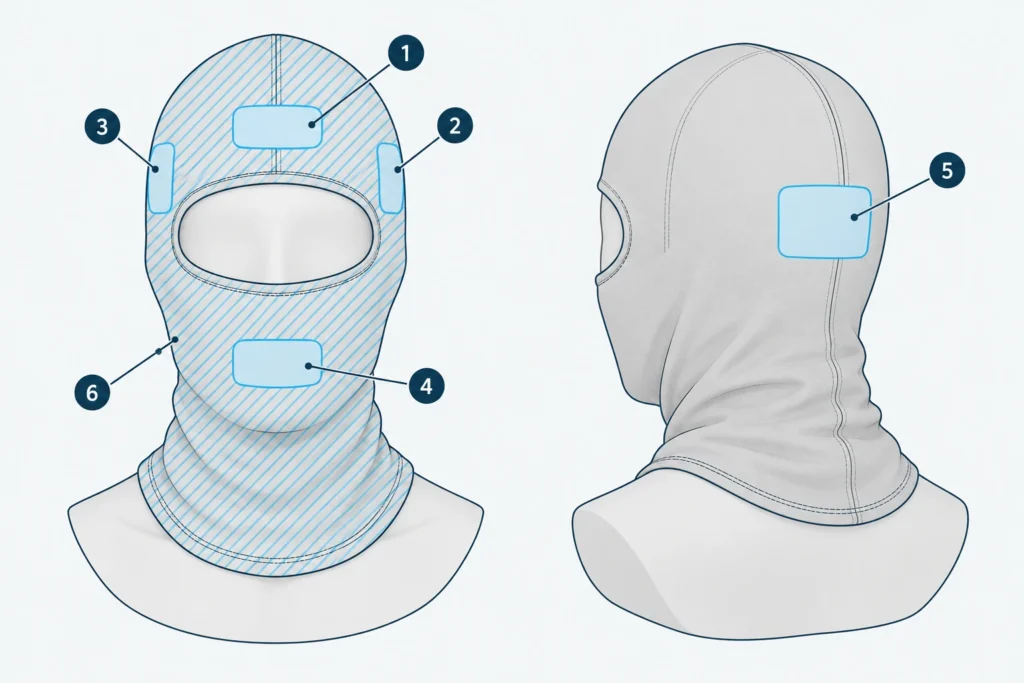
The usual logo placements are the forehead, the left or right side, the chin and mouth area, and the back of the head. Sublimation can also cover the front and side panels all over.
- Forehead: the most visible spot and the usual home of an embroidered or printed logo.
- Left or right side: a small logo near the eye opening or at the temple; buyers often choose this for a discreet look.
- Chin / mouth area: suits a print or small logo; on a three-hole style the mouth opening limits the space, see our guide to balaclava face openings.
- Back of head: a second logo or a web address, visible from behind.
- All-over (sublimation): artwork across the front and side panels; the back panel and crown are often plain.
What artwork do you need to send?
Send a vector file (AI, EPS, PDF or SVG) or an image at 300 dpi at the size it will be printed. We turn it into a real-size mockup on the balaclava before sampling, so you see the size and placement before anything is made.
You see your branding twice: first on the mockup, then on the physical or pre-production sample. Our help pages on artwork files and mockup approval cover the details.
Labels, hang tags, barcodes and packaging
Your brand can appear on every part of the finished product: inside label, care label, hang tag, size sticker, barcode and packaging. Mr Balaclava’s name never appears on your products.
Packaging options include a polybag, a branded bag, a header card and a retail box. Read more on labels, tags and packaging, or see how private label balaclavas are built from your own specification.
Can I buy blank balaclavas to decorate myself?
Yes. Our blank balaclavas are supplied without decoration for your own printing, embroidery or heat transfer. We can also decorate our own blanks for you, so the fabric and method are matched from the start.
If you plan to decorate them yourself, tell us the method first, so we can suggest a fabric and colour that suit it; a black polyester blank, for example, will not take sublimation. If you have another decoration plan in mind, talk to us before you order.
How to choose a decoration method
Start from the look you want and the fabric your range needs; the table below links common goals to the usual method.
| Your goal | Usual method | Typical fabric |
|---|---|---|
| Photo-like or all-over print (animal faces, camo, team colours) | Sublimation | Light polyester or polyester-elastane jersey |
| Premium or tonal logo | Flat or 3D embroidery | Acrylic knit, fleece, cotton |
| Knitted winter range with a built-in logo | Jacquard knit-in | Acrylic, wool-blend or merino knit |
| Small runs or multi-colour logos | DTF or heat transfer | Polyester jersey, cotton jersey |
| Budget promo run with a simple logo | Screen print or a printed transfer | Cotton jersey |
| Night-time detail on a riding or winter range | Reflective heat transfer | Polyester jersey, fleece |
| Retail look without printing on the fabric | Woven, rubber or leather patch | Knit, fleece, cotton |
Character and novelty ranges usually mix methods: a sublimated face plus 3D ears, or a jacquard face on a knit. Our animal balaclava page shows both routes, and our fashion balaclava page covers trims, patches and contrast stitching. For a camo range, see camouflage tactical balaclavas.

Ordering decorated balaclavas from Mr Balaclava
The minimum is 50 pieces per design, and each design or colourway counts as its own design. Standard production takes approximately 14 days after sample approval.
What to send with your brief
- The balaclava style, or a catalogue product to start from
- Your logo or artwork as a vector file or 300 dpi image
- The method you have in mind and where the logo goes
- Fabric and colours (Pantone references help)
- Labels, hang tags and packaging you need
- Quantity per design and delivery country
You can choose a pre-paid physical sample, made in about 5–7 days, or a free pre-production sample made after the order and approved by photos, videos or a video call. Start from a developed style through white label balaclavas, or bring your own design through our OEM and ODM service. For a riding range, our private label motorcycle balaclava guide goes through the steps.
Frequently asked questions
Can you sublimate a black balaclava?
No. Sublimation dye is see-through, so it needs a white or light polyester fabric. For a black look we print the black into the design on a light base, or use embroidery, screen printing or a transfer on black fabric.
Will a printed logo crack when the balaclava stretches?
A sublimated print is unlikely to crack because the dye is in the fibre. Screen prints and transfers sit on the surface and can wear with stretching and washing over time, so on stretch fabrics we usually keep them to logo size and check them on the sample.
Can you knit my logo into the balaclava instead of embroidering it?
Yes, as a jacquard knit-in logo on a knitted balaclava. We make a knit file from your artwork and match the yarn colours on the sample; very fine detail is simplified to suit the stitch.
Can I have a white-on-white or raised logo?
Yes. Tonal logos work well in flat or 3D embroidery, and a tonal jacquard is possible on knits. Raised 3D embroidery suits thicker knits and fleece; on thin stretch jersey we usually suggest flat embroidery.
Can I use two methods on one balaclava?
Yes. A common mix is a sublimated or knitted design with an embroidered logo, a woven label and a hang tag. Each extra method is priced in your quote, and the minimum stays 50 pieces per design. Our decoration methods overview lists every option.
Can you put a cartoon character or a sports logo on my order?
Only if the design is yours or you hold a licence for it. We only print designs you own or are licensed to use.
Ready to brand your range? Browse our knitted balaclavas and other catalogue styles, or send us your artwork for a quote.