
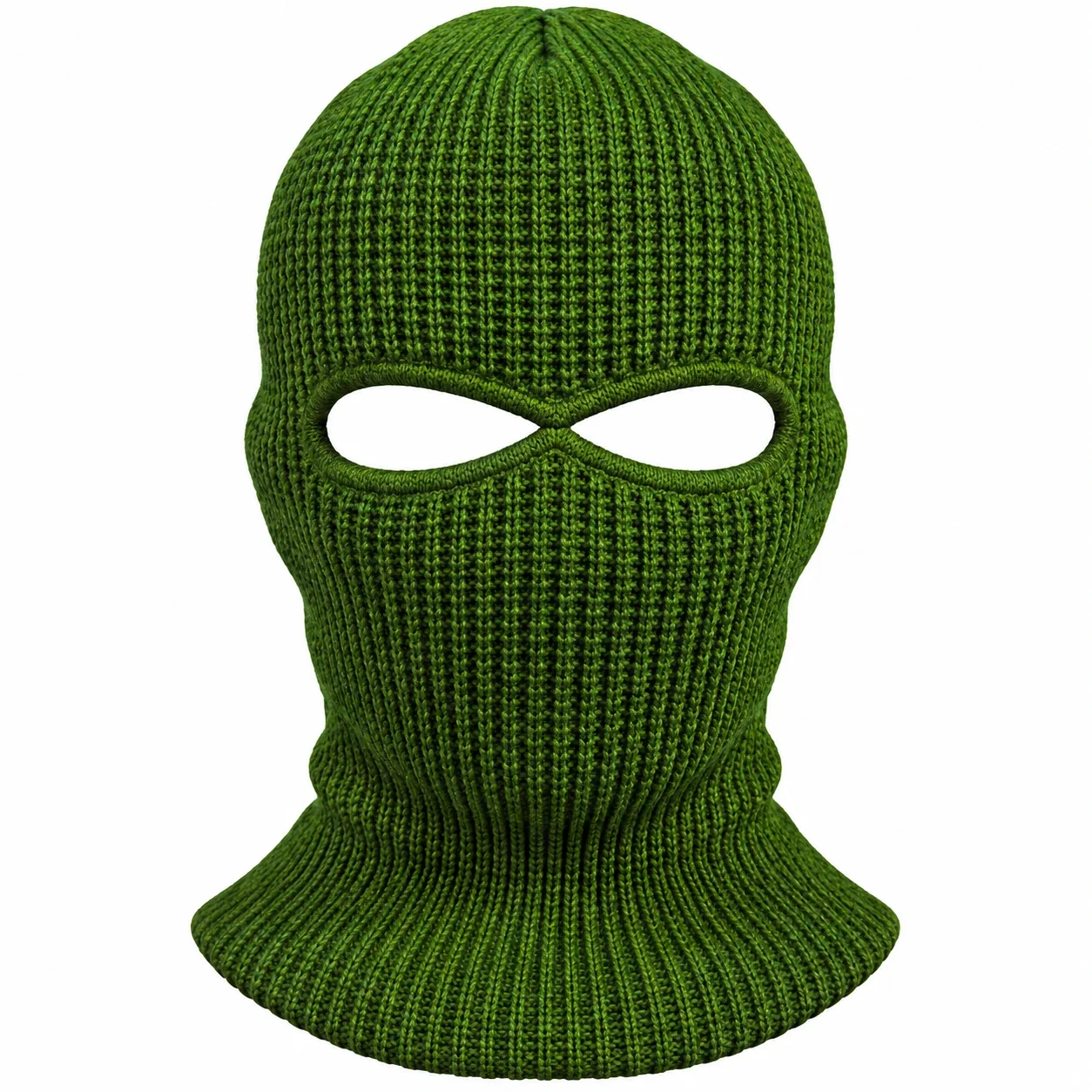
This guide is for brands, shops, clubs and event companies that want to know how a balaclava is made before they order. It explains the two production families, knitted and cut-and-sew, step by step, and how the method shapes fit, warmth, decoration and sampling.
If you are still choosing openings, fabrics and styles, start with our overview of the different types of balaclavas. Here we stay on the factory floor: what happens to the yarn or fabric, where the seams go, and why “seamless” rarely means what buyers expect.
What is the difference between a knitted and a cut-and-sew balaclava?
A knitted balaclava is made directly from yarn, usually knitted to shape on a machine. A cut-and-sew balaclava is made from finished fabric, such as stretch jersey or fleece, cut into pattern pieces and sewn together.
With a knit, the machine builds the fabric and the shape at the same time. With cut-and-sew, the fabric already exists and the shape comes from the pattern and the seams. You can usually tell them apart in seconds:
- Surface: a knit shows visible stitches or ribs; cut-and-sew jersey looks smooth, like a sports top, and fleece looks brushed.
- Seams: a knit often has just one short closing seam; cut-and-sew has several seams over the crown and down the sides.
- Openings: knitted openings are usually finished in the knit; cut-and-sew openings are usually bound or finished with elastic trim.
- Decoration: a logo knitted into the fabric points to a knit; a full-colour print running edge to edge points to cut-and-sew polyester.

How is a knitted balaclava made?
Most knitted balaclavas are knitted to shape on flatbed knitting machines, then closed with a small seam, finished at the openings, relaxed by washing or steaming and inspected. We do this flat knitting in-house in our factory in Sialkot, Pakistan.
A flatbed machine knits on two straight beds of needles, following a knitting programme. The programme can widen, narrow and leave openings as it knits, so the piece comes off the machine close to its final shape. This is called knitting “to shape” or fully fashioned knitting.
The knitted production steps
- Yarn: the yarn is chosen and the colour matched from a yarn palette or to a Pantone reference.
- Knitting to shape: the machine knits the body, openings and neck as one shaped piece, using the programme for that style and size.
- Linking: the piece is closed with a short seam. Linking joins the edges stitch by stitch, which tends to give a flatter, more flexible seam than ordinary sewing.
- Finishing the openings: eye and mouth openings are finished so they keep their shape; some styles have reinforced openings.
- Washing or steaming: the knit is relaxed so the stitches settle and the size stays consistent.
- Inspection: pieces are checked for size, dropped stitches, openings and the seam, then labelled and packed.

Hand knitting follows the same idea with needles; our guide on how to knit a balaclava by hand shows the home version. A machine knit differs mainly in speed and in how consistently it repeats across a whole order.
Which knit stitches are used for balaclavas?
Rib is the classic balaclava stitch because it stretches and recovers well around the head. Jersey, cable and waffle stitches are used when you want a smoother or more textured look.
| Stitch | What it looks like | How it usually behaves |
|---|---|---|
| Rib 1×1 | Fine vertical lines, one knit and one purl stitch | Close fit, good stretch and recovery; the classic ski-mask look |
| Rib 2×2 | Wider ribs, two knit and two purl stitches | Chunkier, more relaxed rib; common for streetwear |
| Jersey | Smooth face with small “V” stitches | Shows embroidery and jacquard detail clearly; less stretch than rib |
| Cable | Twisted rope-like columns | Heavier, decorative, more of a fashion piece |
| Waffle | Small square grid texture | Textured and airy; a visual alternative to rib |
Our acrylic rib knit is the default for knitted styles: soft, springy and good at holding strong colours. In the Order Builder, knitted templates offer Acrylic Rib Knit (default), Acrylic/Wool Blend and Merino & Wool knit; other yarns are possible on request. Our comparison of balaclava materials goes deeper into how each fibre feels and wears.
What does “seamless” mean for a knitted balaclava?
In most cases “seamless” means a seamless top: the crown is shaped in the knit, so no seam runs across the top of the head. A short closing seam usually still exists somewhere on the piece.
Many buyers read “seamless” as “no seam at all”, which is rarely the case for a flat-knitted balaclava. The edges still have to be joined once, and that short linked seam is usually placed where it is least noticeable and tends to lie fairly flat.
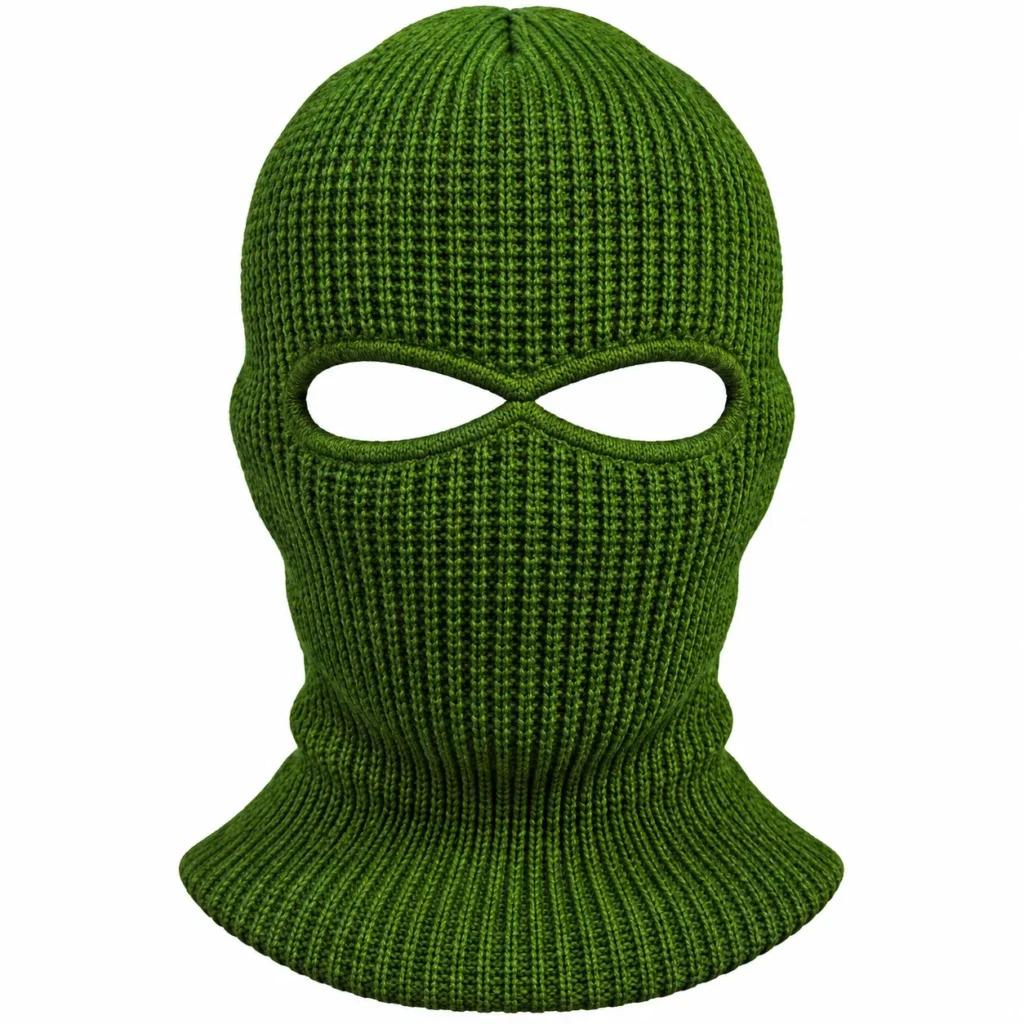
Garments with no seam at all need specialised whole-garment knitting machines, a different route from our standard flat knitting. If your brief needs no seam anywhere, say so and we confirm with your quote what is possible.
What are jacquard and circular knitting?
Jacquard is a pattern or logo knitted into the fabric using two or more yarn colours. Circular knitting makes the fabric as a continuous tube. We produce both with partner mills we work with closely.
In a jacquard knit, the machine switches yarn colours stitch by stitch, so the logo is part of the fabric. The design is first turned into a knit file, a stitch-by-stitch colour map. Detail is limited by the stitch size, so bold shapes, lettering and stripes usually work better than thin lines or gradients. See our two-hole knitted jacquard project in black rib with red graphics, or this three-hole knitted balaclava with a jacquard design.

Circular machines knit round and round, producing a tube. That suits neck gaiters and some balaclava bodies, which are then finished at the crown and the openings. You order it through us like any other style, and we stay your single point of contact.
How is a cut-and-sew balaclava made?
A cut-and-sew balaclava is cut from finished fabric into pattern pieces, printed if needed, sewn with flat or stretch seams, then finished at the openings and hem and inspected. We do cut-and-sew in-house in our Sialkot factory.
Our most-used base is polyester/spandex stretch jersey, a smooth four-way stretch fabric. Fleece such as polar fleece suits warmer styles, mesh suits breathing panels, and polyester microfibre is also common.
The cut-and-sew production steps
- Fabric: chosen for the use and the decoration; sublimation needs a light polyester-rich fabric, so the print often decides the fabric.
- Pattern pieces: a typical model on our product sheets has four panels (front, left, back, right), an eye-opening trim and a neck hem; other styles add mesh inserts or a longer neck.
- Cutting: panels are cut with the stretch direction placed where the head needs it.
- Printing before sewing: sublimated panels are printed before sewing, so the print can run across the face and both sides.
- Sewing: the panels are joined with flatlock seams or four-thread overlock seams, depending on the style and how it will be worn.
- Openings and hem: the eye opening is bound or finished with elastic trim, and the neck is hemmed or bound.
- Inspection: size, seams, stretch, print alignment and openings are checked.


Why do flatlock seams matter under a helmet?
A flatlock seam joins two edges flat, so there is almost no ridge on the inside. Under a tight helmet that tends to mean fewer pressure points than a raised seam.
A four-thread overlock seam joins and finishes the edges in one step and stretches well, but leaves a small ridge inside. In a loose winter balaclava that rarely matters; under a full-face motorcycle, ski or karting helmet it can press into the head over a long ride, so helmet liners usually get flatlock seams and a thin crown. Our guide to motorcycle balaclava fit explains the other details riders notice, and our motorcycle and cycling balaclava page shows how we build them.

How does the method affect stretch, warmth and breathability?
Knits usually feel soft and springy; stretch jersey usually stretches in all directions and fits closer to the face. Warmth depends more on the yarn or fabric than on the method.
- Stretch: a rib knit opens and closes like an accordion, helping one size fit many heads; stretch jersey with spandex tends to hug the face more closely.
- Warmth: a thick acrylic or wool knit holds air in its loops and usually feels warm for everyday winter wear; fleece is often warmer for its thickness; thin jersey suits layering or milder days.
- Breathability: a knit breathes through its stitches; cut-and-sew styles can add polyester mesh at the mouth or sides.
- Wind: neither a plain knit nor plain jersey stops much wind; for extreme cold, a layered or fleece build with a wind-resistant outer usually helps more than a thicker knit.

Which decoration works with each method?
Knits take decoration that is knitted in or attached: jacquard, embroidery and patches. Cut-and-sew polyester takes print: sublimation, screen printing and DTF, as well as embroidery with a stabiliser.
| Decoration | Knitted (acrylic, wool, merino) | Cut-and-sew (polyester stretch jersey) |
|---|---|---|
| Jacquard (knitted-in logo) | Yes, with a partner mill; bold designs suit it | Not possible |
| Embroidery (flat or 3D) | Yes, a common choice | Yes, with a stabiliser behind the stitches |
| Patches (woven, rubber, silicone, leather) | Yes | Woven and printed; rubber and silicone after a test; leather is not suitable |
| Sublimation (all-over print) | No, it needs polyester | Yes, on a light polyester base, printed before sewing |
| Screen printing | Not suitable on a knit surface | Possible after a stretch test |
| DTF / heat transfer | Only after a test on the sample | Yes; the print must stretch with the fabric |
| Woven or printed labels | Yes | Yes |
Our decoration methods table and the guide to balaclava logo and decoration methods go into more detail. One combined build is this breathable full-face balaclava in stretch Lycra with 3D mesh and DTF printing. We only print designs you own or are licensed to use.
Knitted vs cut-and-sew balaclavas at a glance
The main practical differences, in one table.
| Point | Knitted | Cut-and-sew |
|---|---|---|
| How the shape is made | Knitted to shape on a flatbed machine (in-house); jacquard and circular with partner mills | Pattern pieces cut and sewn (in-house) |
| Typical seams | One short linked seam; often a seamless top | Several seams, flatlock or four-thread overlock |
| Typical materials | Acrylic, acrylic/wool blends, merino and wool, cotton | Stretch jersey, fleece, mesh, microfibre |
| Fit | Soft, springy rib stretch | Close fit with four-way stretch |
| Decoration | Jacquard, embroidery, patches, labels | Sublimation, screen print, DTF, embroidery, labels |
| Under a helmet | Usually too thick for a tight helmet | Thin jersey with flatlock seams usually suits it |
| Minimum order and production | 50 pieces per design; approximately 14 days after sample approval | The same |
How do sizes work for each method?
Both methods are made in two sizes, Adult and Kids, each with its own pattern. The base size is approved on the sample first, then graded to the other size.
Adult fits a head circumference of 54–61 cm; Kids fits 49–54 cm, for children of about 4 to 12 years. In a knit, grading means adjusting the knitting programme; in cut-and-sew, grading the pattern. We can also grade to your own size chart. Children’s styles should avoid cords and drawstrings at the hood and neck, which EU EN 14682 and US rules restrict.
How to choose between knitted and cut-and-sew
Choose by how the balaclava will be worn and how you want to brand it: winter retail and streetwear lean towards knits; helmet, sport and all-over prints lean towards cut-and-sew.
| Use or goal | Usually suits | Why |
|---|---|---|
| Streetwear and fashion ski masks | Knitted rib, often three-hole or one-hole | The classic knit look, jacquard or embroidered logos |
| Winter retail and everyday warmth | Knitted acrylic, acrylic/wool or merino | Soft, warm and familiar to shoppers |
| Motorcycle, karting and helmet liners | Cut-and-sew stretch jersey with flatlock seams | Thin crown and flat seams under the helmet |
| Ski and snowboard | Cut-and-sew jersey or fleece; knits for off-slope | Fits under helmets and goggles |
| All-over prints, camo, character faces | Cut-and-sew polyester, sublimated | Full colour from edge to edge |
| Extreme cold | Layered or fleece cut-and-sew, wind-resistant outer | Layers tend to help more than a thicker knit |
| Print shops and decorators | Blank styles in either method | Decorated by you after delivery |
For knits, see our knitted balaclava manufacturing page, browse knitted balaclavas, or read our 100% cotton balaclava page. For print, browse sublimated balaclavas; to decorate yourself, our blank balaclavas. Openings are a separate choice, covered in our guide to one-, two- and three-hole openings.
Ordering a knitted or cut-and-sew balaclava from Mr Balaclava
Both methods start at 50 pieces per design, with standard production of approximately 14 days after sample approval and capacity of around 100,000 pieces a month.
What to send with your brief
- The method you prefer (knitted or cut-and-sew), or the use, and we suggest one
- The opening style and any extras: mesh panels, longer neck, reinforced openings
- Yarn or fabric, and colours as Pantone references
- Your logo or artwork as a vector file, with the placement you want
- Quantities per design and size (Adult, Kids or your own size chart)
- Labels, hang tags and packaging
Choose a pre-paid physical sample, made in about 5–7 days, or a free pre-production sample made after the order and the 30% advance payment and approved by photos, videos or a video call; our guide to sample types explains both. A jacquard sample also needs the knit file and colour matching, so approve the colours on the sample. If you bring your own tech pack, or want us to develop the style from a brief, see our OEM and ODM balaclava services.
Frequently asked questions
Are knitted balaclavas really seamless?
Usually they have a seamless top and one short linked seam where the piece is closed. A balaclava with no seam at all needs whole-garment knitting, which we confirm case by case.
Which is better under a motorcycle helmet, knitted or cut-and-sew?
For a tight full-face helmet, a thin cut-and-sew stretch jersey with flatlock seams usually works better, because it adds little bulk and has almost no seam ridge. A thick rib knit tends to suit open helmets or wear without a helmet.
Can I put a full-colour print on a knitted balaclava?
Not by sublimation, which needs a light polyester fabric. On a knit, a pattern is usually knitted in as jacquard, or the logo is embroidered or added as a patch. Heat transfer on a knit is possible only after a test on the sample.
Is a thick knit warmer than a fleece balaclava?
Not necessarily. A thick knit feels warm in still air, but wind passes through the stitches; for extreme cold, fleece or a layered build with a wind-resistant outer is often more practical.
Ready to compare both methods on your own design? Browse our full face balaclava options, and when your brief is ready, ask for a quote and we will suggest the method, fabric and sample route that fits it.