This guide is for brands, shops, clubs and event companies choosing the material for a balaclava range. It compares the yarns and fabrics we work with, explains what each one is good at, and shows which logo methods and care instructions go with it.
Material is one of several ways to classify a balaclava, next to the face opening, the construction and the use; our pillar guide to the different types of balaclavas covers all of them. Here we stay with the material question, because it decides warmth, breathability, stretch, price and how your logo can be applied.
What are balaclavas made of?
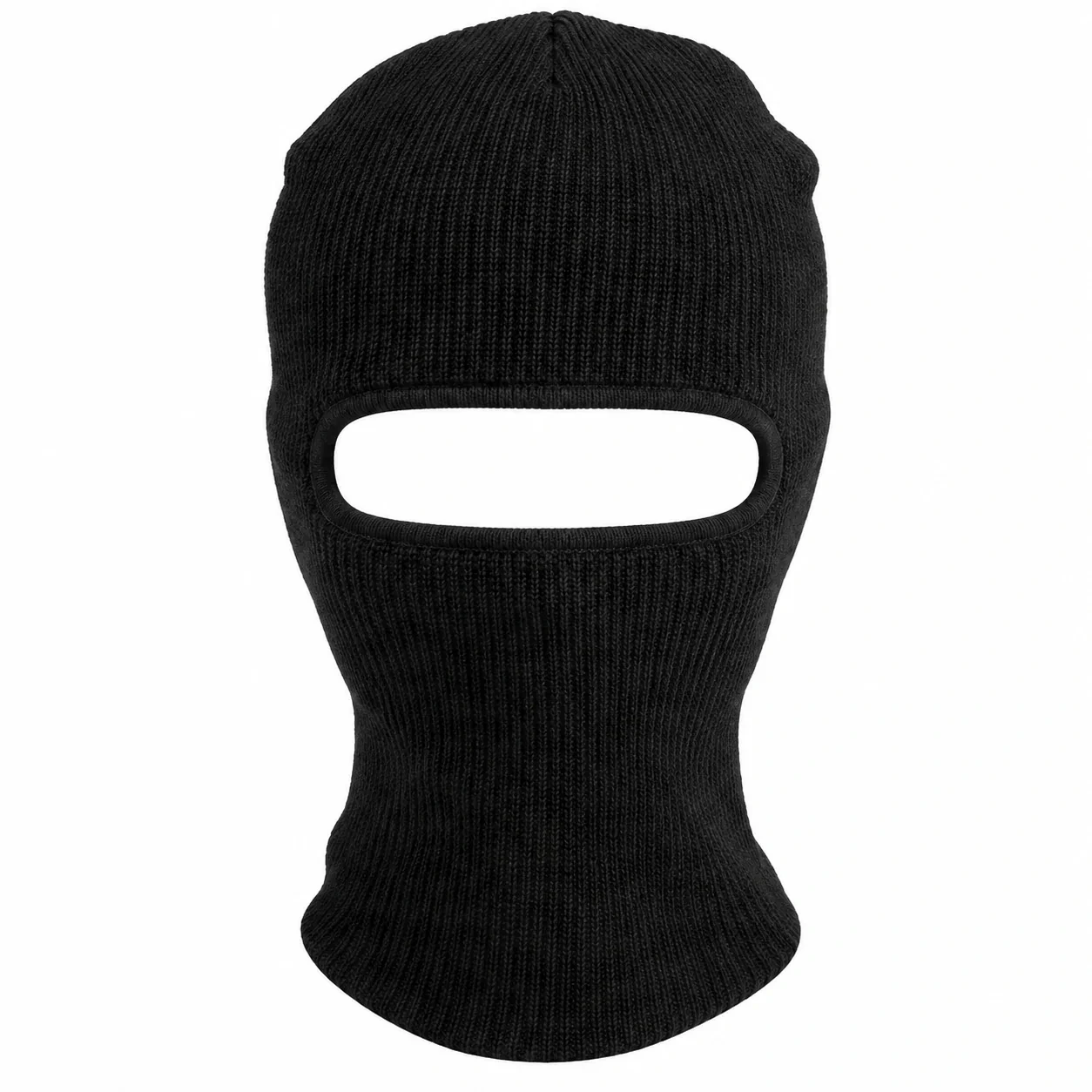
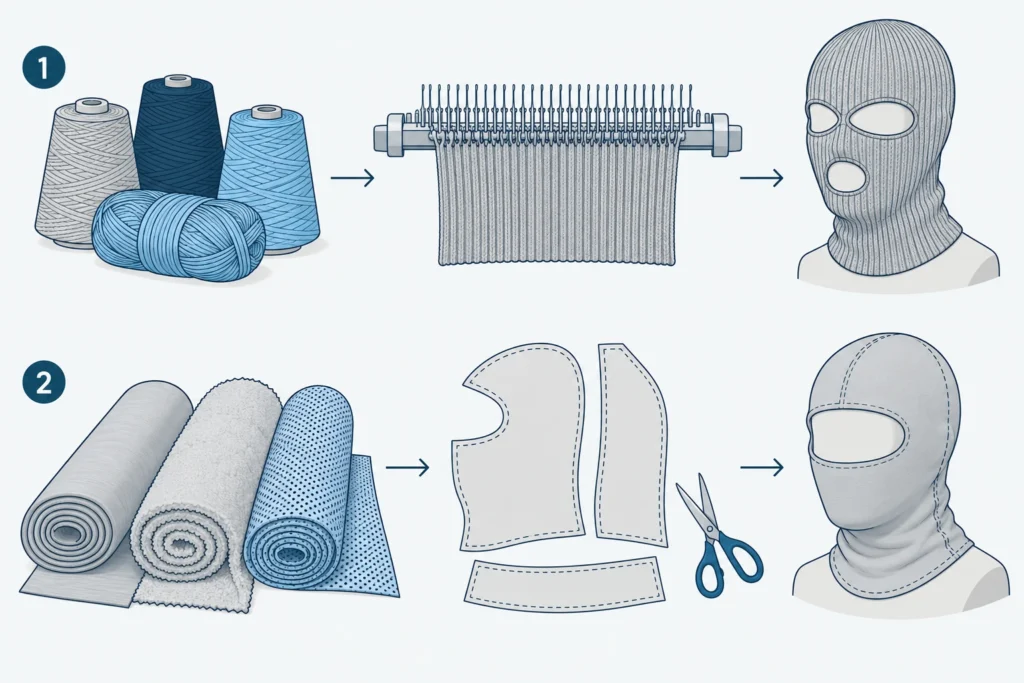
Balaclavas are made either from yarn that is knitted to shape, or from knitted fabric that is cut and sewn. Acrylic, wool, merino and cotton are the usual yarns; polyester/spandex jersey, fleece and mesh are the usual fabrics.
The two groups are often listed together, which is confusing: a merino yarn and a merino jersey fabric behave differently, and they are made on different machines. If you are not sure which construction suits your design, read how knitted and cut-and-sew balaclavas are made first. In this guide we keep the two groups apart.
Which yarns are used for knitted balaclavas?
Most knitted balaclavas are made from acrylic, with wool, merino and cotton as the main alternatives. Luxury fibres, chenille and recycled or bamboo yarns are made on request.
Acrylic
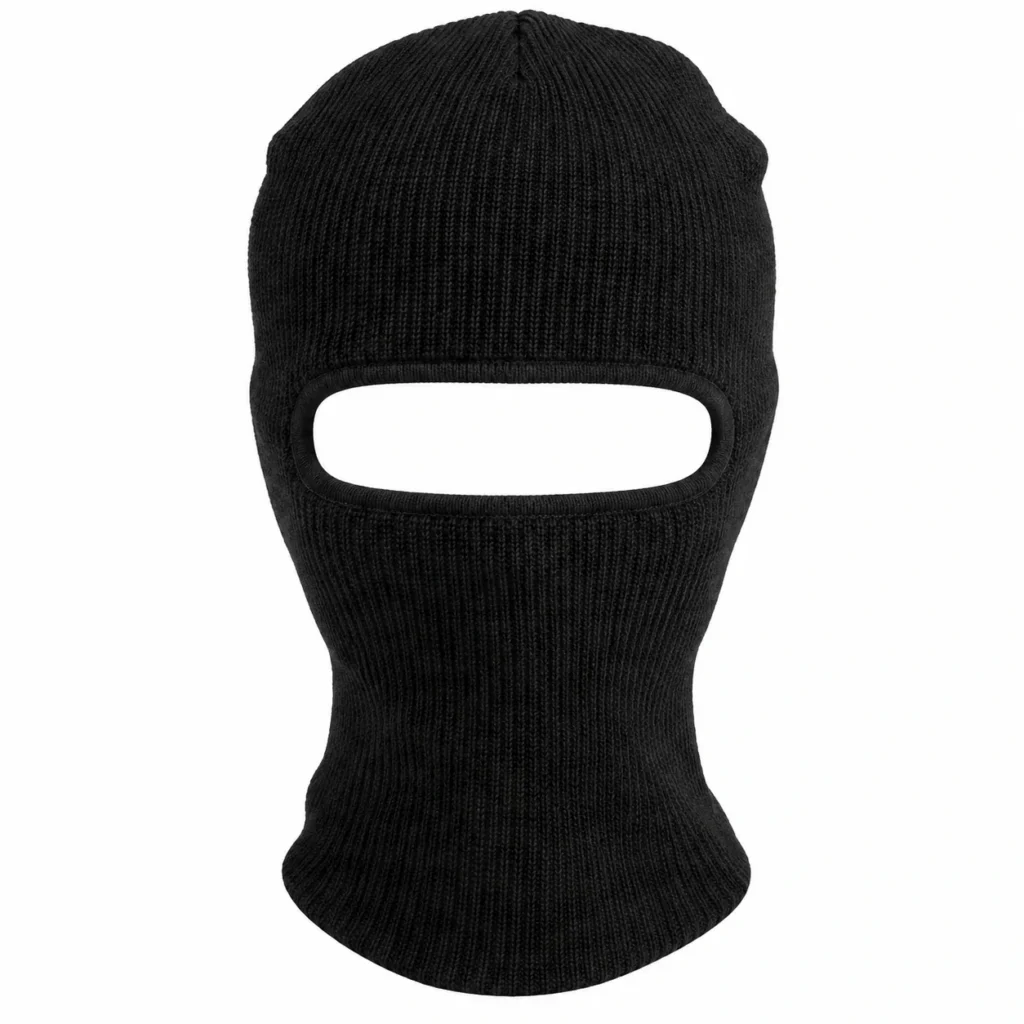
Acrylic yarn is usually 100% acrylic. It is light, soft and wool-like, it holds bright colours well, and it is the value option for streetwear, promotional and retail ranges. It can pill with friction; an anti-pilling acrylic is a common upgrade. Acrylic/wool blends add some wool crispness and warmth, and the wool share sets the price.
Merino and wool
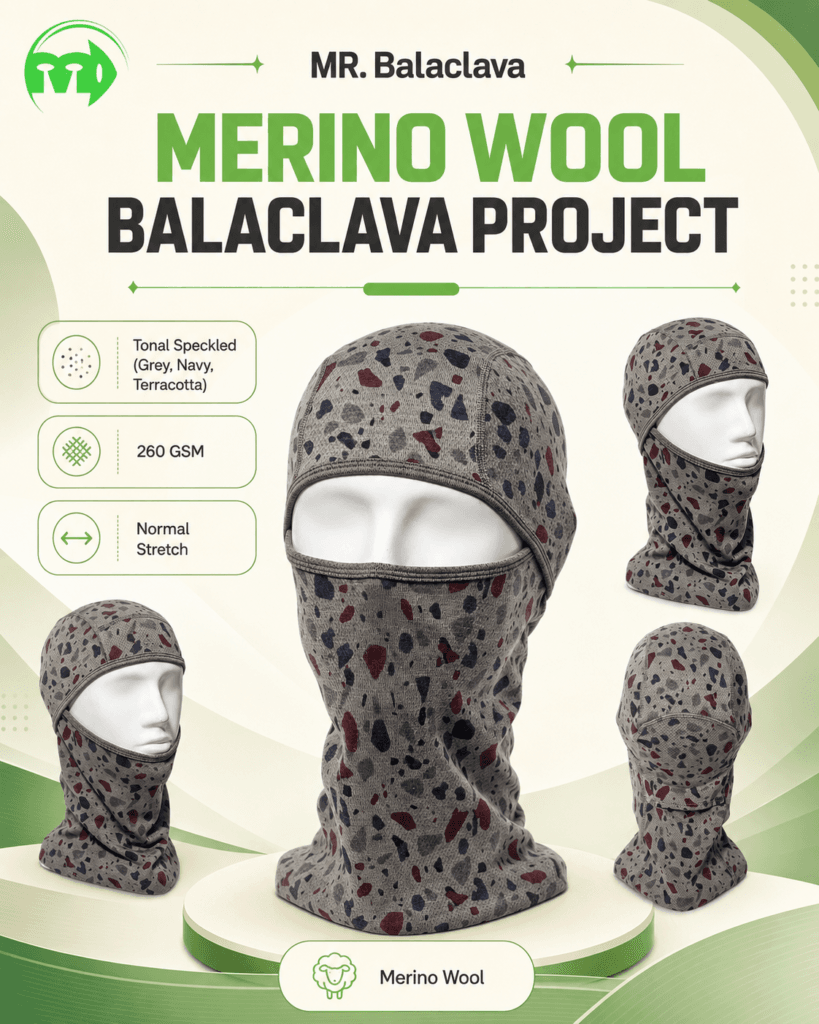
Wool and merino are warm and handle moisture well, so they suit ski, outdoor and premium ranges. They are usually the priciest yarn option for a knitted balaclava. Wool blend yarn, with acrylic or nylon, tends to be easier to care for than pure wool. You can see a finished example in our merino wool balaclava project.
Cotton
Cotton is soft and breathable and feels gentle on the face. It is less warm than wool or fleece and dries more slowly, so it suits everyday wear, mild weather and sensitive skin rather than high-exertion winter sport. Some cotton yarns add a little elastane for stretch.

Cashmere, alpaca and mohair
These are luxury yarns for designer collections, made on request and often blended with wool or nylon. They feel very soft and warm, but a fluffy halo, typical of alpaca and mohair, blurs fine detail, so a knitted-in design, a woven label or a patch tends to work better than embroidery.
Chenille
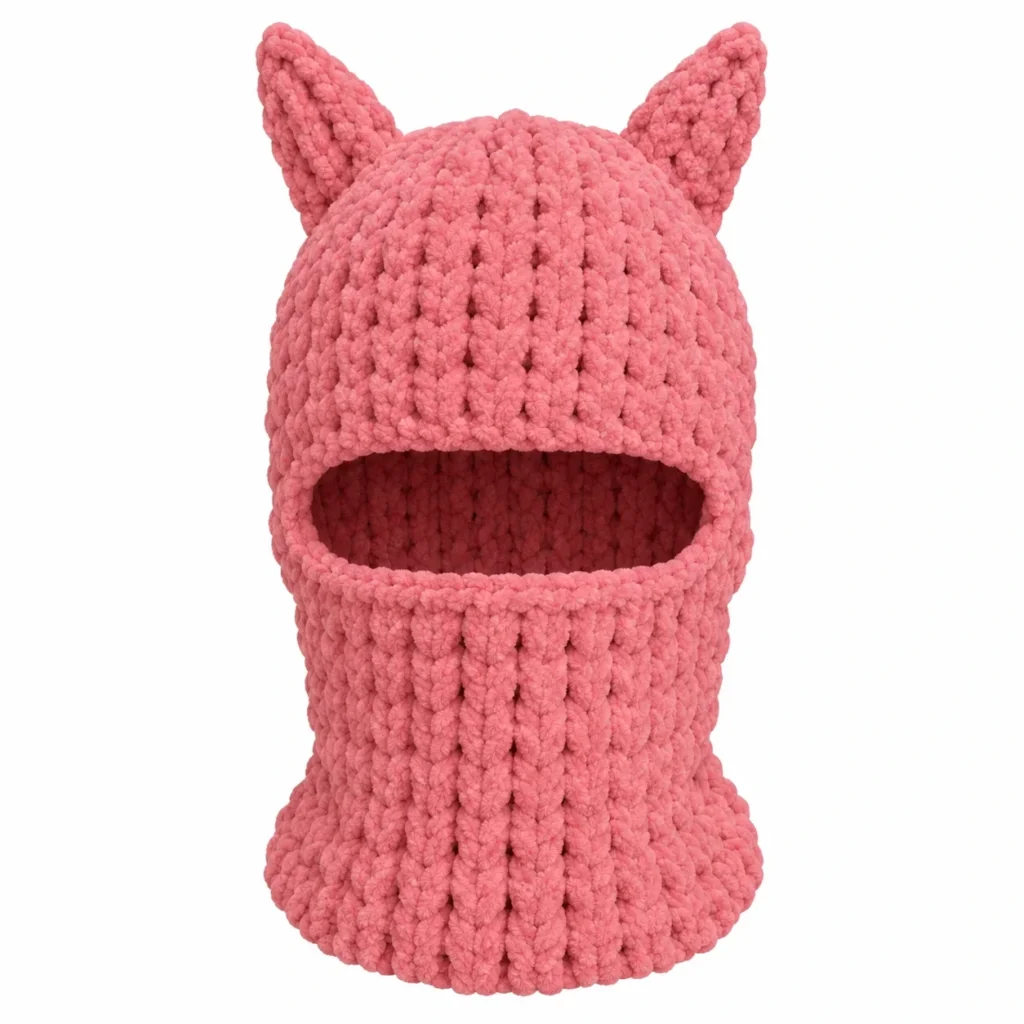
Chenille is a velvety, plush yarn, usually acrylic or polyester. It knits into the chunky, very soft look of novelty styles with cat or bear ears. The plush pile hides detail, so branding usually goes on a woven label or a leather-style patch.
Recycled and bamboo yarns
Recycled polyester and recycled wool yarn are available on request; the recycled share varies by spinner and is confirmed with your quote. Bamboo yarn is usually viscose made from bamboo: very soft and cool to the touch, but low in warmth.
Which fabrics are used for cut-and-sew balaclavas?
Our main sewn fabric is a polyester/spandex stretch jersey, followed by polyester microfibre, fleeces and meshes. Softshell, stretch velvet, merino jersey and cotton jersey are used for specific ranges.
Polyester/spandex stretch jersey
This is the smooth, four-way-stretch fabric of most printed and sublimated balaclavas. Our SHY Series stretch jersey is 88% polyester / 12% spandex. It wicks moisture, dries quickly and fits closely, which suits sport, riding and all-over prints. Buyers sometimes ask for nylon/spandex instead; it can usually be sourced on request and is confirmed with your quote.

Polyester microfibre, jersey and interlock
Microfibre knit is lightweight, smooth and fluid, a common choice for thin helmet liners and printed styles. Plain polyester jersey is light and cool to the touch; polyester interlock is a stable midweight double knit. All three take sublimation.
Fleece
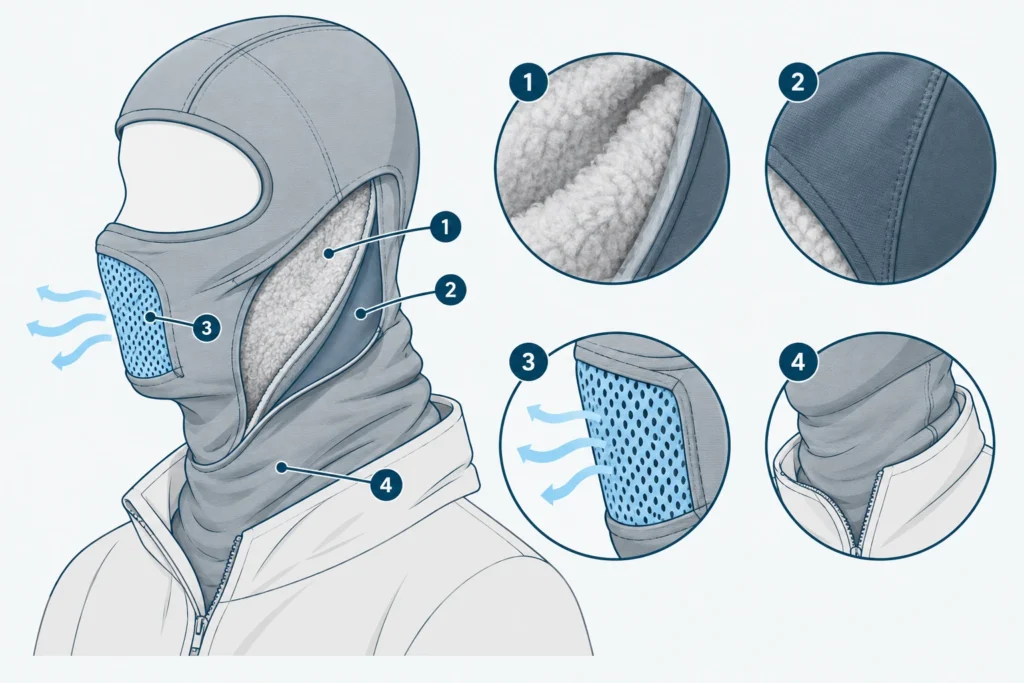
Fleece is the usual fabric for thermal balaclavas. Polar fleece is lofty and warm; microfleece is thinner and denser; brushed-back stretch fleece combines a smooth face with a soft inside and some stretch. Coral fleece has a long plush pile, and cotton-rich brushed fleece feels soft but dries more slowly.

Mesh
Mesh lets warm, moist breath out, so it is used for warm weather, sport and the mouth zone of winter styles. Polyester mesh and bird’s-eye mesh are light and airy; power mesh is sheer and very stretchy; 3D spacer mesh is thick and springy and holds the fabric away from the mouth. Mesh is usually a panel, with the branding on the solid fabric next to it.

Softshell, stretch velvet, merino jersey and cotton jersey
Softshell is a heavier bonded fabric with a firm face and a soft inside; it is wind-resistant and used as the outer layer for extreme cold. Stretch velvet has a soft pile and takes bright sublimation. Merino jersey is a fine knit fabric for base-layer style liners. Cotton jersey is soft, breathable and prints well with screen printing.
How do balaclava materials compare?
Wool and polar fleece rate very high for warmth, meshes and lightweight jerseys for breathability, and polyester/spandex for stretch and quick drying. The tables use the relative ratings from our Material Library: they compare materials with each other and are not lab values.
| Yarn (knitted) | Warmth | Breathability | Stretch | Dries | Softness |
|---|---|---|---|---|---|
| Acrylic rib knit | high | high | high | quickly | high |
| Acrylic/wool blend knit | high | high | high | moderately | high |
| Merino and wool knit | very high | high | high | moderately | high |
| Lambswool | very high | high | high | moderately | high |
| Cotton | moderate | very high | low | slowly | high |
| Cashmere | very high | high | moderate | moderately | very high |
| Alpaca | very high | high | low | moderately | very high |
| Chenille | high | moderate | low | moderately | very high |
| Bamboo viscose | low | very high | low | moderately | very high |
| Fabric (cut and sewn) | Warmth | Breathability | Stretch | Dries | Softness |
|---|---|---|---|---|---|
| Polyester/spandex stretch jersey (88/12) | moderate | high | very high | very quickly | high |
| Polyester microfibre knit | low | high | moderate | very quickly | very high |
| Polyester jersey | low | very high | moderate | very quickly | high |
| Polyester interlock | moderate | high | moderate | very quickly | high |
| Polar fleece | very high | high | low | very quickly | high |
| Polyester microfleece | high | high | moderate | very quickly | very high |
| Coral fleece | high | moderate | low | quickly | very high |
| Cotton-rich brushed fleece | high | high | moderate | slowly | very high |
| Technical grid fleece | high | high | high | quickly | high |
| Polyester mesh | low | very high | moderate | very quickly | moderate |
| Bird’s-eye mesh | low | very high | moderate | very quickly | moderate |
| Power mesh | low | very high | very high | very quickly | moderate |
| 3D spacer mesh | moderate | very high | low | quickly | moderate |
| Softshell (bonded) | high | moderate | high | quickly | moderate |
| Stretch velvet | high | moderate | very high | moderately | very high |
| Merino wool jersey | high | very high | moderate | moderately | high |
| Lightweight cotton jersey | low | very high | moderate | slowly | high |
The full records, with typical compositions and finishes, are in our Material Library.
Which material suits which use?
Start with where and how the balaclava will be worn; the sample confirms the choice.
| Use | Usual materials | Why |
|---|---|---|
| Winter streetwear | Acrylic or acrylic/wool rib knit | Warm, holds bright colours, takes knitted-in logos |
| Skiing and snowboarding | Merino, microfleece or stretch jersey with fleece | Warmth with moisture handling; thin enough under a helmet |
| Motorcycle, under a helmet | Stretch jersey or microfibre; mesh at the mouth | Thin, close-fitting, quick-drying; less fogging |
| Summer and warm weather | Polyester mesh, lightweight jersey, bird’s-eye mesh | Light and airy; covers the face, ears and neck on sunny, windy and dusty days |
| Extreme cold | Fleece or merino inner + softshell outer | Insulation plus a wind-resistant layer; mesh at the mouth so breath escapes |
| Sensitive skin | Cotton, fine merino, microfibre | Smooth, soft surfaces with fewer prickly fibres |
| Novelty and fashion | Chenille, stretch velvet, cashmere blends, printed stretch jersey | Plush or luxury feel, or full-colour prints |
For sport-specific detail, see our guides to ski balaclava materials, motorcycle balaclava materials and merino for ski balaclavas. For layered winter styles, see how we build an extreme cold weather balaclava; for airflow, our mesh balaclava page; for summer stock styles, the summer balaclava catalogue.
For kids’ ranges, choose soft, breathable materials and avoid cords or drawstrings at the hood and neck: EU EN 14682 and US rules restrict them on children’s clothing. Kids’ sizes have their own pattern.
Which decoration works on which material?
The material decides the logo method. Sublimation works only on polyester and polyester/elastane fabrics with a light base, while acrylic knits take jacquard, embroidery and patches but not screen printing or sublimation.
| Material | Works well | Test first | Not suitable |
|---|---|---|---|
| Acrylic and wool knits | Jacquard (a pattern knitted into the fabric), embroidery, woven labels, patches | Heat transfer on acrylic | Screen printing, sublimation |
| Cotton knits | Jacquard, embroidery, labels, patches | Heat transfer | Screen printing, sublimation |
| Chenille | Woven labels, leather-style patches | Silicone or rubber patches | Embroidery, printing, sublimation |
| Polyester/spandex jersey, microfibre, interlock | Sublimation (light base), heat transfer, labels | Embroidery (with a stabiliser), screen printing | Leather patches |
| Polyester fleece | Embroidery, labels, patches | Sublimation, screen printing, heat transfer | — |
| Mesh | Labels; branding on the solid panel next to it | Sublimation, embroidery | Screen printing (on polyester and spacer mesh) |
| Cotton jersey | Screen printing, heat transfer, embroidery (with a backing on thin jersey) | Patches on lightweight jersey | Sublimation |
| Softshell | Heat transfer, embroidery, patches | Screen printing | Sublimation |
Sublimation dyes the artwork into the polyester fibres, so it needs a white or light polyester fabric; it cannot be done on a black balaclava or on cotton, wool or acrylic. On a stretch fabric, the print can look a little lighter where the fabric stretches most. Our guide to balaclava logo and decoration methods covers each method in detail. We only print designs you own or are licensed to use.
How should each material be cared for?
Follow the care label sewn into the balaclava. As a general rule, our product sheets say: wash cold, no bleach, hang dry, do not iron the print, and wash inside out.
- Acrylic knits: can pill with friction; washing inside out and avoiding rough loads helps.
- Wool and merino: heat and agitation can felt and shrink wool, so a gentle cold wash and flat or hang drying are usual.
- Fleece: can pill over time; cold washes and no tumble heat help it keep its surface.
- Polyester/spandex jersey and mesh: dry quickly on a line; high heat can weaken the stretch and the print.
- Cotton: takes longer to dry and may shrink slightly in warm washes.
For the buyer’s side, see when to wash a balaclava and our Help Center answer on product care.
What should the fibre label say?
The fibre and care label must state the real fibre names and percentages, not marketing names. EU and US labelling rules both use generic fibre names.
- “Bamboo” is usually bamboo viscose, so the label says viscose (from bamboo).
- “Ice silk” is not a fibre name; it is a trade term for cool-touch knits, usually nylon or polyester with elastane, and the label states that fibre.
- Faux fur is labelled as the synthetic fibre it is made of. We use faux fur only.
Can you make fire-resistant balaclavas?
Yes, from flame-resistant fabric supplied with the mill’s test certificate. We do not certify finished products.
If your market requires certified protective gear, the finished product must be tested and certified for your market, and the certificate is issued in the selling brand’s name. Acrylic and polyester melt when exposed to flame, so standard acrylic, fleece or polyester balaclavas should not be presented as fire protection. Our flame-resistant balaclava page explains how testing works.
Are OEKO-TEX, recycled or organic materials available?
Fabrics from OEKO-TEX® certified mills are available on request; the certificate is the mill’s. Recycled and organic options, such as organic cotton yarn or recycled polyester knit, are also available on request.
Eco Jersey Limited, which powers Mr Balaclava, is ISO 9001 certified and a Sedex member. More detail is in our Help Center answer on certified materials.
How to choose a balaclava material
Decide the use, then the construction, then the decoration.
- Will it be worn in real cold, in mild weather or in heat? Cold points to wool, merino or fleece; heat to mesh or lightweight jersey.
- Will it sit under a helmet? Then choose a thin, close-fitting fabric such as stretch jersey or microfibre.
- Do you want a knitted look or a smooth, printed one? Knitted means yarns; printed means polyester fabrics.
- Is a full-colour print essential? Then you need light polyester for sublimation.
- What price point are you selling at? Acrylic is the value option; merino and luxury yarns cost more.
Our Help Center also explains how to choose a fabric.
Ordering a balaclava in your chosen material from Mr Balaclava
We knit to shape and cut and sew in our factory in Sialkot, Pakistan; jacquard and circular knitting are done with partner mills we work with closely. The minimum order is 50 pieces per design, and standard production takes approximately 14 days after sample approval.
What to send with your request
- The use (sport, streetwear, summer, extreme cold) and the material you have in mind, or a reference product
- Style and face opening; see balaclava openings explained
- Colours (Pantone references if you have them) and your logo files
- Quantity per design and your deadline
You can approve the material with a pre-paid physical sample (about 5–7 days) or a free pre-production sample made after the order and the 30% advance payment. Mr Balaclava’s name never appears on your products.
Frequently asked questions
Is acrylic warm enough for a winter balaclava?
For everyday winter wear, yes: acrylic rates high for warmth in our Material Library. It is lighter than wool and handles moisture less well, so for skiing or long outdoor days merino or fleece is often chosen instead.
Merino or fleece: which is warmer?
Both rate high to very high for warmth. Merino tends to handle moisture better and feels finer on the face; polar fleece is loftier and dries very quickly. Neither is wind-resistant on its own, so extreme cold styles add a softshell outer layer.
Can you make a balaclava in polyester/spandex or nylon/spandex?
Polyester/spandex stretch jersey is our main sewn fabric, at 88% polyester / 12% spandex. Nylon/spandex can usually be sourced on request; the composition is confirmed with your quote.
Can I have a knitted balaclava with a fleece lining?
A lining is sewn in, so lined styles are usually built as cut-and-sew, with fleece inside and a stretch or softshell outer. If you want a knitted look with a lining, ask with your quote; the build is confirmed on the sample.
Is a “seamless” knitted balaclava completely without seams?
Usually not. Most knitted balaclavas are knitted to shape with a seamless top, and still have one short seam where the piece is closed.
Is cotton a good choice for summer?
Cotton breathes well and feels soft, but it dries slowly, so in heat or during sport a polyester mesh or lightweight jersey is often more comfortable. See our cotton balaclava page for where cotton works well.
Browse our knitted balaclavas and thermal balaclavas, see how we make a knitted balaclava in each yarn, or request a quote for your material.