For a modest fashion brand, the fabric decides almost everything about a hijab: how it drapes, whether it stays in place, how opaque it is, how it feels in summer heat and how it survives washing. Common problems, such as a hijab that slides, shows the hair or creases badly, usually come back to the fabric.
This guide compares the hijab fabrics brands ask us about, together with the sizes, edges and colour options to decide on. You can see finished styles on our hijabs page.
Which fabrics are used for hijabs?
Everyday hijabs are mostly made in polyester chiffon, georgette, viscose, modal and cotton voile. Silk chiffon and silk georgette are used for luxury and occasion ranges, and pashmina and cashmere blends for winter.
Each fabric links to its page in our scarf fabrics collection, where you can compare feel, weight class and printing options.
How do hijab fabrics compare?
| Fabric | Opacity | Grip | Drape and feel | Care | Best for |
|---|---|---|---|---|---|
| Polyester chiffon | Sheer | Slippery | Light and floaty | Easy to wash, dries fast | Everyday plain and printed hijabs, worn over an under-scarf |
| Georgette | Semi-sheer | Good (crepe surface) | Holds a drape | Gentle care for silk | Hijabs that need to stay in place |
| Viscose | Opaque | Good | Soft, cool and fluid | Gentle wash; creases more easily | Everyday plain and printed hijabs, shawls |
| Modal | Opaque | Good | Very soft, smooth and silky | Keeps its shape after washing | Everyday soft hijabs and wraps |
| Cotton voile | Slightly sheer | Good | Light, crisp and breathable | Easy to wash | Summer hijabs and head scarves |
| Silk chiffon | Sheer | Slippery | Floating, very light | Gentle hand wash | Luxury, bridal and occasion hijabs |
| Pashmina | Opaque | Good | Very soft, fluid, warm for its weight | Gentle hand wash or dry clean | Winter hijabs, shawls and gift ranges |
Which hijab fabric does not slip?
Fabrics with a textured or matte surface grip best: georgette, viscose, modal and cotton voile stay in place better than smooth chiffon or satin. Polyester and silk chiffon are light and elegant but slide more, so they are usually worn over an under-scarf or pinned.
Georgette is the usual answer when a brand wants the light, sheer look of chiffon with better hold: its crinkled, crepe-like surface grips and holds a drape. We make it in silk (silk georgette); polyester georgette can be quoted on request, and availability is confirmed with your quote.
Jersey hijabs, cut from a soft stretch knit, are another style buyers ask about. If you need them, mention it in your brief and we confirm what we can offer with the quote.
Which hijab fabric is not see-through?
Viscose, modal and pashmina are opaque in a single layer. Chiffon is sheer by design, georgette is semi-sheer and cotton voile is slightly sheer, so these are usually worn with an under-scarf or chosen in darker or printed colours.
Opacity also depends on the weight and colour of the individual fabric, so it is worth checking on a sample. You can order a pre-paid physical sample, made in about 5–7 days, to check it in hand, or approve a free pre-production sample by photos, videos or a video call after the order and the 30 % advance payment.

Which hijab fabrics suit summer and winter?
For summer, choose light, breathable fabrics: cotton voile, viscose, modal and chiffon. For winter, choose pashmina or cashmere blends, which are warm for their weight.
Pashmina is a very fine cashmere, often blended with silk; we state the exact composition on the quote and the care label, never just the name. For a warm hijab or shawl at a lower price, cashmere-wool blends are an option; see woven cashmere and cashmere blends. For light summer wraps in voile, viscose or chiffon, see our beach scarves and sarongs.
What size should a hijab be?
The standard rectangular hijab or stole is 70 × 180 cm, and a larger wrap is 100 × 200 cm. Square hijabs are 140 × 140 cm, and triangle scarves go up to about 180 × 90 cm. Any size can be made to your specification.
| Style | Size | Notes |
|---|---|---|
| Rectangular hijab or stole | 70 × 180 cm | Everyday wraps and styles |
| Wrap or large shawl | 100 × 200 cm | More coverage; also sold as a shawl |
| Square hijab | 140 × 140 cm | Folded into a triangle before wearing |
| Triangle scarf | Up to about 180 × 90 cm | Ties without folding |
Which edge finishes are available for hijabs?
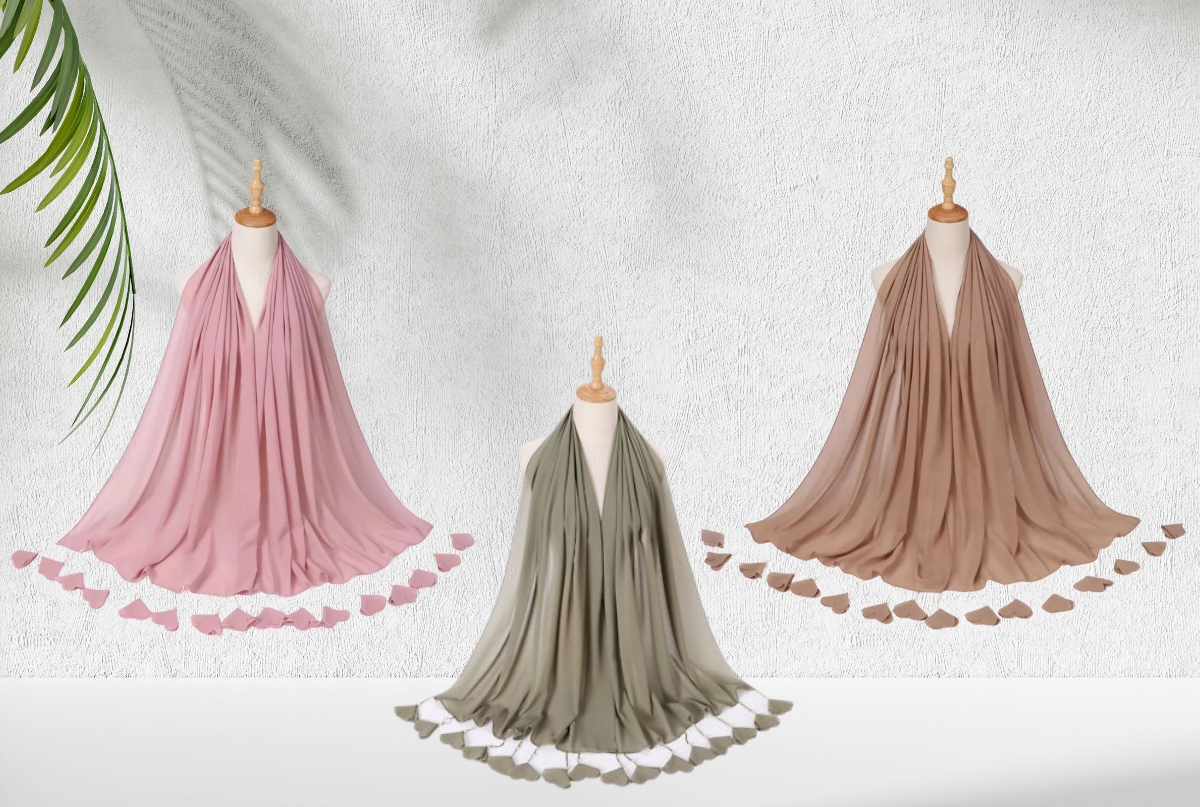
Hijabs can be finished with hand-rolled or machine-rolled hems, narrow hems, overlocked edges, tassels, fringes or lace edging.
The edge changes both the look and the price point. A fine rolled hem is almost invisible on chiffon and silk; an overlocked edge is neat and durable on everyday viscose and modal; tassels and lace edging turn a plain hijab into a fashion or occasion piece. An embroidered logo or monogram in one corner adds a brand detail without a visible label.
How do you choose hijab colours?
Start from the colour card of the fabric you choose, or send your own colour references; the colours available for your order are confirmed with the quote.
Many ranges combine a core of neutral colours with seasonal shades, so plan both when you send your brief. Plain hijabs are usually dyed in solid colours; viscose, cotton voile and silk can also be printed digitally or by rotary screen, and polyester chiffon can be sublimated. Modal is usually dyed in solid colours.
What to include in your hijab brief
- Fabric, and the weight or a reference sample if you have one.
- Size: 70 × 180 cm, 100 × 200 cm, 140 × 140 cm or your own.
- Edge finish: rolled hem, overlocked edge, tassels, fringes or lace.
- Colours or artwork, with the quantity for each.
- Labels and packaging: woven label, hang tag, polybag, tissue or gift box.
What is the minimum order for private label hijabs?
Orders start at 50 pieces per design, with a standard production lead time of approximately 14 days after sample approval. The confirmed schedule is agreed for each order.
Woven hijab fabrics come from partner mills; we cut, print, hem, brand, inspect and pack the hijabs in our factory in Sialkot. Your labels, hang tags and packaging carry your brand, and Mr Balaclava’s name never appears on your products.
Frequently asked questions
What is the best fabric for an everyday hijab?
For daily wear, viscose and modal are soft, breathable and grip well. Polyester chiffon is light, colourfast and easy to wash, but it needs an under-scarf or pins to stay in place.
Is georgette better than chiffon for hijabs?
Georgette has a crinkled surface that grips better and is less transparent; chiffon is lighter and floats more. Choose georgette for hold and chiffon for a light, floating look.
What is the difference between pashmina and cashmere?
Pashmina is a very fine cashmere, often blended with silk. Many fabrics sold as pashmina are blends, so we always state the exact composition on the quote and the care label.
Are the fabrics certified?
Fabrics from OEKO-TEX® certified mills are available on request; the certificate is the mill’s. Eco Jersey Limited, which powers Mr Balaclava, is ISO 9001 certified and a Sedex member.
Browse our hijabs catalog, compare every woven fabric on the scarf fabrics page, or send us your brief for a quote.