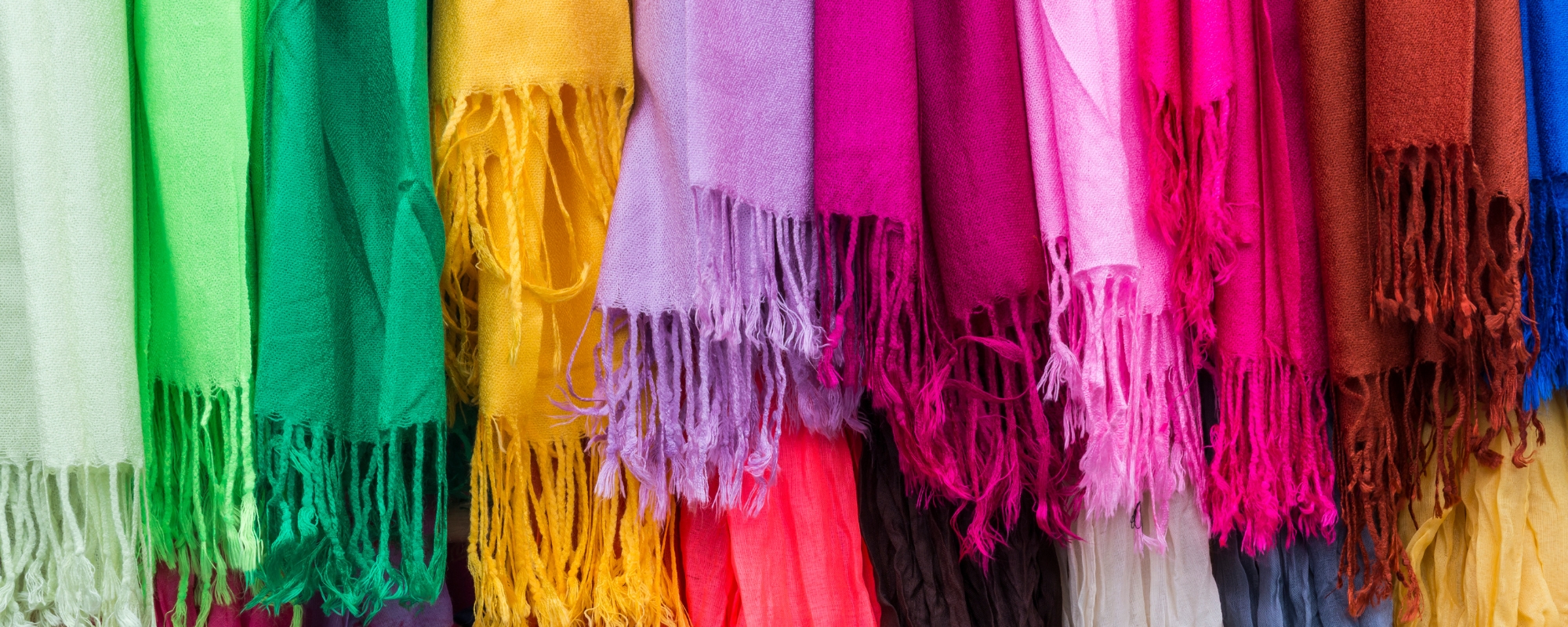
A private label scarf line lets a brand or retailer sell scarves under its own name without running a factory. The manufacturer makes the scarves to your design and specification and finishes them with your labels and packaging, so your customers only see your brand.
This guide walks through the decisions in the order they come up, from choosing categories to reordering. Mr Balaclava makes custom scarves in Sialkot, Pakistan: knitted scarves on our own flatbed machines, and woven scarves from partner-mill fabrics that we cut, print, hem, brand, inspect and pack in our factory.
What is a private label scarf?
A private label scarf is made by a manufacturer and sold under your brand, with your labels, tags and packaging. Mr Balaclava’s name never appears on your products.
Private label can mean adding your branding to an established style, or developing a scarf from your own design, fabric and artwork. Many lines combine both: a few core styles carrying your branding, plus a few signature designs that only you sell.
Which scarf categories should you start with?
Start with one or two categories that match your customers and season: knitted scarves for winter and team merchandise, printed silk or polyester scarves for fashion and gifts, bandanas for streetwear and merchandise, and hijabs or shawls for modest fashion.
| Category | Main fabrics | Typical branding | Typical buyers |
|---|---|---|---|
| Knitted scarves | Acrylic, wool, merino, cashmere | Knitted-in jacquard logo, woven label | Winter fashion, schools, corporate gifts |
| Football scarves | Acrylic jacquard; printed polyester satin or fleece | Name and crest knitted in or sublimated | Clubs, supporter groups, events |
| Silk scarves | Silk twill, satin, chiffon and georgette | Printed design, satin or woven label | Fashion brands, luxury and gift ranges |
| Printed scarves | Polyester satin and twill, viscose, cotton voile | Sublimated or digital print, woven label | Promotions, events and fashion ranges |
| Bandanas | Cotton, polyester twill | Screen, discharge or sublimation print | Streetwear, merchandise and events |
| Neckerchiefs | Polyester twill and satin, silk twill | Printed in your brand colours | Airlines, hotels and uniforms |
| Hijabs | Polyester chiffon, georgette, viscose, modal | Woven label | Modest fashion brands and retailers |
How do you choose the fabric and price point?
Decide the retail price first, then choose the fabric that fits it. Polyester and acrylic keep costs down; silk, cashmere and pashmina belong in luxury and gift ranges.
The fabric also decides the printing method. Sublimation works only on polyester, while silk is printed digitally or by screen, so the same artwork on polyester satin and on silk twill is printed differently and priced differently. Each fabric has its own page in the Material Library, for example mulberry silk twill for classic squares, polyester satin for sublimated scarves, polyester chiffon for everyday hijabs, bandana cotton for bandanas and acrylic jacquard for fan scarves.
What goes into a scarf tech pack?
A scarf tech pack lists the size, fabric and weight, colours, artwork with its placement, the edge finish, labels and packaging, and the quantity per design. A clear PDF with measurements and references is enough to start.
- Size and shape: for example 70 × 180 cm, a 90 cm square or a 51 cm bandana.
- Fabric and weight: for example silk twill of about 12–16 momme, polyester satin, or a reference sample.
- Colours: colour references such as Pantone numbers or a fabric swatch.
- Artwork: full-size print files with the placement or repeat marked; for knitted scarves, the design and the colours of yarn.
- Edges and trims: hand-rolled or machine-rolled hems, overlocked edges, fringes, tassels or lace edging.
- Branding: woven, satin or printed labels, hang tags, polybags, tissue, belly bands, gift boxes and barcodes.
- Quantity per design and the date you need the goods.
If some details are still open, say so in the brief; they are settled with the quote and checked on the sample.
Which sample should you choose?
There are two sample types: a pre-paid physical sample, made in about 5–7 days and paid 100% in advance, or a free pre-production sample, made after the order and the 30 % advance payment and approved by photos, videos or a video call.
| Pre-paid physical sample | Free pre-production sample | |
|---|---|---|
| When it is made | Before you order | After the order and the 30 % advance payment |
| Time | About 5–7 days | Before bulk production starts |
| Cost | Paid 100% in advance; deducted from the order only when it is 1,000 pieces or more | Free |
| Shipping | Charged separately and not refundable | Approved remotely by photos, videos or a video call |
| Best for | New designs and fabrics you want to hold in hand | Styles and fabrics you already know |
How many pieces do you need per design?
The minimum order is 50 pieces per design. A first collection of four designs therefore needs at least 200 pieces, and each design can be reordered on its own.
Build the range around a few designs you can reorder, plus one or two seasonal designs to test. Monthly capacity is around 100,000 pieces, so the same lines handle a 50-piece test and a large reorder.
How do labels and packaging work?
Your brand goes on woven, satin or printed labels, on hang tags and on the packaging: polybags, tissue, belly bands or gift boxes, with barcodes for retail. Mr Balaclava’s name never appears on your products.
Logos and monograms can also be printed or embroidered on the scarf, or knitted in as jacquard on knitted scarves. Silk and gift scarves are often packed flat in tissue or a gift box; bandanas and everyday scarves are folded into polybags with a hang tag.

How long does it take from brief to delivery?
Standard production lead time is approximately 14 days after sample approval, followed by shipping. Seven days is possible on request, and complex products or very large orders (100,000–200,000 pieces) can take up to one month; the confirmed schedule is agreed for each order.
| Step | What happens | Time |
|---|---|---|
| Brief and quote | You send the tech pack or artwork; we confirm fabric, price and schedule | Agreed for each brief |
| Sample | Pre-paid physical sample, or free pre-production sample after the order | About 5–7 days for a physical sample |
| Order | You confirm the order with the 30 % advance payment | When the advance is paid |
| Production | Knitting or cutting and printing, hemming, branding; 30 % paid after the work-in-progress update | Approximately 14 days after sample approval |
| Quality control | Inspection and packing; 40 % paid when the goods are ready to ship | Before dispatch |
| Shipping | Express by DHL, FedEx or UPS, or air and sea freight for large orders | 3–6 working days by express |
How does payment work for a private label order?
Bulk orders are paid in three steps: 30 % in advance to confirm the order, 30 % during production after you review the work-in-progress update, and 40 % after quality control when the goods are ready to ship.
A pre-paid physical sample is paid 100% in advance. Shipping method, cost and delivery terms are agreed for each order; FOB quotations are common.
How do reorders work?
A reorder repeats an approved design and specification: tell us the design and the quantity, from 50 pieces per design, and we confirm the price and schedule with the quote.
Keep your tech pack and the approved sample as the reference, so that every reorder matches the first run. Reorders are also the moment to add a new colour or a seasonal design to the range.
Frequently asked questions
Can one order include different scarf categories?
Yes. Each design needs at least 50 pieces, and knitted and woven scarves can be ordered together.
Do you weave the fabrics yourselves?
No. Woven fabrics such as silk, satin, chiffon, viscose, cotton and cashmere come from partner mills; we cut, print, hem, brand, inspect and pack the scarves in our factory. Knitted scarves are knitted in-house on our own flatbed machines.
Do you supply quality certificates?
Eco Jersey Limited, which powers Mr Balaclava, is ISO 9001 certified and a Sedex member. Fabrics and yarns from OEKO-TEX® certified mills are available on request; the certificate is the mill’s.
Will my scarves carry your name?
No. Mr Balaclava’s name never appears on your products.
Browse the scarves catalog, start from the custom scarves overview, or send us your brief for a quote.