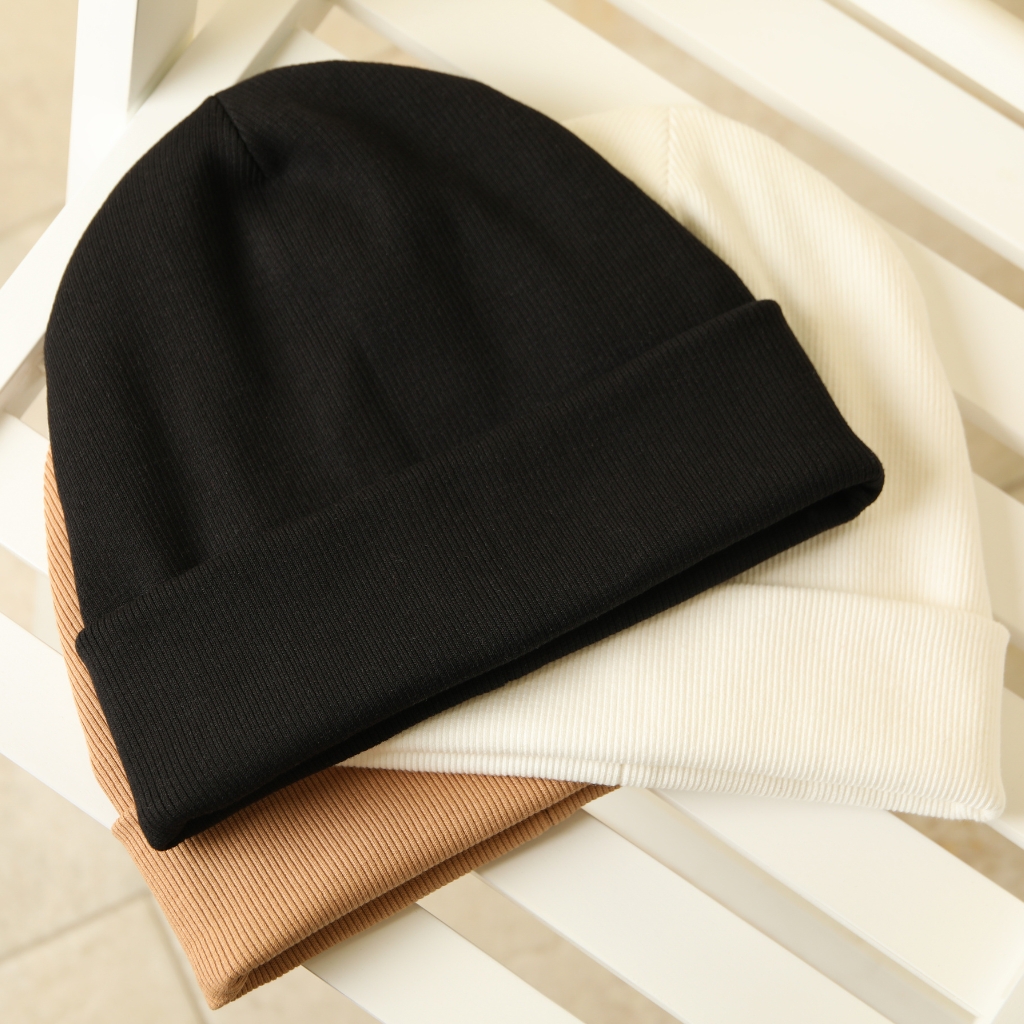
A beanie looks like the easiest item in a range to size: it stretches, and most people buy it in one size. Yet buyers still ask how big a one-size beanie really is, whether it fits large heads, how a slouchy or high top style differs, and what to do for children. This guide is for brands, shops, clubs, schools and promotional companies planning beanies, and it answers those questions with real measurements.
Size is one part of choosing a beanie; shape, knit, yarn and trims are the others, and our guide to the different types of beanies covers them all. Here we stay with fit: how to measure a head, adult sizes, kids and baby sizes, how each style changes the measurements and how the size is checked on your sample.
How do you measure your head for a beanie?
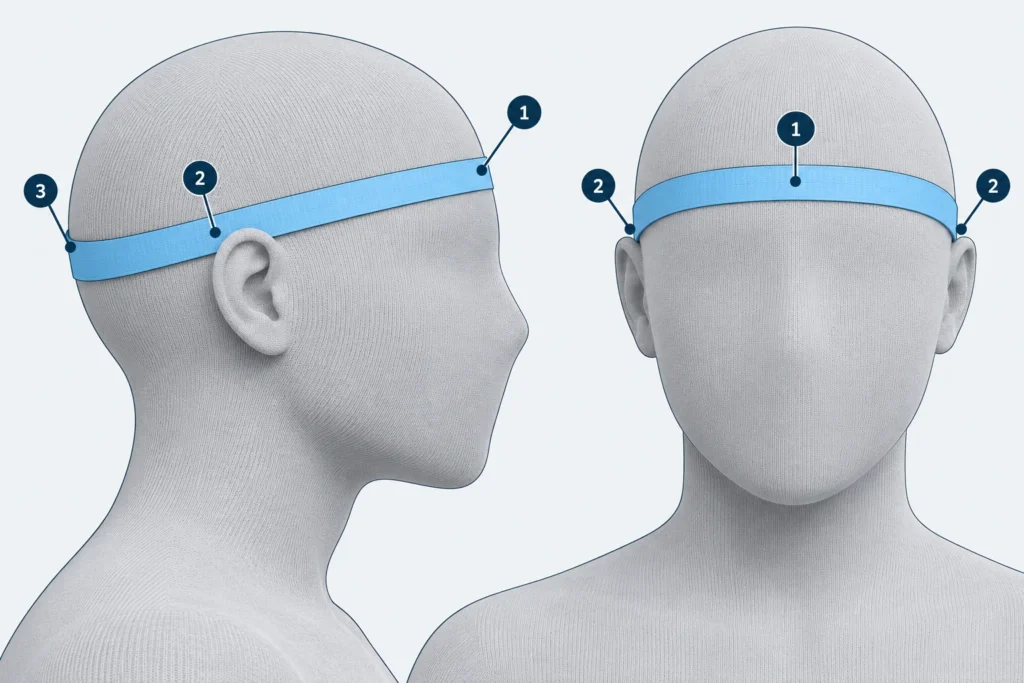
Wrap a soft tape measure around the widest part of the head, about 1–2 cm above the eyebrows and the tops of the ears, and read the measurement in centimetres. That number is the head circumference, and every beanie size is based on it.
Keep the tape level all the way round, snug but not tight, and pass it over the slight bump at the back of the head. If there is no tape to hand, a piece of string marked with a pen and then laid along a ruler works too. For a range, measure several people of the age group you sell to, not only one.
What size is a one-size adult beanie?
A one-size adult beanie usually fits head sizes of about 54–60 cm. Every beanie in our catalogue is made in this one adult size, with stretch.
The reason is the knit. A rib knit, such as 1×1 rib (one knit stitch, one purl stitch, in columns) or 2×2 rib, works like a spring: it opens out across the head and pulls back when it is taken off. That is how one beanie can sit comfortably on a wide range of heads without sliding off a smaller one.
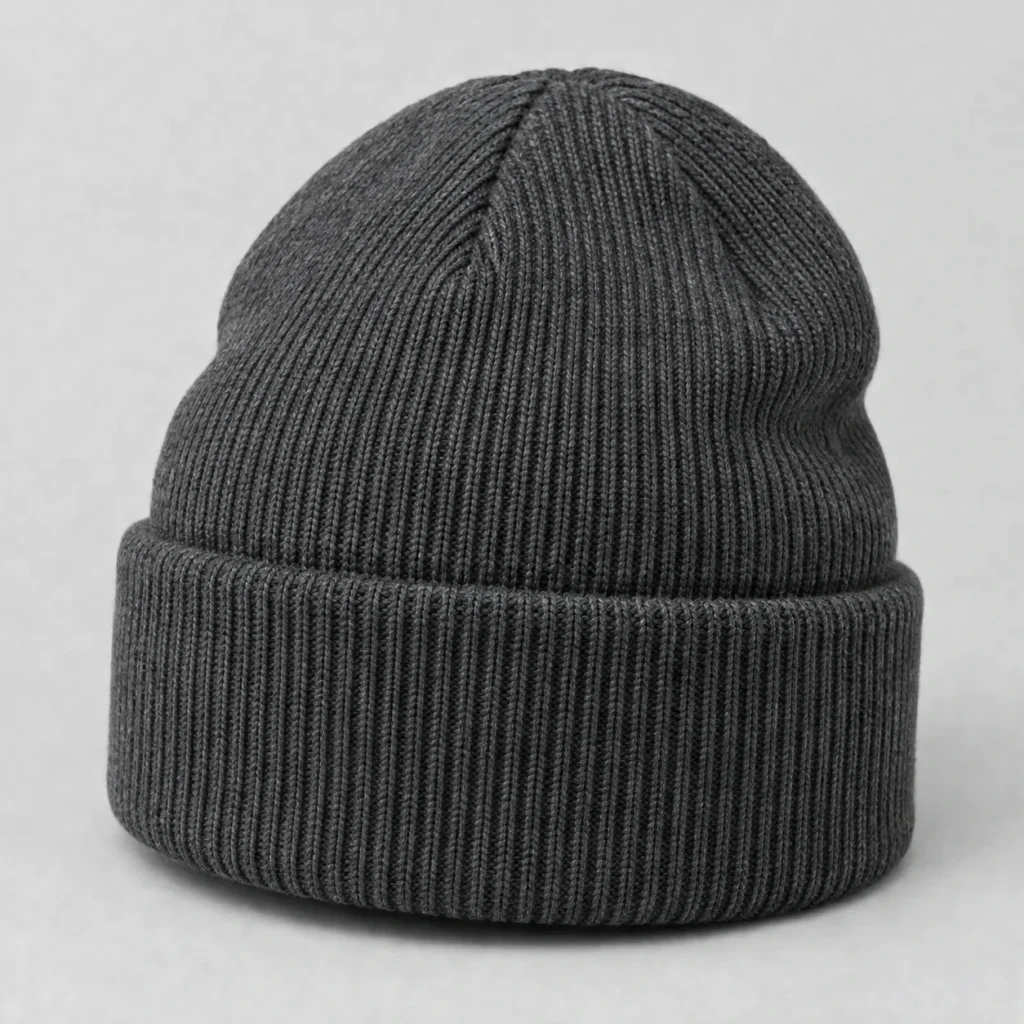
Take our cuffed acrylic rib beanie as an example. Laid flat it measures about 20.5 cm across, which is about 41 cm all round when relaxed, and it stretches to about 60 cm. On the head it sits slightly stretched, which is what holds it in place. The yarn matters less than many buyers expect: acrylic, wool blends and merino all stretch and recover well in a rib, as our guide to beanie gauges and yarns explains.
When do you need Adult S/M and L/XL?
Graded adult sizes are worth it when fit is part of the product, for example for uniforms, workwear, close-fitting sports beanies or heads outside the usual range. For most retail, team and promotional beanies, one size is enough.
Adult S/M and L/XL are made to order. As a rough guide, S/M often covers about 54–57 cm and L/XL about 58–61 cm, but the exact split is set with you and confirmed on the sample. If you already sell hats, we can also grade the pattern to your own size chart. A size split adds work to the order, so tell us the quantity per size when you ask for a quote.
| Size | Head circumference (typical) | When it is used |
|---|---|---|
| One size (adult) | About 54–60 cm | Catalogue beanies, retail, teams, events and promotion |
| Adult S/M | Often about 54–57 cm | Uniforms, workwear, fitted and sports styles |
| Adult L/XL | Often about 58–61 cm | Larger heads, room for hair, fitted styles |
| Your own size chart | As you specify | Brands with an existing hat range |
Which measurements does a beanie product sheet give?
A beanie is measured laid flat, without stretching it. Our product sheets give the height, the cuff depth if there is a cuff, the width laid flat and the maximum stretched circumference.
- Height: from the bottom edge to the top of the crown, with the cuff folded if the style has one.
- Cuff depth: the height of the folded cuff.
- Width laid flat: straight across the bottom edge. Doubled, it gives the relaxed circumference.
- Maximum stretch: the circumference the edge stretches to without strain.
- Extras by style: pom-pom diameter, earflap length, tie length, fleece band height or a ponytail opening.
Because a knit relaxes and recovers a little, these are flat measurements with a small tolerance, usually about ± 0.5 cm, and each value should be read as “about”. The Help Center page on sizes and colours covers the basics, and a full beanie tech pack is the place to fix your own measurements.
How does the style change the fit and the measurements?
The width is close to the same on most adult styles; the height, the cuff and the knit are what change. That is why two beanies for the same head can look very different.
| Style (catalogue example) | Height | Cuff depth | Width laid flat | Max. stretch |
|---|---|---|---|---|
| Classic cuffed, 1×1 rib | About 21 cm (cuff folded) | About 7 cm | About 20.5 cm | About 60 cm |
| Watch cap, double-layer rib | About 20 cm (cuff folded) | About 6.5 cm | About 20 cm | About 58 cm |
| Chunky rib, wide cuff | About 22 cm (cuff folded) | About 9 cm | About 21 cm | About 62 cm |
| Fisherman, short chunky rib | About 13 cm (cuff folded) | About 5 cm | About 21 cm | About 60 cm |
| High top, tall crown | About 25 cm (cuff folded) | About 8 cm | About 20 cm | About 60 cm |
| Oversized, chunky 5GG rib | About 25 cm (cuff folded) | About 8 cm | About 23 cm | About 64 cm |
| Slouchy, single jersey | About 28 cm (laid flat) | None | About 21.5 cm | About 60 cm |
| Cable knit, fleece-lined | About 22 cm (cuff folded) | About 6 cm | About 21 cm | About 58 cm |
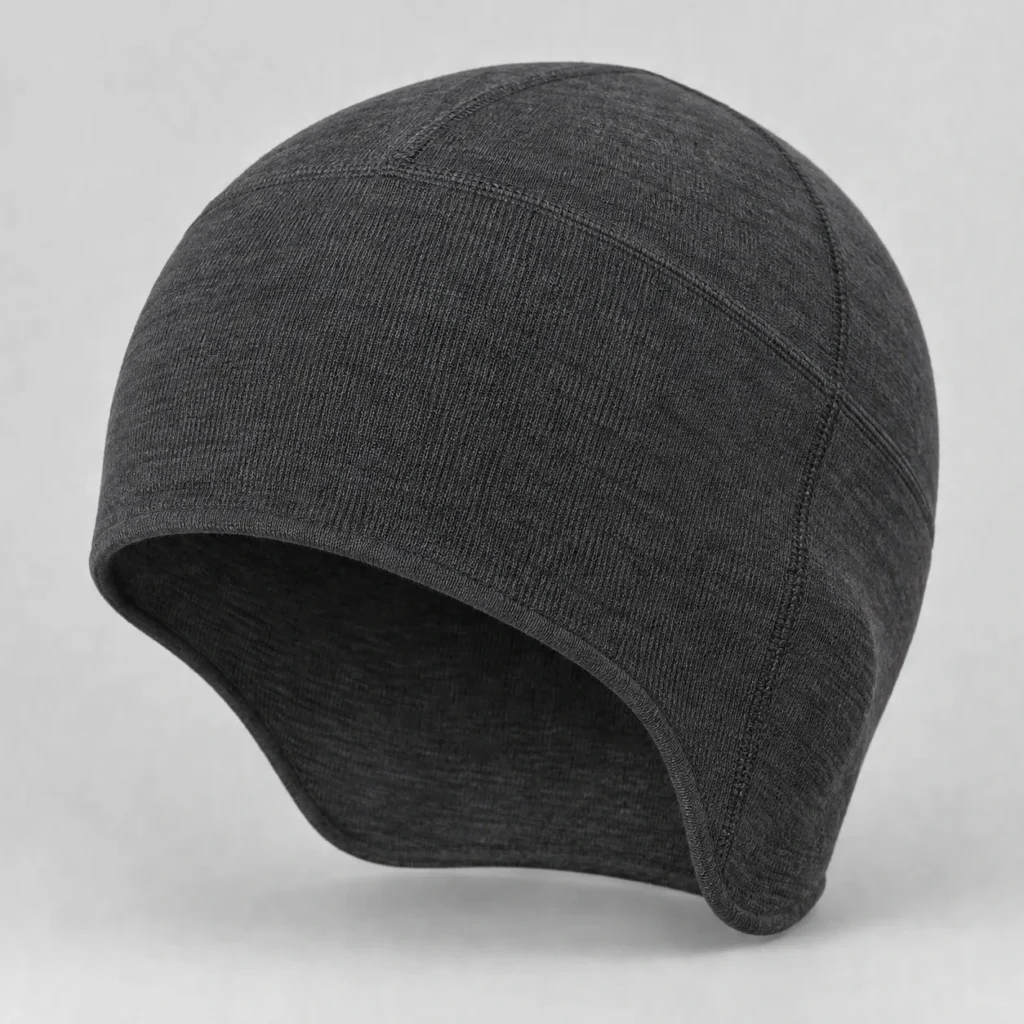
| Helmet liner, 14GG jersey | About 19 cm (laid flat) | None | About 20 cm | About 60 cm |
Cuffed and uncuffed beanies
A cuff is a double layer of knit at the band, so it grips a little more and covers the ears well. An uncuffed beanie of the same height sits lower or slouches more, because there is no fold to take up length. Cuffs on our catalogue styles run from about 5 cm on the fisherman to about 9 cm on the wide-cuff chunky rib.
Slouchy and high top beanies
Slouchy and high top beanies fit the head at the band like a classic beanie; the difference is extra length above it. On our slouchy beanie the extra length falls to the back, and on a high top beanie the tall crown stands above the head.
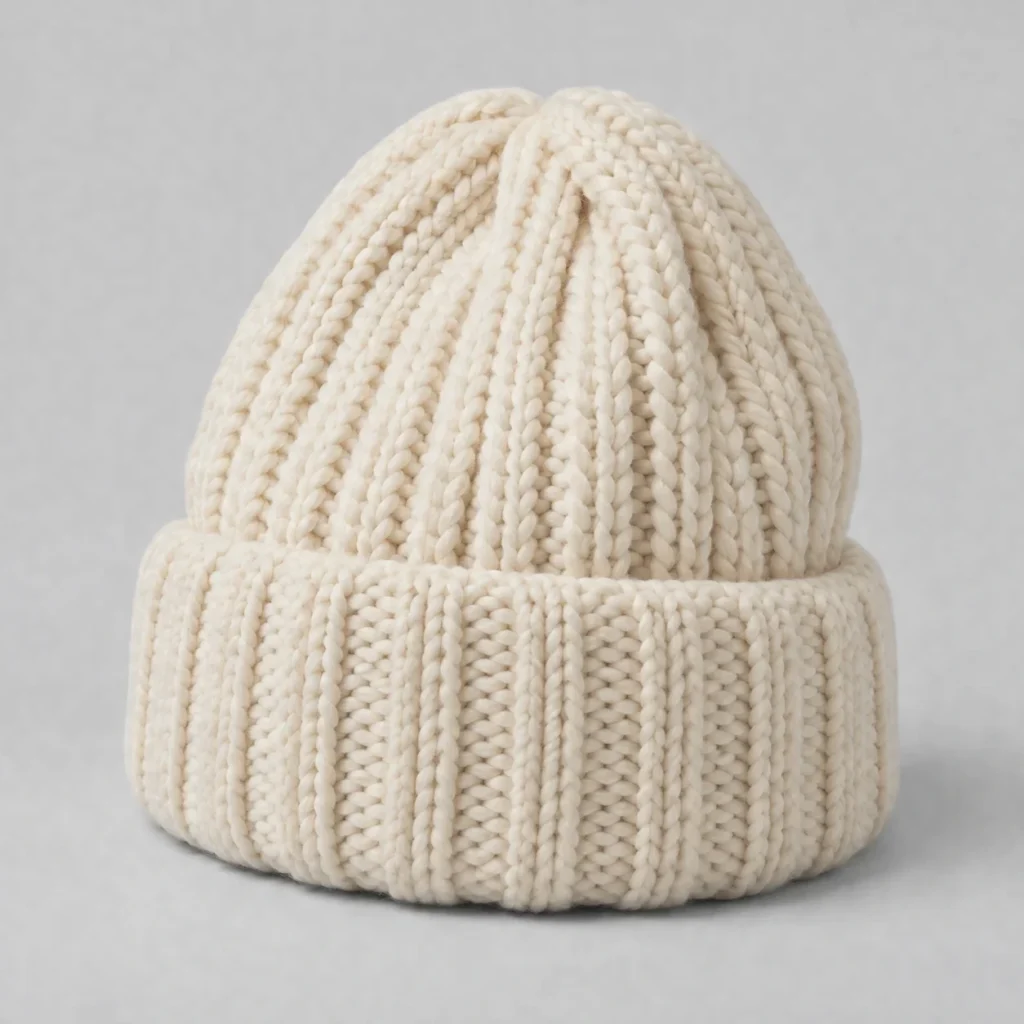
Oversized styles go one step further and are also cut wider, so they sit loosely. The chunky 5GG knit (5 needles per inch on the knitting machine, so thick stitches) adds bulk, which makes the beanie look bigger on the head.
Fisherman beanies
A fisherman beanie is shallow on purpose: about 13 cm high with the cuff folded, so it sits high on the head above the ears. Buyers who want the look but need the ears covered usually choose a classic cuffed beanie instead.
Helmet liners and fine-gauge beanies
Fine 12–14GG knits sit close to the head, and a helmet liner beanie is cut close on purpose so that it fits under a ski, bike or work helmet. Our merino helmet liner is about 19 cm high and 20 cm wide; check the fit with your helmet on the sample, because the depth can be adjusted.
Lined and double-layer beanies
A lining stretches less than a rib knit, so lined beanies tend to sit a little snugger. Our fleece-lined cable knit and the double-layer watch cap both stretch to about 58 cm rather than 60 cm. A double-layer knit is two layers of knit, not the same as a lining; our guide to beanie linings explains the difference. Jacquard knits also stretch a little less than a plain rib, so the pattern is set to sit flat on the head.
What sizes do kids and baby beanies come in?
Kids and baby beanies are made to order, either in standard age sizes or graded to your own size chart. They are not small adult beanies: each has its own pattern, with its own crown depth, width and cuff.
| Age group | Typical head circumference |
|---|---|
| Baby (0–12 months) | Typically about 34–46 cm |
| Toddler (1–3 years) | Typically about 46–50 cm |
| Kids (4–7 years) | Typically about 50–53 cm |
| Older kids (8–12 years) | Typically about 52–55 cm |
| Adults | Typically about 54–60 cm |
Because the age groups overlap and a knit stretches, many brands sell two or three children’s sizes rather than one per year of age, for example a baby, a toddler and a kids size. As a starting point, a kids beanie for about 4–7 years is often around 18 cm high and 18 cm wide laid flat, and a baby beanie around 15 × 15 cm; your own chart takes priority.
Yarns and trims for children
For babies and small children, softer yarns such as cotton yarn, fine merino or soft acrylic are the usual choice, because they tend to feel gentler next to the skin. When a style is graded down, the trims are scaled with it, so a pom-pom on a kids beanie is smaller than on an adult one.
Safety points for children’s beanies
- No detachable pom-poms. Kids’ beanies get a sewn-on pom-pom or none, because small detachable parts are not suitable for children. Our pom-pom guide explains the options.
- No cords or ties that could catch. European standard EN 14682 restricts cords and drawstrings at the hood and neck of children’s clothing. Hats sit outside its formal scope, but related European guidance covers them, and most kidswear buyers apply the same caution.
- Earflap ties are a point to discuss. On kids’ earflap styles we talk through short ties, no ties or another closure with you, based on the age group and your market.
- Trims sewn on securely. Pom-poms and labels are stitched firmly, and pom-poms are pull-checked by hand.
Rules for children’s products differ by market, so tell us where you sell when you send your brief. For more on styles for the youngest, see our article on baby beanies.
How are sizes checked before production?
Sizes are checked on the sample: we measure it against the agreed chart, and you check the fit on real heads before bulk production starts. Any change to height, width or cuff is made on the pattern at that stage.
You can approve the fit on a pre-paid physical sample, made in about 5–7 days, or on a free pre-production sample made after the order and the 30% advance payment and approved by photos, videos or a video call. Our guide to sample types compares the two. During production, measurements are usually checked against the approved sample as part of our quality control.
For the steps from yarn to finished hat, including how the crown is closed and the cuff is folded, see how a beanie is made.
How do you choose the right beanie size?
Start from who will wear the beanie and how closely it needs to fit. The list below matches common uses to the sizing that usually suits them.
- Promotion, events and teams: one adult size in a stretchy 1×1 or 2×2 rib.
- Retail basics: one adult size; add a slouchy, high top or oversized style for variety rather than graded sizes.
- Uniforms and workwear: one size in a double-layer or fine rib, or S/M and L/XL for a closer fit.
- Under helmets: a fine-gauge, close-fitting style, checked with the helmet on the sample.
- Room for long hair, braids or locs: a slouchy or oversized style, or L/XL with a deeper crown.
- Kidswear and family ranges: baby, toddler and kids sizes on their own patterns, or your size chart.
Ordering beanies in your sizes from Mr Balaclava
Every style can be made in one adult size, S/M and L/XL, kids and baby sizes or to your own chart. The minimum order is 50 pieces per design, and standard production takes approximately 14 days after sample approval.
What to send us
- The style, or a reference beanie or photo.
- The sizes you need, or your size chart with height, width and cuff depth.
- The age group and the markets you sell in, for children’s styles.
- Yarn, colours, trims and your logo with its placement.
- Quantity per design and per size, labels and packing.
Inside labels can carry your own size marking, and Mr Balaclava’s name never appears on your products.
Frequently asked questions
Will a one-size beanie fit a large head?
Usually up to about 60 cm, since most rib beanies stretch that far without strain. Beyond that, a chunky or oversized style that stretches further, or an L/XL size made to order, tends to fit more comfortably. The sample is the place to check it.
Do acrylic and merino beanies fit the same?
Very nearly. Both stretch and recover well in a rib knit. The stitch, the gauge and any lining change the fit more than the yarn does.
Does a beanie shrink or stretch out over time?
A rib relaxes a little with wear and recovers when washed as the care label says. Wool can shrink and felt with heat and rubbing unless it has been treated, so the care label matters; our product care guide gives the basics.
Can one design be split across several sizes?
Yes. Tell us the quantity per size with your request, and the split is confirmed with your quote. The same design can also be made in baby, kids and adult sizes for family ranges.
Where can I find the measurements of each beanie?
On each product page in our beanie catalogue, under the blueprint and measurements. They are flat measurements with a small tolerance.
Browse the styles and their measurements in our beanie catalogue, see all options on the custom beanies page, or send us your size chart for a quote.