
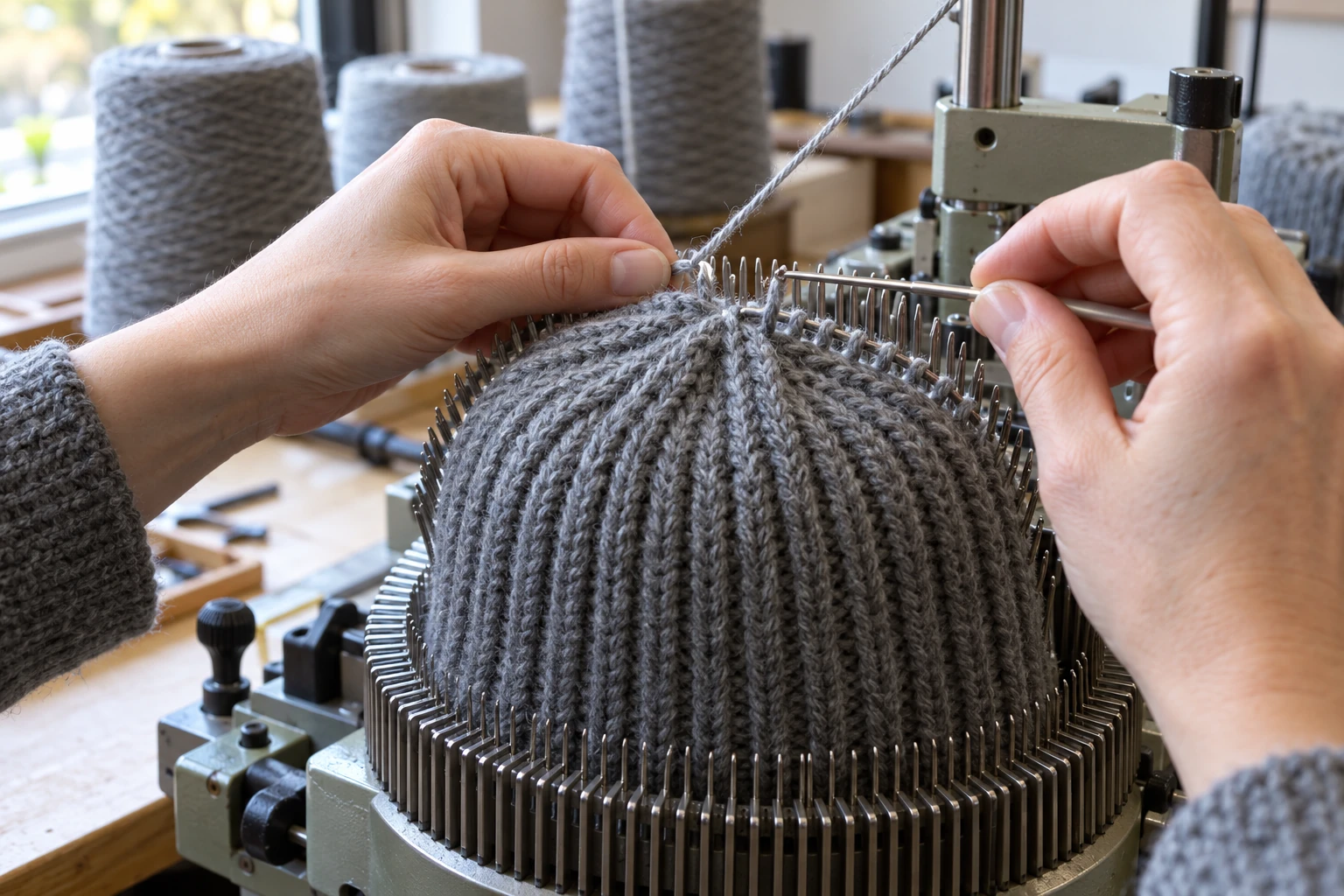
This guide is for brands, shops, clubs, teams and promo companies that want to understand how a beanie is made before they order one. It follows a custom beanie through the factory, from the brief and the yarn to the knitting machine, the crown, the trims, the logo and the final check.
If you are still deciding on a style, start with our overview of the different types of beanies. Here we stay on the production floor and explain what each step does to the fit, warmth and look of the finished hat, and where the common misunderstandings are.
What are the main steps in making a beanie?
A beanie is usually knitted to shape from yarn, closed at the crown, given its cuff and trims, decorated, steamed to shape and inspected. The exact order changes a little from style to style.
- Brief and tech pack: style, yarn, colours, size, logo and trims are fixed.
- Yarn and gauge: the yarn is chosen and the machine gauge set to suit it.
- Knitting programme: a knitted-in design becomes a stitch-by-stitch colour map.
- Knitting: the rib cuff and body are knitted to shape as one piece.
- Closing: the crown is closed by linking, gathering or a small seam.
- Trims: the cuff is folded; any lining or pom-pom is added.
- Decoration: embroidery, patches, plates or labels go on.
- Finishing: steaming, trimming, inspection and packing.
How does a beanie order start?
With a brief that becomes a tech pack: a short technical document that fixes every measurement, yarn, colour and logo position before anything is knitted.
Our design team sends a mockup of each logo and label placement, and the details go into the tech pack the sample is made from. Our beanie tech pack guide shows what goes into one; a reference beanie or a photo also works as a starting point.
Yarn comes first because it decides almost everything else. Acrylic yarn is the usual choice for durable, colourful everyday beanies; wool blends, merino, cashmere blends, mohair, alpaca and cotton change the feel, warmth and price. Recycled and organic yarns are possible on request, supplied with the mill’s or spinner’s certificate.
Are beanies knitted or sewn?
Almost all beanies are knitted from yarn, not cut from fabric and sewn. The knitting machine builds the fabric and the shape at the same time, so the beanie stretches to fit the head without darts or panels.
Most of our beanies are knitted on flatbed (flat knitting) machines in-house, in our factory in Sialkot, Pakistan. A flatbed machine has two straight beds of needles and follows a knitting programme that can widen, narrow and change stitch as it goes. That lets it knit the rib cuff and the body as one piece, already close to its final shape. This is called knitting to shape.
Two other routes are used for some styles. Circular knitting makes a continuous tube that is then closed at the crown. Jacquard knitting switches yarn colours stitch by stitch to knit a pattern or logo into the fabric. We do both in-house as well. For very large runs, such as 50,000–100,000 pieces, our team may also use our other units or partner mills we work with closely, depending on the product; you still order through us as your single point of contact.
What does the gauge mean?
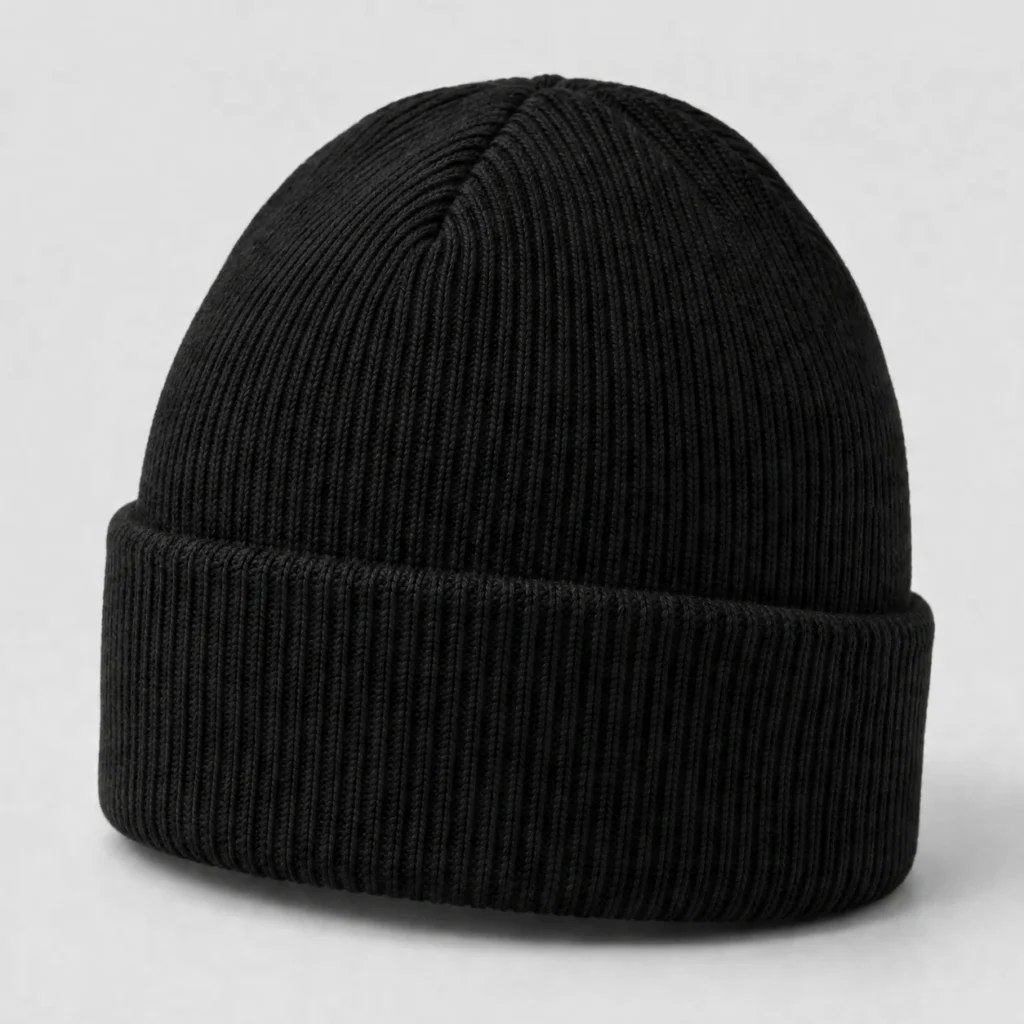
Gauge (GG) is the number of needles per inch on the knitting machine. A low gauge such as 3GG or 5GG gives a chunky knit with thick yarn; a high gauge such as 12GG or 14GG gives a fine, smooth, lighter beanie.
We knit from 3GG to 14GG. A classic cuffed logo beanie is usually 7GG, cable and fisherman styles 5GG, detailed jacquard 12GG, and thin helmet liners 14GG. Our guide to beanie knitting gauges and yarns maps each gauge to looks, yarns and styles.
Which stitches are used?
The stitch decides stretch, texture and how a logo shows. Rib is the standard because it stretches and recovers around the head.
| Stitch | What it looks like | Where it is usually used |
|---|---|---|
| 1×1 rib | Fine vertical lines, one knit and one purl stitch | Cuffs, classic cuffed beanies, watch caps |
| 2×2 rib | Wider, bolder ribs | Fisherman, oversized and chunky styles |
| Single jersey | Smooth face with small “V” stitches | Slouchy, skull cap, running beanies and helmet liners |
| Cable | Crossed columns that form twists or braids | Chunky winter beanies, usually at 5GG or lower |
| Waffle | A small square grid texture | Textured fashion beanies |
| Jacquard | A pattern or logo knitted in two or more colours | Logo bands, Fair Isle, camo and stripes |
The default for many styles is our acrylic rib knit: soft, springy and good at holding strong colours.
How is a knitted-in logo or pattern made?
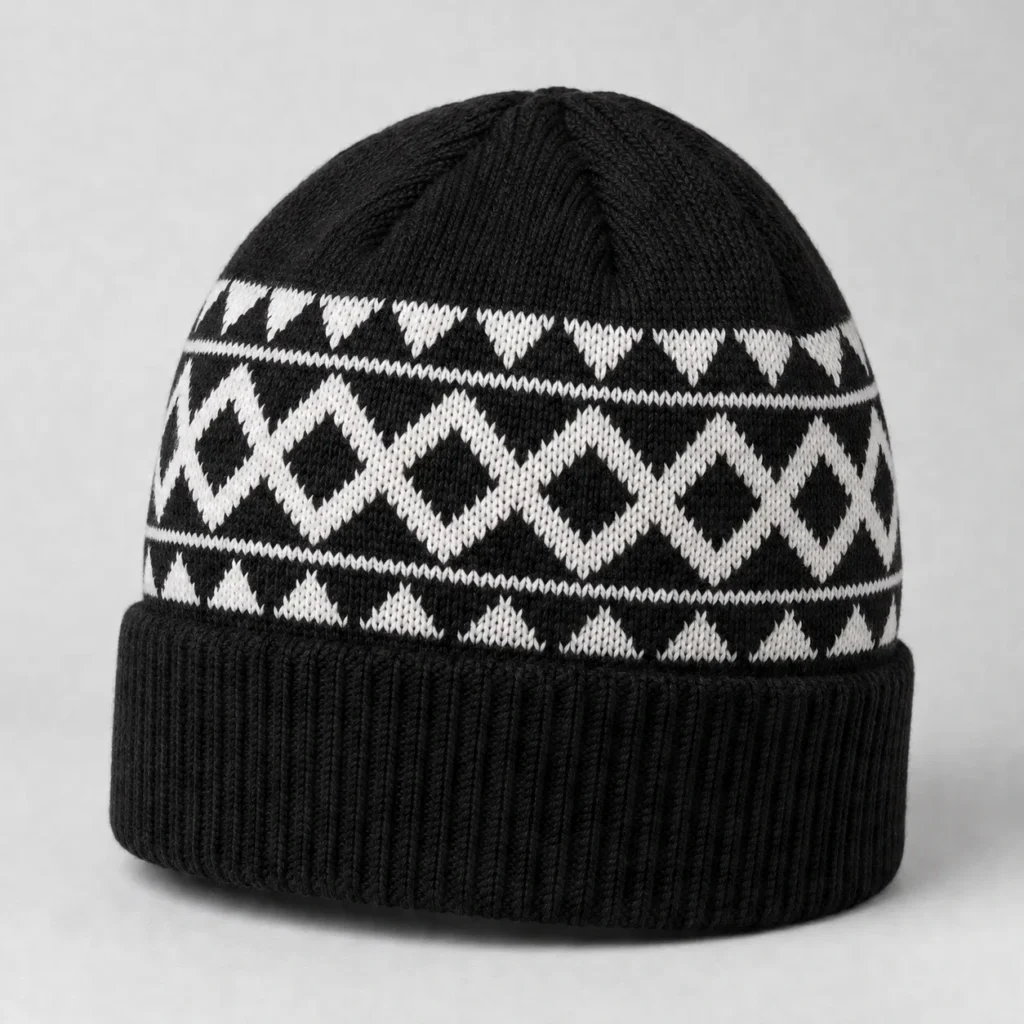
Your artwork is turned into a knit file, a grid where each square is one stitch in one yarn colour. The machine then knits that colour map into the fabric, so the design is part of the beanie rather than added on top.
Detail is limited by the gauge. Knitted-in logos usually use 2–4 colours; bold shapes and lettering work well, while small text needs a fine gauge such as 12GG and will not knit in clearly on a chunky one. Gradients and photographs do not translate into stitches. See our guide to jacquard beanies for pattern ideas, and approve the colours on the sample.
How is the crown of a beanie closed?
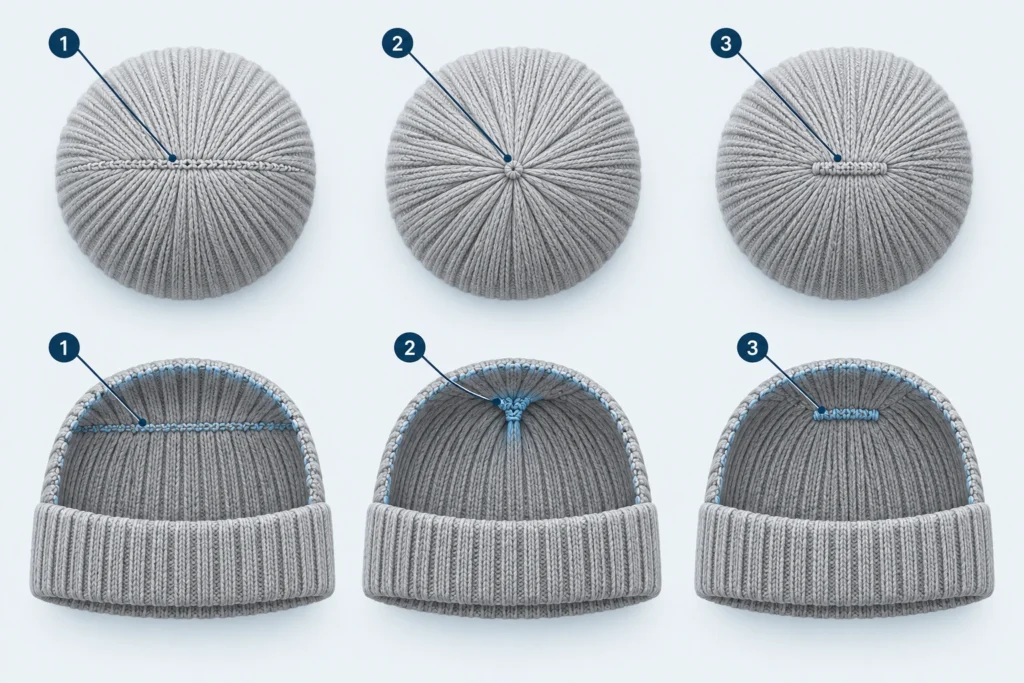
Once the piece is knitted, it is joined and the crown is closed. The three common methods are linking, gathering and a small seam, and the choice changes how the top looks and feels.
- Linking: the open loops are joined stitch by stitch on a linking machine, so the closure stretches with the knit and tends to lie fairly flat. Many of our catalogue beanies have a linked crown.
- Gathered top: a yarn is threaded through the last row of loops and pulled tight. It is simple and gives a small gathered point at the top, which is often covered by a pom-pom.
- Small seam: some shaped crowns are closed with a short sewn seam. It is quick and neat on the outside but can leave a slight ridge inside.
- Flat-linked crown: on fine helmet liners, the crown is linked as flat as possible so nothing presses under a helmet, as on our merino helmet liner.
What does “seamless” mean for a beanie?
A “seamless” beanie is knitted to shape, so it needs no cut-and-sewn panels. It is usually still closed once, at the crown or the back, by linking or a small seam.
Many buyers read “seamless” as “no join at all”. In practice, a flat- or circular-knitted beanie has an open end that must be closed; a well-linked closure is soft, flat and hard to spot, hence the word. A hat with no closure anywhere needs specialised whole-garment knitting, which is a different process from our standard production. If your brief needs that, tell us and we confirm with your quote what is possible.
How are the cuff, lining and pom-pom added?
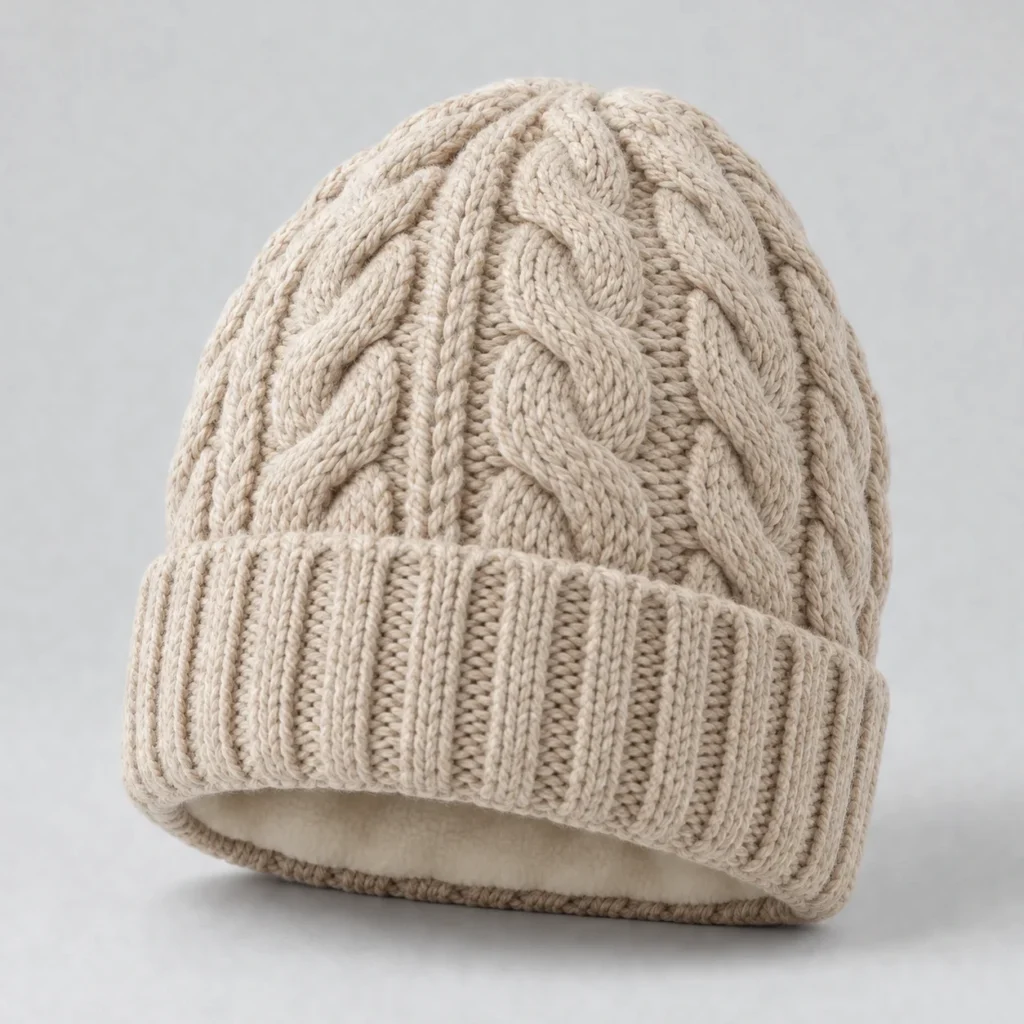
The cuff is knitted as an extra-long rib section and folded up. A lining or fleece band is cut and sewn inside, and a pom-pom is sewn or fastened onto the crown.
Cuffs and double layers
Folding the cuff gives a double thickness over the ears and a flat front for a logo. A double-layer beanie goes further: the body is usually knitted about twice as long and one half is turned inside the other, so the whole hat has two knit layers, as on our double-layer watch cap in 1×1 rib. Double-layer is not the same as lined; our guide to beanie linings and warmth explains the difference.
Linings and fleece bands
Linings are fleece (polar fleece or microfleece), cotton jersey or satin. They come as a band inside the brim, around the forehead and ears, or as a full lining up into the crown. The lining is cut to size and sewn into the knit shell, which tends to keep it in place better than a lining tacked only at the edge. A lining also reduces stretch a little, so the fit is checked on the sample.
Pom-poms
A yarn pom-pom is made from the same or a contrasting yarn and sewn firmly onto the crown. A faux fur pom-pom is sewn on, or made detachable with a press stud so it can come off for washing. Detachable pom-poms are for adult beanies only: small detachable parts are not suitable for children, so kids’ beanies get a sewn-on pom-pom or none. Our beanie pom-pom guide compares the options.
How is a beanie decorated?
A logo is either knitted in during knitting or added afterwards. Added methods include flat and 3D embroidery, patches, metal logo plates, reflective logos and woven or printed labels.
- Embroidery: usually stitched on the flat front of the cuff. On lined styles it is usually done before the lining goes in, so the back of the stitches is covered.
- Patches: woven, leather-look, rubber (PVC) or silicone patches are sewn on around the edge.
- Metal logo plates: a small plate fixed to the cuff, for a more fashion-led look.
- Reflective logos: a reflective label or detail, which suits workwear and running beanies.
- Labels: a woven flag label on the side of the cuff, an inside brand label, a care label, hang tags and packaging.
Flat prints such as screen printing and sublimation do not sit well on a knit; heat transfer is possible only on smooth sports beanies in fine single jersey. Fuzzy yarns such as mohair, alpaca and cashmere blur fine detail, so labels, patches or bold knitted-in designs usually suit them better. The guide to custom logo beanies compares every method, and our decoration methods table covers all products. We only use designs you own or are licensed to use, and Mr Balaclava’s name never appears on your products.
How is a beanie finished and checked?
Each beanie is steamed to shape, trimmed of loose ends and inspected by hand, then labelled and packed to your specification.
Steaming relaxes the knit so the stitches settle evenly and the size stays consistent across the order; the beanie is usually steamed on a form. Quality is then checked twice: first on the sample, which you approve, and again before dispatch, when pieces are checked against the approved sample for size, stitches, crown closure, logo position, trims and labels. Our quality control page explains how this works across all products.
Packing follows your brief, from a plain polybag to a retail box, and orders ship with tracking.
Hand crochet or a machine-made crochet look?
Real crochet is made by hand with a hook, loop by loop. A machine-made crochet look reproduces a similar texture on knitting machines.
Hand crochet has the most authentic texture but takes longer than standard production; its lead time is confirmed with the order. The machine-made crochet look follows the standard lead time and is more uniform. Our crochet beanie page shows both routes.
How long does it take to make custom beanies?
A pre-paid physical sample takes about 5–7 days. Standard production takes approximately 14 days after sample approval, and the schedule is confirmed for each order.
Seven days is possible on request; complex or very large orders of 100,000–200,000 pieces can take up to one month. Capacity is around 100,000 pieces a month. What usually moves the timeline:
- Yarn: special yarns or dyed-to-match colours can add time.
- Jacquard: the knit file and colours are approved on the sample.
- Trims: linings, pom-poms, plates and custom labels are extra steps.
- Approvals: production starts once the sample is approved.
Express shipping by DHL, FedEx or UPS then usually takes 3–6 working days.
How to choose the right construction
Start from how the beanie will be worn and branded; gauge, stitch and trims follow.
| Use or goal | Construction that usually suits | Why |
|---|---|---|
| Classic logo beanie | 7GG 1×1 rib, linked crown, folded cuff | Flat cuff front for embroidery, a patch or a label |
| Chunky winter or fashion beanie | 3–5GG rib or cable, often with a pom-pom | Bold texture and a warm, heavier feel |
| Knitted-in logo or pattern | 12GG jacquard with a rib cuff | Fine gauge shows detail; the design is part of the knit |
| Under a helmet | 12–14GG jersey or rib, flat-linked crown | Thin, smooth and low, nothing pressing inside |
| Workwear and cold sites | Double-layer rib or a fleece band | Extra layer over the ears |
| Handmade look | Hand crochet, or a machine crochet look for larger runs | Texture versus lead time |
Ordering custom beanies from Mr Balaclava
Custom beanies start at 50 pieces per design, with standard production of approximately 14 days after sample approval. Knitting to shape and finishing are done in-house in Sialkot.
What to send with your brief
- The style, or a reference beanie or photo
- Yarn and colours, as Pantone references if you have them
- Your logo as a vector file, with the method and placement you want
- Trims: cuff, lining, pom-pom, labels and packaging
- Sizes and quantities per design
- Your deadline and delivery country
Choose a pre-paid physical sample, made in about 5–7 days, or a free pre-production sample made after the order and the 30% advance payment and approved by photos, videos or a video call. Our guide to sample types explains both, and our custom knit beanie page lists the gauges, stitches and yarns we offer.
Frequently asked questions
Why does my beanie have a seam at the back or on top?
Because a knitted-to-shape piece has to be closed once. On most beanies the edges are linked stitch by stitch, which gives a soft, flat join that is usually placed at the back or the crown.
Can a logo be knitted into any beanie?
A knitted-in logo is possible on most styles, but detail depends on the gauge. Bold logos work at most gauges; small text needs a fine gauge such as 12GG, and fuzzy yarns blur fine lines.
Can I order fewer than 50 beanies?
No, 50 pieces per design is our minimum. It is already low for custom knitting, because the machine programme, colours and trims are set up for each design.
Do you wash beanies before packing?
Our standard finish is steaming to shape, which relaxes the knit and settles the size. If your design needs a special wash or a softer finish, tell us in the brief and we confirm it with your quote.
Ready to see the styles? Browse our custom beanies catalogue, read how we work across all products on our manufacturing process page, and when your brief is ready, ask for a quote.