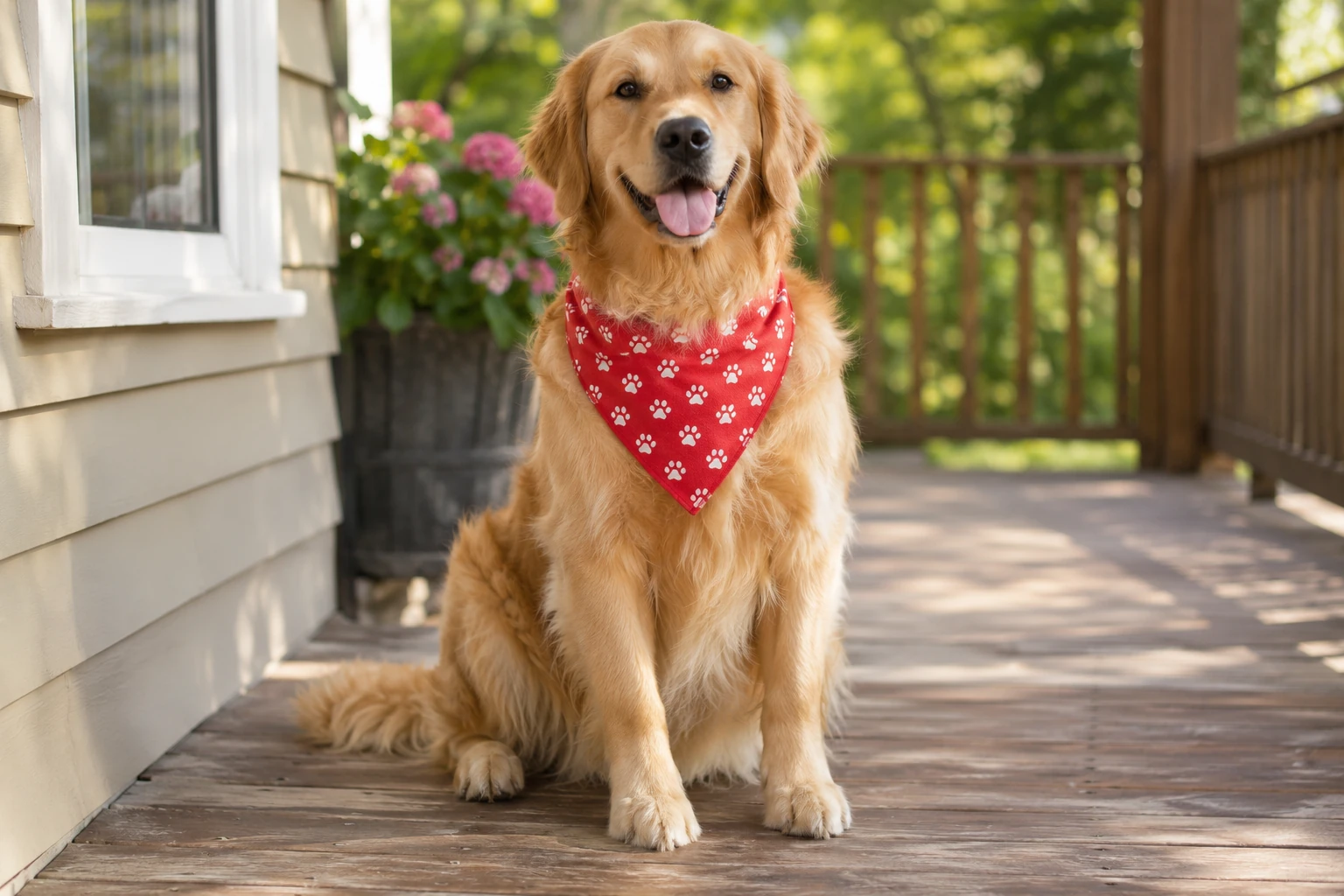
A dog bandana only looks right when it fits: too small and the knot pulls tight, too large and the point drags between the front legs. There is no industry standard, and every pet brand’s chart is a little different, so this guide gives typical sizes by neck circumference, explains the main styles and covers the fabrics, prints and safe-wear advice that matter when you sell pet bandanas. For bandanas in general, see our guide to bandanas explained.
We make pet bandanas for pet brands, pet shops, groomers, shelters and merchandise companies, cut, printed, hemmed and finished in-house in Sialkot, Pakistan, from partner-mill fabric. Human sizes are on our bandana size chart, and the full range is on our custom bandanas page.
What size bandana does my dog need?
Measure the neck where the collar sits and choose the size whose range includes that number: typically S up to about 33 cm, M about 33–46 cm, L about 46–56 cm and XL about 56–66 cm. If the dog is between two sizes, choose the larger one.
| Size | Neck circumference | Triangle, long edge | Square, folded | Typical breeds (examples) |
|---|---|---|---|---|
| S | up to about 33 cm (13 in) | about 55 cm (22 in) | about 40 × 40 cm | Chihuahua, Yorkshire terrier, toy poodle, miniature dachshund, most cats |
| M | about 33–46 cm (13–18 in) | about 65 cm (26 in) | about 46 × 46 cm | Beagle, cocker spaniel, French bulldog, Brittany, smaller doodles |
| L | about 46–56 cm (18–22 in) | about 75 cm (30 in) | 51 × 51 or 56 × 56 cm | Labrador, golden retriever, boxer, husky |
| XL | about 56–66 cm (22–26 in) | about 85–90 cm (34–35 in) | 69 × 69 cm | Bernese mountain dog, Newfoundland, Saint Bernard |
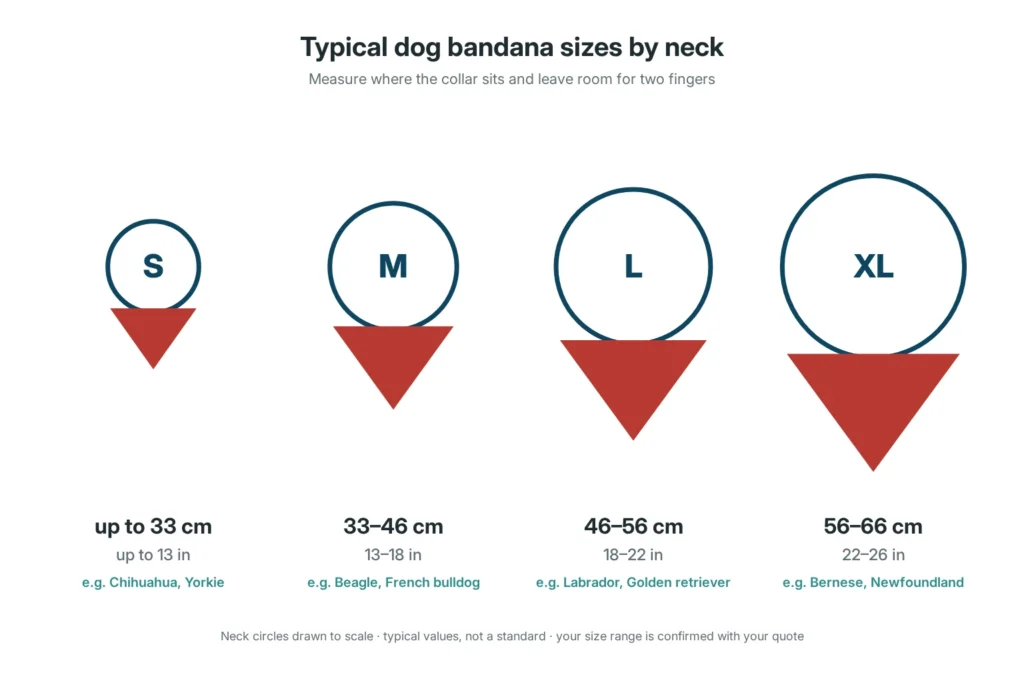
The triangle column follows a simple rule: the long edge needs the neck measurement plus roughly 20–25 cm for the two tie ends. The square column works because a square folded corner to corner gives a long edge about 1.4 times its side, which is why our adult 51 and 56 cm squares fit many large dogs and the 69 cm oversized square suits giant breeds. Very small breeds and puppies may need an extra XS, and very large dogs an XXL; both can be made to your specification.
How do you measure a dog for a bandana?
Use a soft tape measure around the neck where the collar normally sits, with two fingers between the tape and the neck. That figure is the neck size to compare with the chart.
- Measure with the dog standing or sitting calmly, head up, not straining on a lead.
- Keep two fingers under the tape so the bandana will not sit tight; some charts suggest adding about 5 cm (2 in) instead.
- If you have no soft tape, wrap a piece of string around the neck, mark it and measure the string flat.
- Between two sizes, choose the larger one; a tie bandana can always be knotted a little tighter.
- For puppies, size for the current neck and expect to size up as they grow.
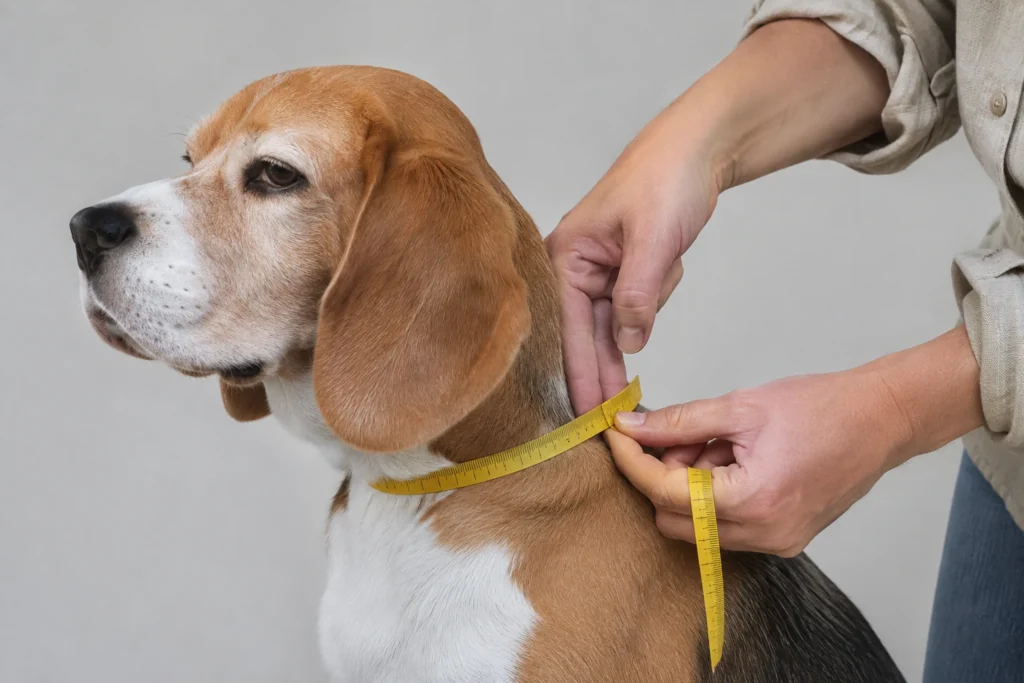
For a range, ask a handful of customers or a groomer for neck measurements of the breeds you serve before you fix your size breaks. Retail charts disagree by several centimetres, so your own data is a more reliable starting point.
Triangle or square: which pet bandana style should you choose?
Triangle bandanas are cut to shape and tie with less bulk; square bandanas are folded first and can double as a human bandana. We make both, in the sizes of your range.
| Style | How it is worn | Sized by | Points to know |
|---|---|---|---|
| Triangle | Tied at the back of the neck, point on the chest | Neck circumference; long edge of the triangle | Less fabric than a folded square, so a lighter knot; prints on one layer |
| Square | Folded into a triangle, then tied | Neck circumference; side of the square | Two layers at the front; the same piece can match an owner’s bandana |
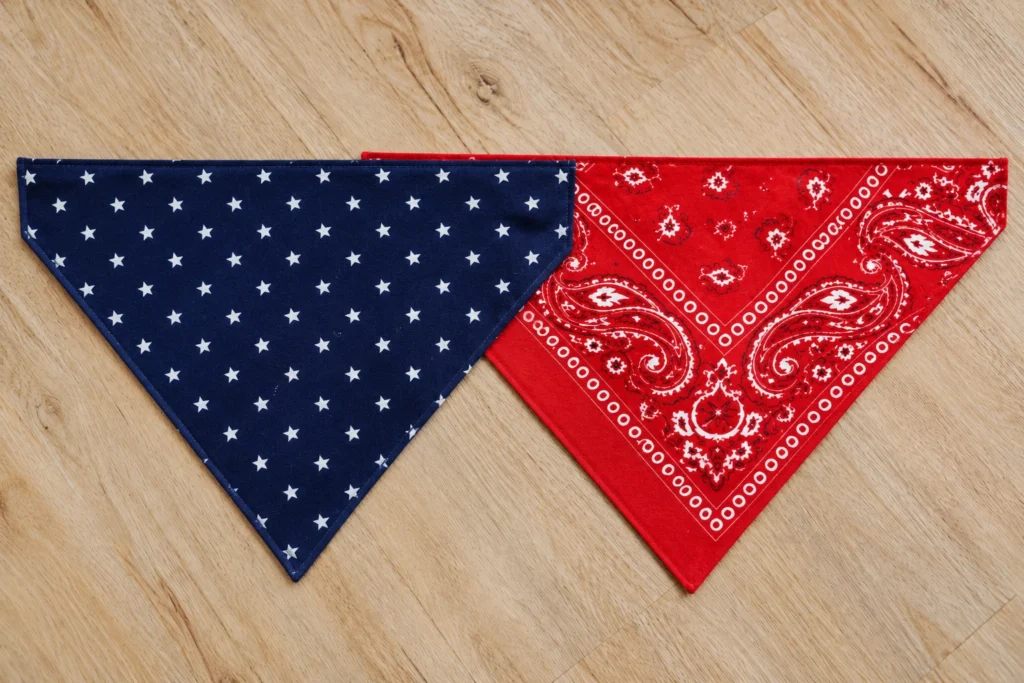
Triangles are the usual style for pet shops, and our pet bandana is a triangle in S, M and L as standard, with XL and other sizes made to your range. Squares make sense when the same print is sold to owners as well, and our bandana tying guide shows the basic triangle knot.
Which fabrics suit pet bandanas?
Cotton poplin is the usual choice: soft, light, easy to knot and easy to wash. Polyester twill suits full-colour sublimated prints, and cotton voile gives a lighter bandana for warm weather.
| Fabric | Feel | Print options | Good for |
|---|---|---|---|
| Bandana cotton (poplin) | Soft, matt, softens with washing | Screen, discharge, digital, small embroidery | Everyday pet bandanas, paw prints, logos, pet-and-owner sets |
| Polyester twill | Smooth, light, holds a knot | Sublimation, screen, digital | Photo-style and full-colour designs, event and team prints |
| Cotton voile | Very light and airy, slightly sheer | Digital, screen for simple designs | Summer ranges and small breeds |
| Polyester satin or velvet | Glossy or plush, more fluid | Sublimation or digital | Gift, holiday and occasion bandanas |
Pet bandanas are washed often, so wash behaviour matters more than for most accessories. A printed cotton bandana usually holds its colour well when washed as recommended, and dark or bright cottons should be washed separately for the first few washes. Our bandana fabrics guide compares every fabric in more depth.
How are pet bandanas printed and branded?
Simple repeats such as paw prints, bones or a shop logo are usually screen printed on cotton; many-colour or photo designs are digitally printed on cotton or sublimated on polyester. A small embroidered logo can sit near the point or on one corner.
On a triangle, the area that shows is the point and the space just above it, so a name, logo or slogan works well there, reading the right way up when the dog faces you. On a square, the design is printed with the fold in mind, since only one half shows once it is folded. Keep embroidery small and flat on pet bandanas, because a dense patch makes the point stiff. Our bandana printing guide compares the methods, and the bandana artwork guide covers print area and bleed, usually 5 mm on each side.
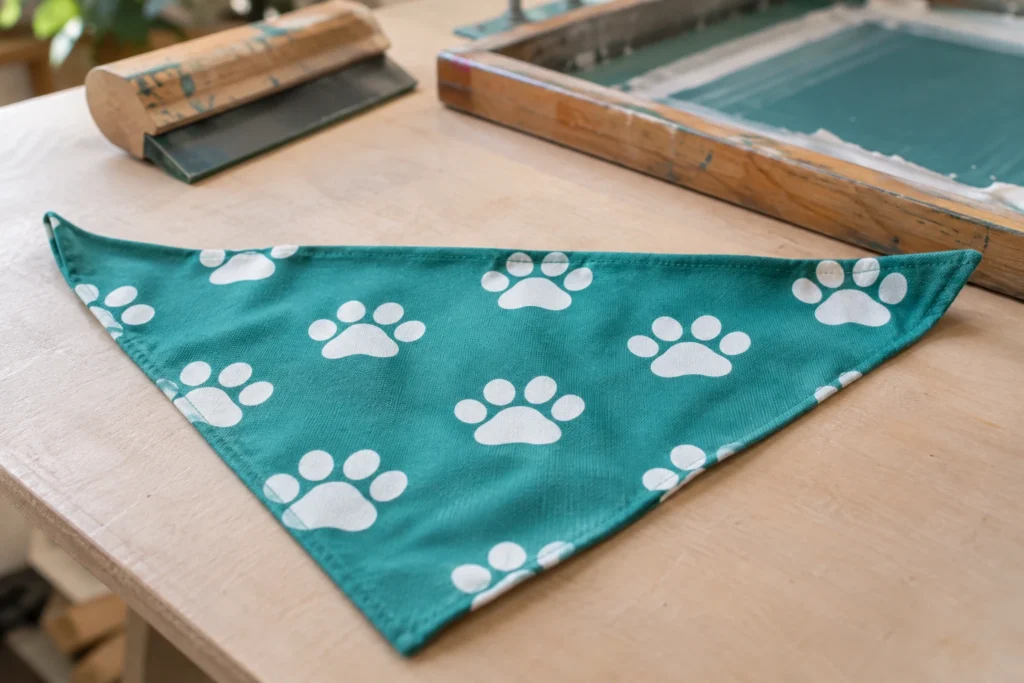
Matching sets are a popular gift idea: the same artwork on a pet triangle and on a 56 cm human bandana such as our classic paisley bandana. Each size is ordered as part of the design, and we send a mockup before production, which starts only after you approve it.
Are dog bandanas safe to wear?
A well-fitting bandana is a light accessory, but it should be worn while someone is around. Do not leave a dog wearing a bandana unattended, in its crate or while it plays rough with other dogs.
- Fit it loosely, with two fingers of room, and check the knot does not tighten when the dog moves.
- Keep pet bandanas free of cords, drawstrings, bells, beads, buttons and other small attached parts.
- Take the bandana off if it gets wet, snagged or chewed, and before the dog is left alone.
- Use soft fabrics and flat hems, and keep prints and embroidery on the outside.
- For brands: put simple wear and care advice on the header card or swing tag.
These are practical tips, not a safety standard. If you sell in a market with specific rules for pet accessories, tell us what your products need; we follow your specification, and it is confirmed with the quote.
Who orders custom pet bandanas?
Typically pet brands and pet shops, groomers, shelters and rescues, and merchandise companies running pet-friendly events. Each uses them differently.
- Pet brands and shops: seasonal and holiday prints in S to XL, often with matching human bandanas, sold under their own label through private label.
- Groomers: a branded bandana tied on after each groom, which carries the salon name home.
- Shelters and rescues: “adopt me” bandanas for events and fundraising, in one or two sizes.
- Merchandise and event companies: pet versions of a brand’s bandana for dog-friendly events, shops and promotions.
Because the minimum is 50 pieces per design, a first range can be tested in a small run; see our small runs page.
How should pet bandanas be labelled and packed?
Retail pet bandanas usually carry fibre content and country of origin, plus care instructions, and are packed flat or folded with a header card or swing tag showing the size.
Labelling rules differ by market: fibre content and origin labels are usually required for textiles in the US (Textile Act) and the EU (Regulation 1007/2011), and care labels typically follow ISO 3758 symbols; check what your market needs. A size sticker or printed size chart on the header card helps buyers choose online and in store. Our labels and packaging page lists the options, and Mr Balaclava’s name never appears on your products.
How to choose sizes for a pet bandana range
Start from the dogs your customers own, then keep the range as small as you can.
- Mixed-breed or general pet shop: S, M and L cover most dogs; add XL for large-breed customers.
- Small-breed boutique or cat range: S and M, possibly with an XS.
- Groomers and shelters: M and L, which fit most dogs loosely; S for small breeds.
- Pet-and-owner sets: one pet size range plus a 56 cm human bandana in the same print.
Ordering pet bandanas from Mr Balaclava
The minimum order is 50 pieces per design, and the split across sizes is agreed with the quote. Production takes approximately 14 days after sample approval; you can order a pre-paid physical sample, paid 100% in advance and made in about 5–7 days, or approve a free pre-production sample by photos or video after the order and the 30% advance, as our sample types page explains.
Catalogue bandanas start at about $1.30–$2.70 per piece at 50 pieces, depending on fabric, size and print. More customization, such as your own artwork, more print colours, all-over or two-sided prints, embroidery, special fabrics, labels and packaging, raises the price, and our team confirms the price for every custom order; our custom bandana cost guide explains what changes it.
What to send with your pet bandana request
- Style: triangle or square.
- Sizes and neck ranges, or the breeds you sell to, and quantity per size.
- Artwork, colours (Pantone references if you have them) and placement on the point.
- Fabric, or how and where the bandanas will be sold.
- Labels, header cards or swing tags, your deadline and the delivery country.
Frequently asked questions
What size bandana does a Labrador need?
Most Labradors and golden retrievers typically wear L, for a neck of about 46–56 cm. Measure the dog, since large males can need XL.
Can a dog wear a human bandana?
Often, yes: a 51 or 56 cm square folded into a triangle fits many large dogs. Small dogs need a smaller square or a triangle, or the ends become bulky.
What size bandana for a puppy?
Measure the puppy’s neck now and choose that size, usually S or XS. Puppies grow quickly, so plan to size up within weeks or months.
Can cats wear pet bandanas?
Cats usually fit the smallest size, a small triangle tied loosely. Keep the same rules as for dogs: no small parts and no wear while unattended.
Do you make matching dog and owner bandanas?
Yes. The same artwork can run on a pet triangle and a 51, 56 or 69 cm human bandana; each size is part of the same design order.
See every style in our bandana catalogue, or send us your pet bandana sizes and artwork for a quote.