
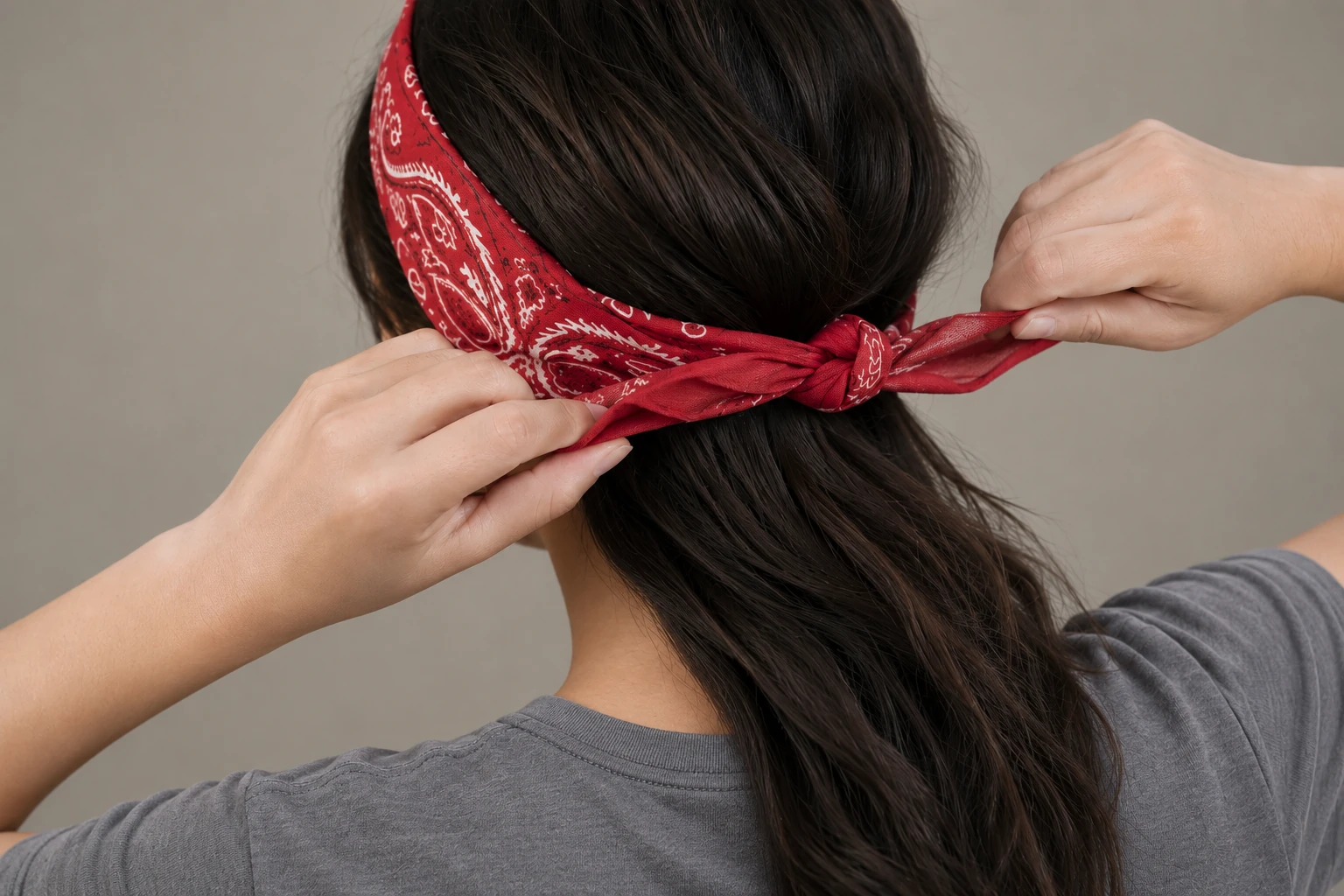
A bandana is a square of light printed fabric, and almost everything people do with it starts with one of two folds. Learn those, and the twelve ways in this guide follow in a few movements each. If you want the background first (what a bandana is, the sizes, fabrics and prints), our complete guide to bandanas covers it all.
Each way below has numbered steps, the size that suits it in centimetres and inches, and the mistake people make most often. The guide is written for wearers and for the brands, shops, festivals and clubs that sell or hand out bandanas; if you plan your own, our custom bandanas page shows what we make.
Which bandana size suits which way of tying?
A 56 × 56 cm (22 in) bandana suits almost every adult style. Choose 69 × 69 cm (27 in) for full head wraps and long ends, and 51 × 51 cm (20 in) for wrists, hair ties and children.
The size on the label is the flat square. Once it is folded, the useful length is roughly the diagonal: about 72 cm for a 51 cm bandana, about 79 cm for 56 cm and about 98 cm for 69 cm. An adult head usually measures about 54–60 cm around and a neck about 33–43 cm, and a knot needs another 15–20 cm, which is why the standard size works for most people. Our bandana size chart gives every size, including kids’, pet and tube bandanas.
| Way to tie | Fold | Size that suits it | Why |
|---|---|---|---|
| Headband | Band | 56 cm (22 in) | Band of about 79 cm goes round the head with short ends |
| Head wrap (pirate style) | Triangle | 56 cm (22 in); 69 cm (27 in) for thick hair | The triangle must cover the head and still knot at the nape |
| Around the neck, knot at the back | Triangle | 56 cm (22 in) | Front point sits on the chest, ends meet behind |
| Around the neck, knot at the front | Triangle or band | 51 or 56 cm (20 or 22 in) | Small, neat knot under the chin |
| Cowboy neckerchief | Triangle | 56 or 69 cm (22 or 27 in) | Larger triangle drapes over the chest |
| Over the nose and mouth (look) | Triangle | 56 or 69 cm (22 or 27 in) | Must reach behind the head with room to knot |
| Wristband | Band | 51 cm (20 in) | Shorter band wraps twice without bulk |
| Ponytail or hair tie | Band | 51 or 56 cm (20 or 22 in) | Ends hang a little below the knot |
| On a bag | Band or loose square | 51 or 56 cm (20 or 22 in) | Fits round a handle with visible ends |
| Pocket square | Folded square | 51 cm (20 in) or a smaller custom square | Less fabric to fit in the pocket |
| On a hat | Band | 56 cm (22 in) | Band reaches round the crown and ties |
| Tube bandana | None | About 25 × 50 cm tube | Pulls on, no knot |
What are the two basic bandana folds?
The triangle fold and the band fold. Fold the square corner to corner for a triangle; roll or fold that triangle from the long edge to the point for a band.
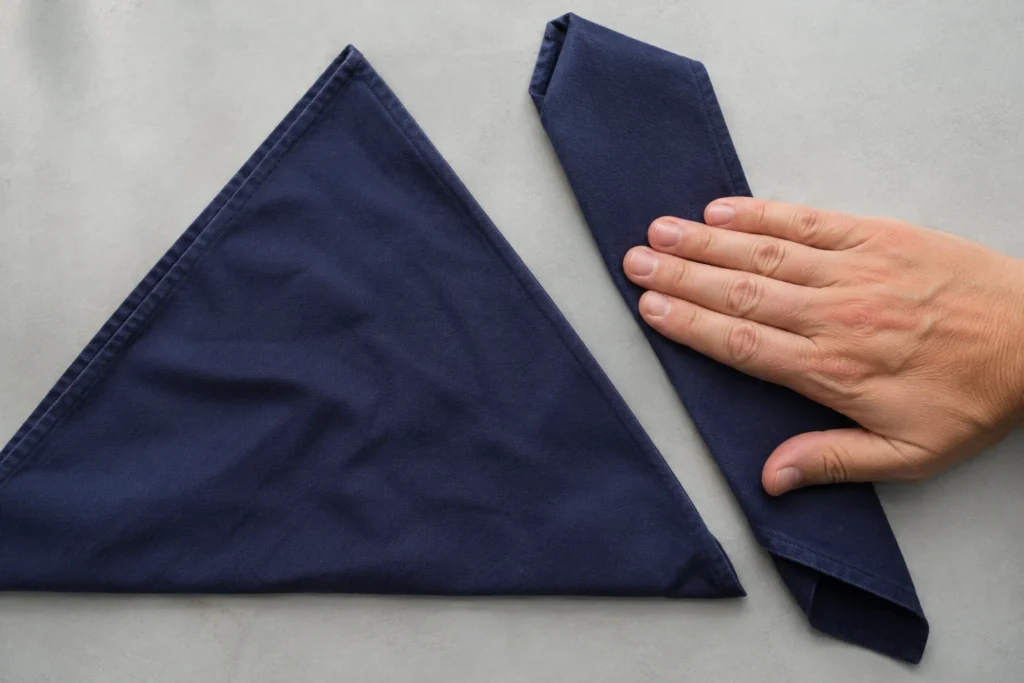
The triangle fold
- 1. Lay the bandana flat, wrong side up if it is printed on one side only.
- 2. Take one corner and fold it over to the opposite corner, so you have a triangle.
- 3. Line up the corners and smooth out the fold with your hand.
The band (strip) fold
- 1. Make the triangle fold.
- 2. Fold the point up to the long edge, then fold the band in half again, and again, until it is as wide as you want, usually 3–8 cm.
- 3. Keep each fold flat and the same width; a twisted band shows the plain back.
The fold also decides which part of the print shows. A corner logo ends up on the point of a triangle, while the middle of the square disappears into a band. Our bandana artwork guide shows where to place a design so it stays visible when the bandana is folded.
How do you tie a bandana? 12 ways, step by step
Here are twelve common ways, from the head down. Each one uses the triangle fold, the band fold or no fold at all.
1. As a headband
The folded band sits across the forehead or just behind the hairline and knots at the nape. Size: 56 cm (22 in), folded about 5–8 cm wide.
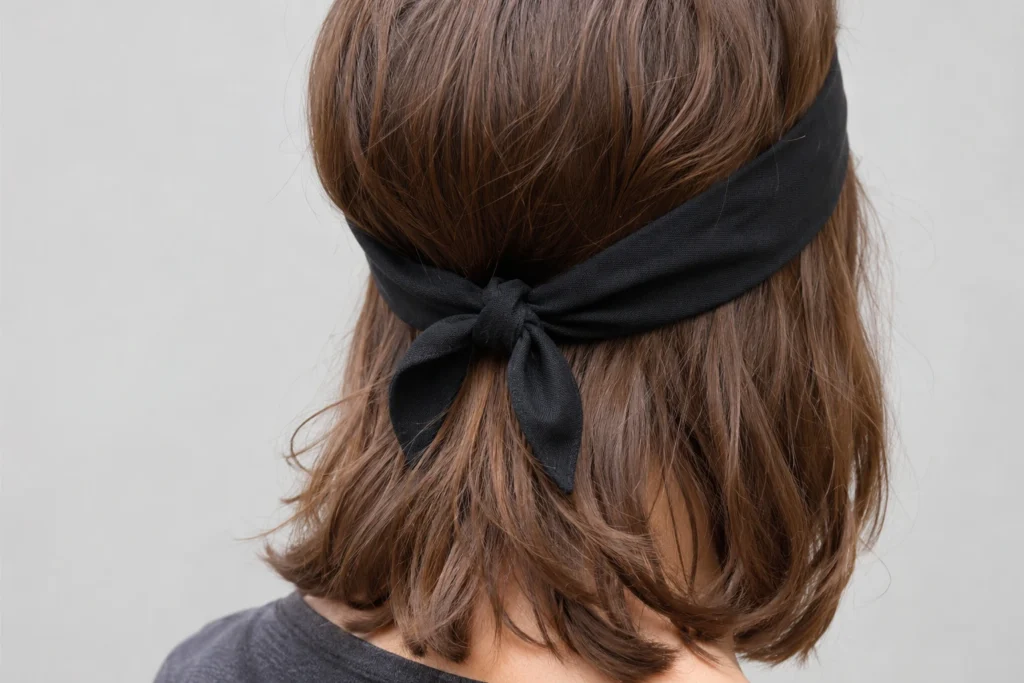
- 1. Make the band fold, about 5–8 cm wide.
- 2. Place the middle of the band on your forehead or just behind the hairline.
- 3. Bring both ends round to the back of your head, under your hair or over it.
- 4. Tie a double knot at the nape and tuck the ends in or let them hang.
Common mistake: tying it too tight. A headband that presses on the forehead slips up; one that sits just firm stays in place.
2. As a head wrap (pirate style)
The triangle covers the top of the head and knots at the back over the point. Size: 56 cm (22 in); 69 cm (27 in) for thick or long hair.
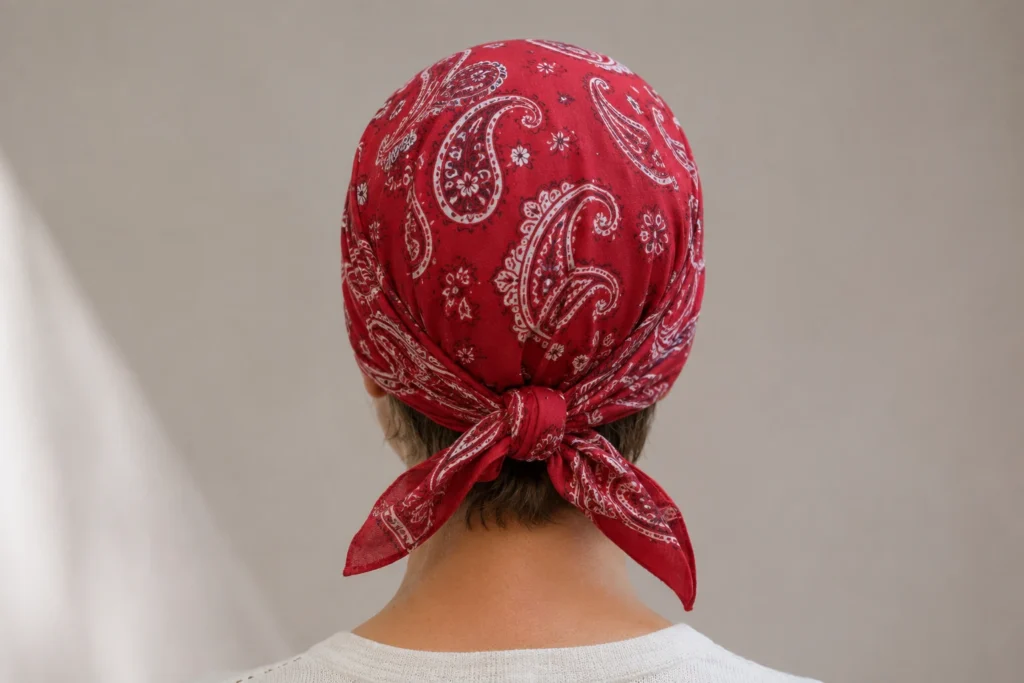
- 1. Make the triangle fold.
- 2. Lay the long edge across your forehead, with the point hanging down the back of your head.
- 3. Bring the two ends to the back, over the point, and tie a double knot at the nape.
- 4. Tuck the point under the knot, or let it hang.
Common mistake: using a bandana that is too small. If the ends barely meet, take the next size up rather than tying a tight knot that pulls the fabric off the crown.
3. Around the neck, knot at the back
The point hangs at the front over the chest and the ends knot behind the neck. Size: 56 cm (22 in).
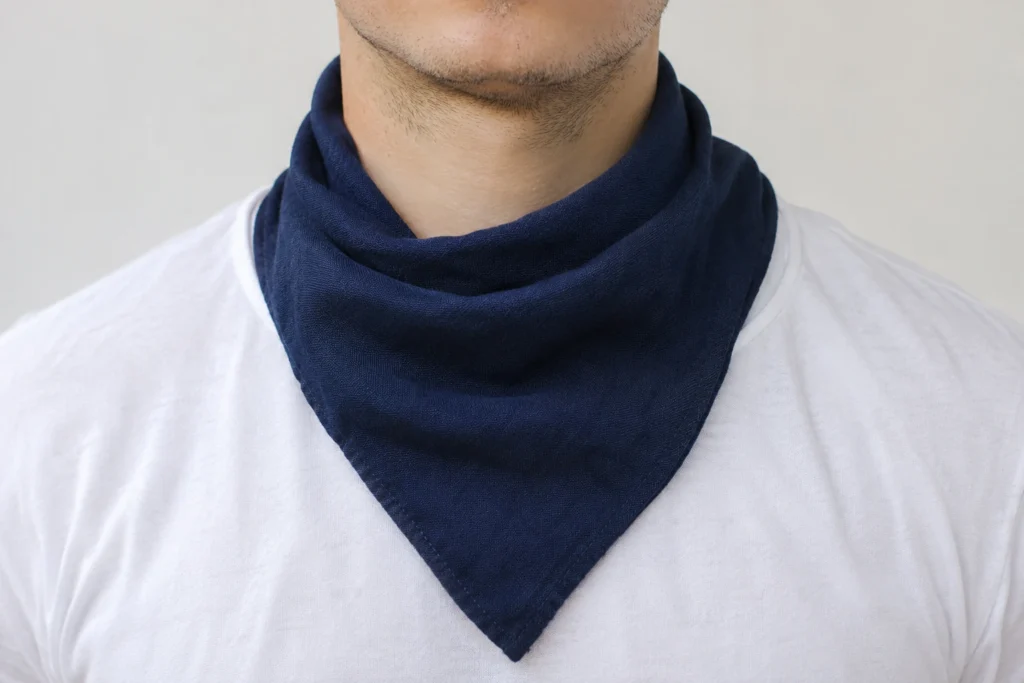
- 1. Make the triangle fold.
- 2. Hold the long edge against your throat, with the point hanging down your chest.
- 3. Bring the ends round to the back of your neck and tie a loose double knot.
- 4. Pull the point straight and turn the knot so it sits flat.
Common mistake: a knot pulled tight against the neck. Leave room for two fingers.
4. Around the neck, knot at the front
A neat, small look: the bandana sits close to the neck and the knot sits under the chin or slightly to one side. Size: 51 or 56 cm (20 or 22 in).
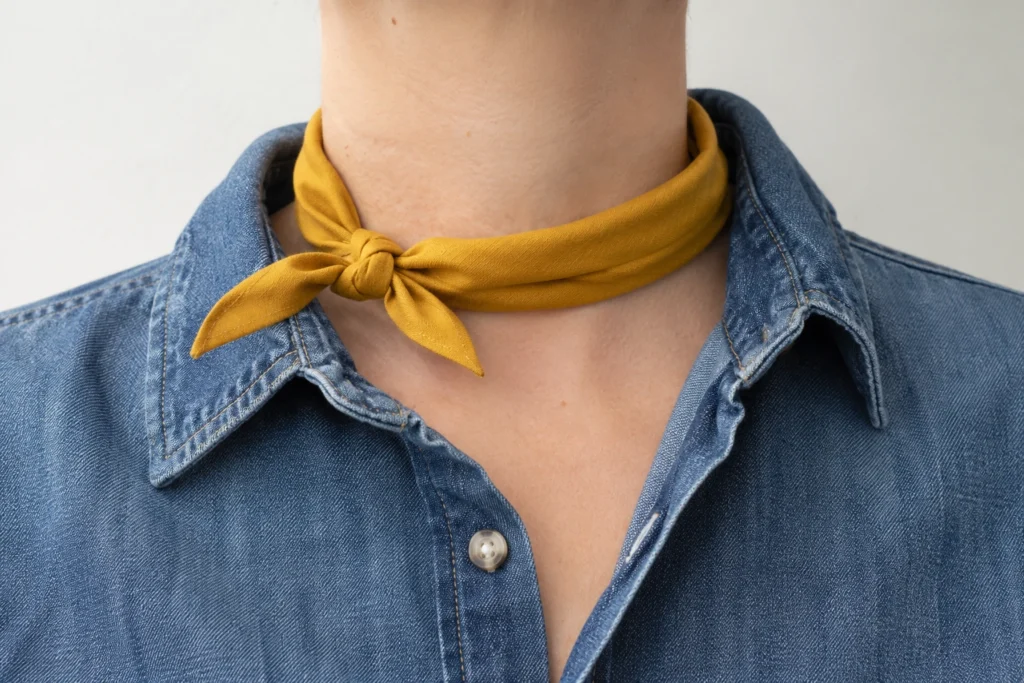
- 1. Make the triangle fold, then fold it into a loose band about 8–10 cm wide.
- 2. Lay the middle of the band at the back of your neck.
- 3. Bring both ends to the front and tie a single or double knot under the chin.
- 4. Slide the knot to one side if you prefer, and tuck the ends under a collar.
Common mistake: folding the band too wide. A wide band bunches under the chin; narrower looks neater.
5. Cowboy neckerchief style
The classic workwear look: a large, loose triangle sits low over the collarbone, and the ends cross behind the neck and knot at the front, hidden under the point. Size: 56 cm (22 in), or 69 cm (27 in) for a fuller drape and longer ends.
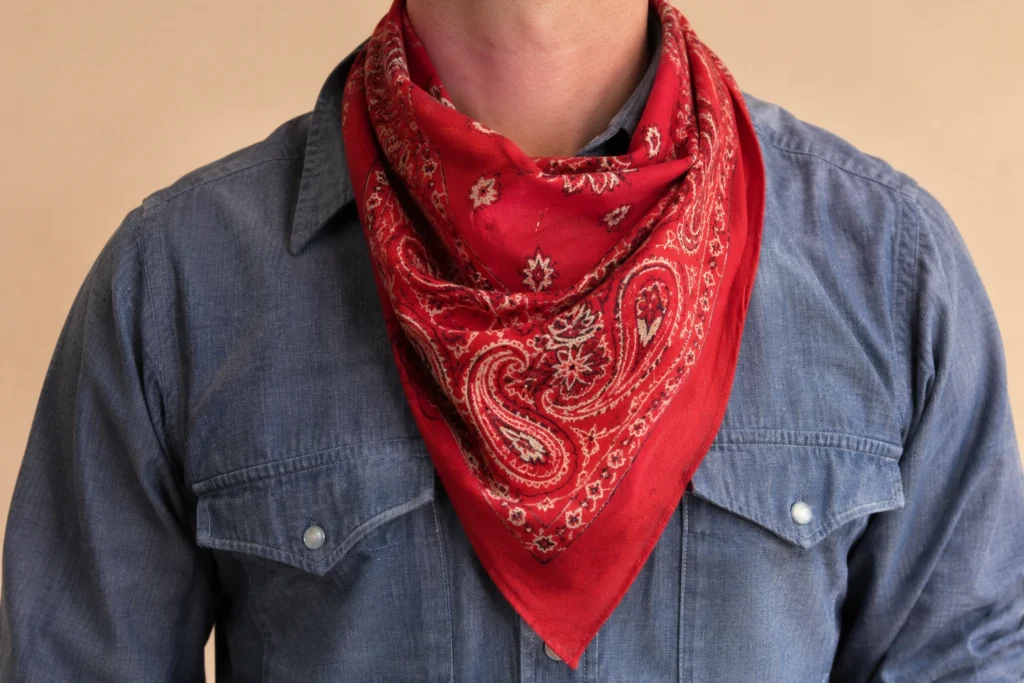
- 1. Make the triangle fold.
- 2. Hold the long edge against your throat, with the point hanging over your chest.
- 3. Take the ends round the back of your neck, cross them there and bring them back to the front.
- 4. Tie the ends in a loose knot under the point, then pull the point down over the knot so it hangs evenly.
This style is close to a uniform neckerchief, and the two are often confused; our guide to bandanas vs neckerchiefs explains the difference. Common mistake: tying it close to the neck; the cowboy look is loose and sits low.
6. Over the nose and mouth (a face-cover look)
Worn high, the triangle covers the nose and mouth and knots at the back of the head, a look seen at festivals and in fashion shoots. It is a style only: a bandana is not a mask or safety equipment. Size: 56 cm (22 in), or 69 cm (27 in) for more fabric under the chin.
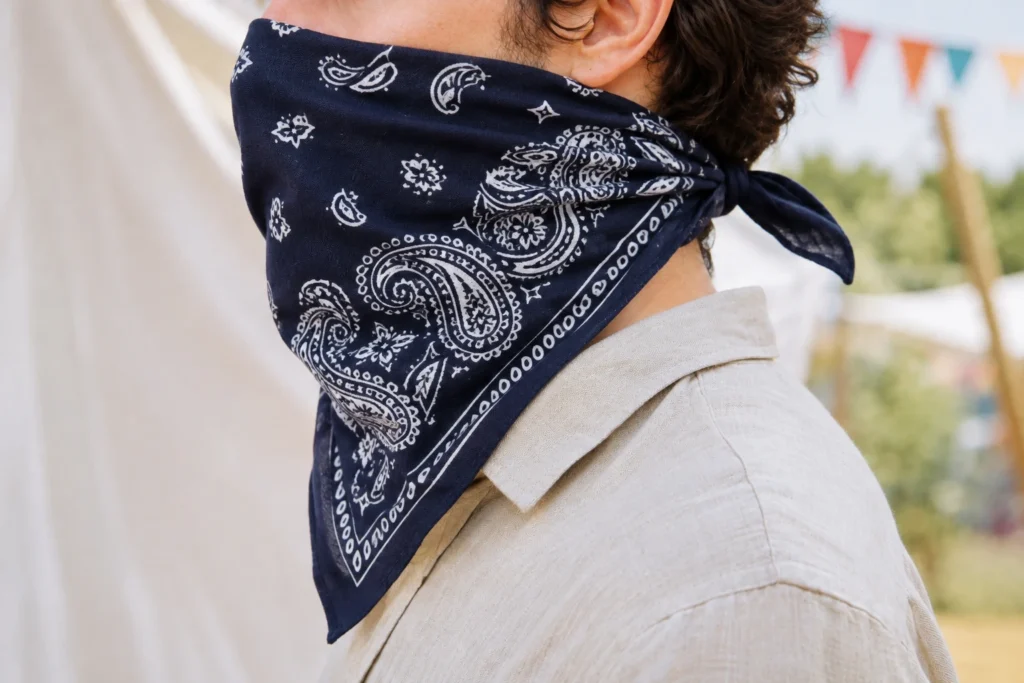
- 1. Make the triangle fold.
- 2. Place the long edge across the bridge of your nose, with the point hanging below your chin.
- 3. Bring the ends round, above your ears, and tie a double knot at the back of your head.
- 4. Adjust the edge so it sits comfortably and you can breathe and speak freely.
To cover the head and neck as well, a scarf can be wrapped into a fuller shape, shown in our guide to tying a scarf like a balaclava. Common mistake: tying the knot low on the neck, which pulls the bandana down off the nose.
7. As a wristband
A narrow band wrapped twice round the wrist and knotted. Size: 51 cm (20 in); a 56 cm bandana works with an extra wrap.
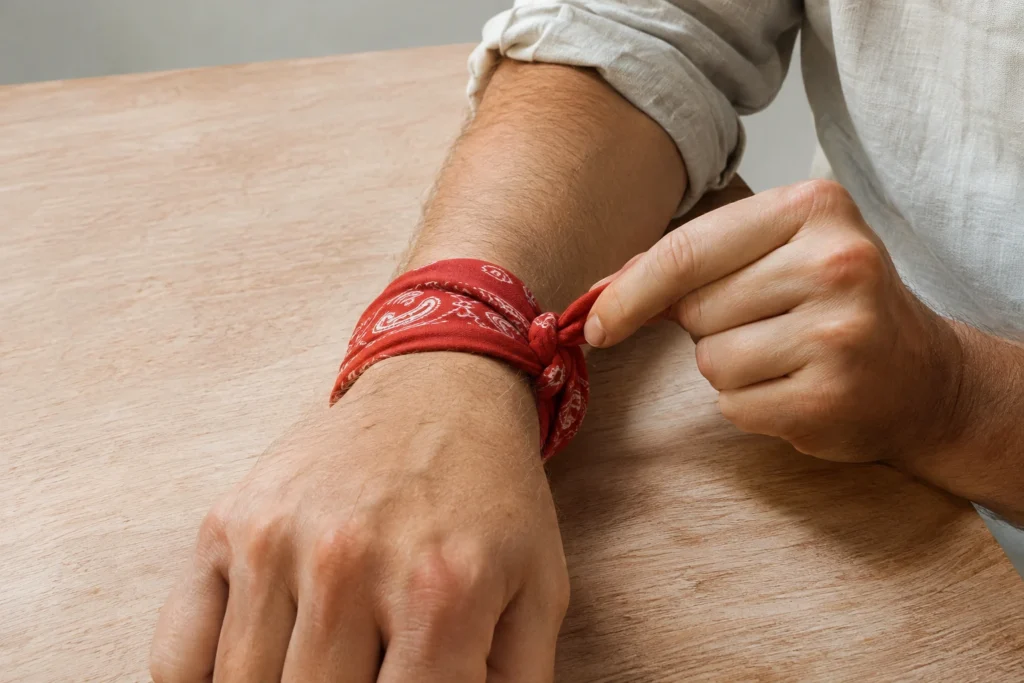
- 1. Make the band fold, about 3–4 cm wide.
- 2. Hold one end against the inside of your wrist and wrap the band round twice.
- 3. Tie the two ends in a small double knot; a second pair of hands makes this easier.
- 4. Tuck the ends under the wraps for a clean look.
Common mistake: a band that is too wide. Above 4 cm it stiffens and stands up off the wrist.
8. As a ponytail or hair tie
The band ties round a ponytail, bun or plait over a hair elastic, with the ends hanging as a bow. Size: 51 or 56 cm (20 or 22 in).
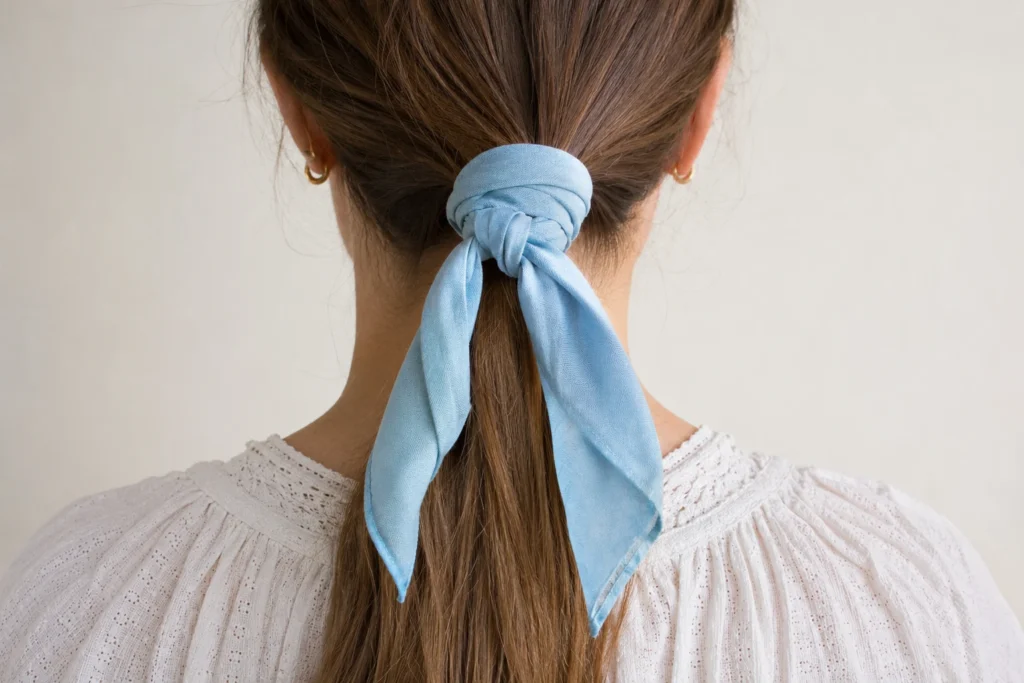
- 1. Tie your hair with an elastic first; the bandana is the decoration, not the hold.
- 2. Make the band fold, about 4–6 cm wide.
- 3. Wrap the middle of the band under the ponytail and bring both ends up over the elastic.
- 4. Tie a double knot or a bow and let the ends hang.
Satin and voile bandanas are often chosen for hair because they are smooth or very light; our bandana fabrics guide compares how each one ties. Common mistake: skipping the elastic, so the bandana slides down.
9. On a bag
Tied round a handle or strap, a bandana adds colour to a tote, backpack or handbag. Size: 51 or 56 cm (20 or 22 in).
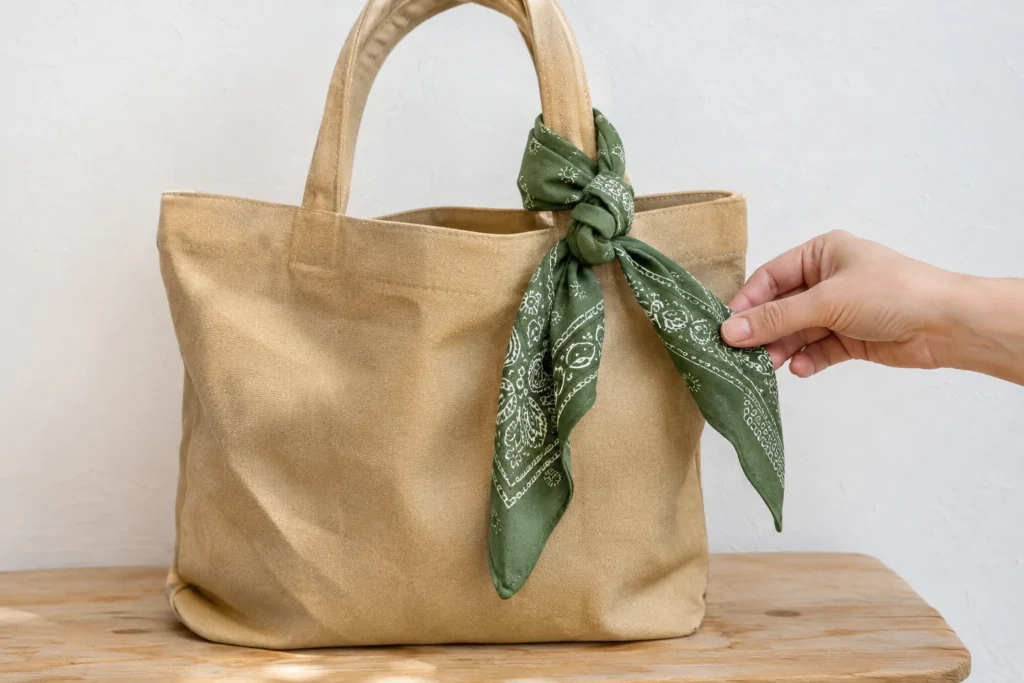
- 1. Make the band fold, or roll the bandana loosely from one corner to the other.
- 2. Pass the middle round the base of the handle or strap.
- 3. Tie a double knot or a bow, and spread the ends so the print shows.
Common mistake: tying it where the hand grips the handle; tie it close to the bag, where it stays clean.
10. As a pocket square
Folded small, a bandana works as a casual pocket square in a jacket or work shirt. Size: 51 cm (20 in) or a smaller square made to your size; a 56 cm bandana is bulky in a narrow pocket.
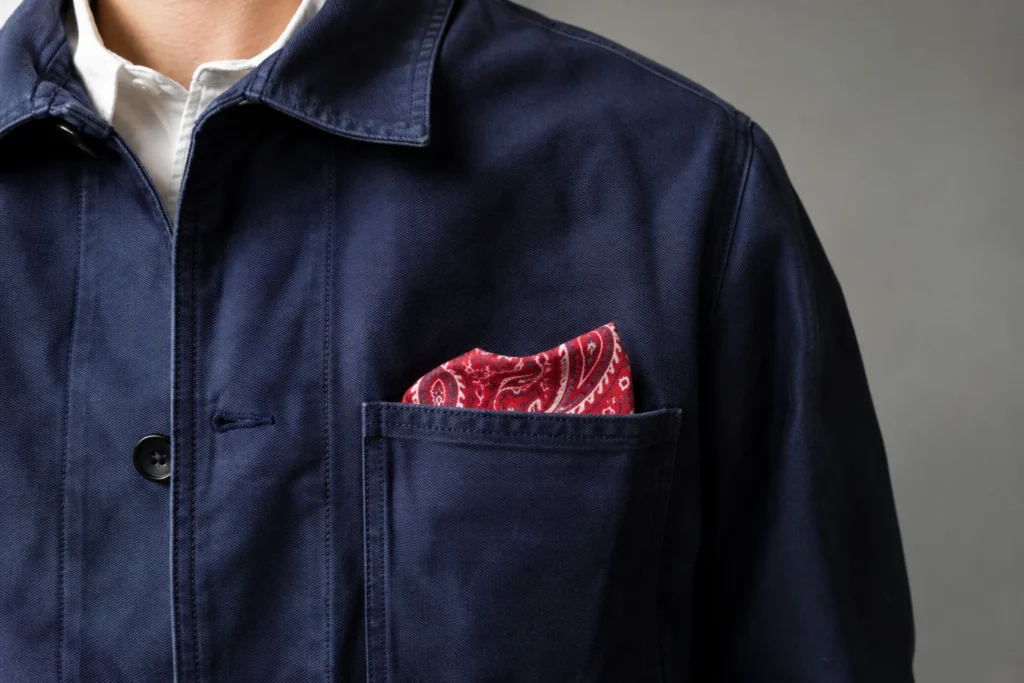
- 1. Lay the bandana flat and fold it in half, then in half again, to a square.
- 2. Fold the sides in until the width matches your pocket, about 10–12 cm.
- 3. Fold the bottom up so the square stands about 2 cm above the pocket edge.
- 4. Slide it in and fluff the top so a little print shows.
A paisley print is the classic choice here; our history of the paisley bandana explains where the pattern comes from. Common mistake: too much fabric, which makes the pocket bulge.
11. On a hat
A band tied round the crown of a hat becomes a hatband. It suits wide-brim, bucket and straw hats. Size: 56 cm (22 in).
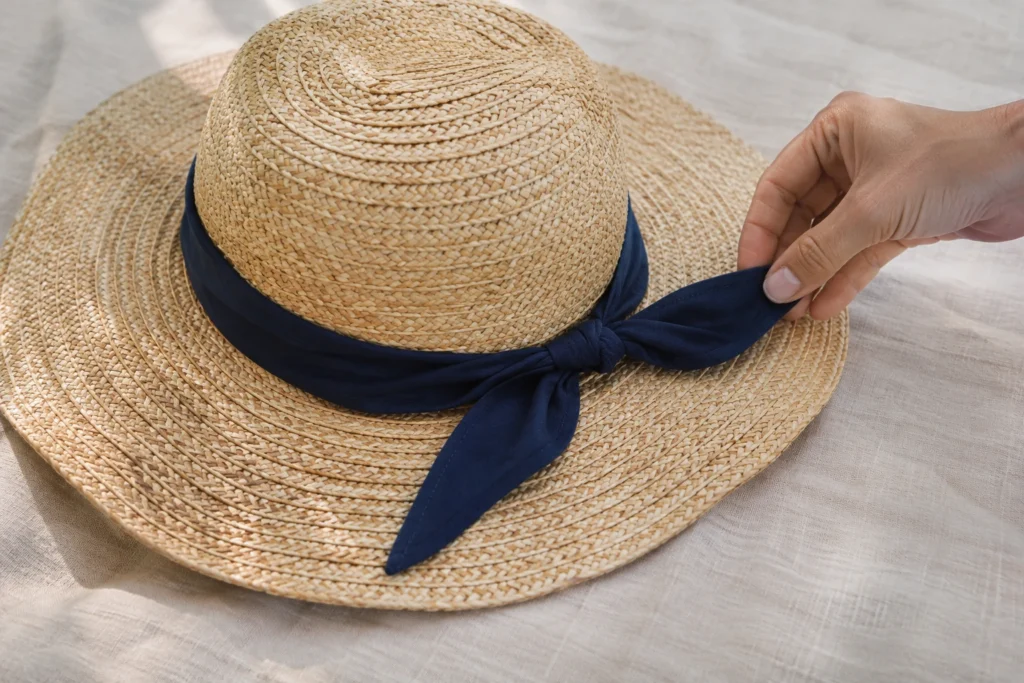
- 1. Make the band fold, about 3–5 cm wide.
- 2. Lay it round the base of the crown, where it meets the brim.
- 3. Tie a flat double knot at the side or the back.
- 4. Tuck the ends under the band if they are long.
Common mistake: tying it high on the crown, where it slides up; keep it at the base.
12. Tube bandana as a neck gaiter or headband
A tube bandana is a stretch tube of about 25 × 50 cm that pulls on with no knot. We make it as a seamless knitted tube or cut from stretch fabric and sewn with one seam. It is worn as a neck gaiter, a headband or a hair wrap.
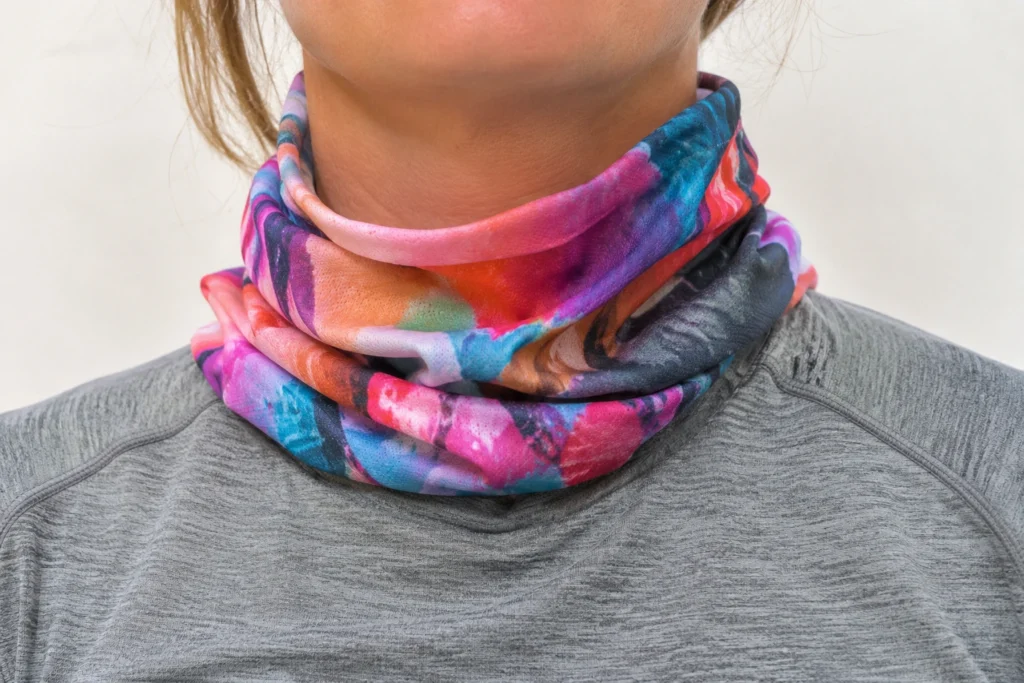
- 1. As a neck gaiter: pull the tube over your head and let it sit round your neck.
- 2. As a headband: fold one half of the tube back over the other to make a double band, then pull it on across the forehead.
- 3. As a hair wrap: pull it over the head like a hood, then fold the lower part up to the hairline.
- 4. As a wristband: fold it in four and slide it over the hand.
See our tube bandana in the catalogue, and our neck gaiters for warmer and longer styles. Common mistake: pulling the tube on by one edge, which stretches the ends out of shape; gather it and pull it over evenly.
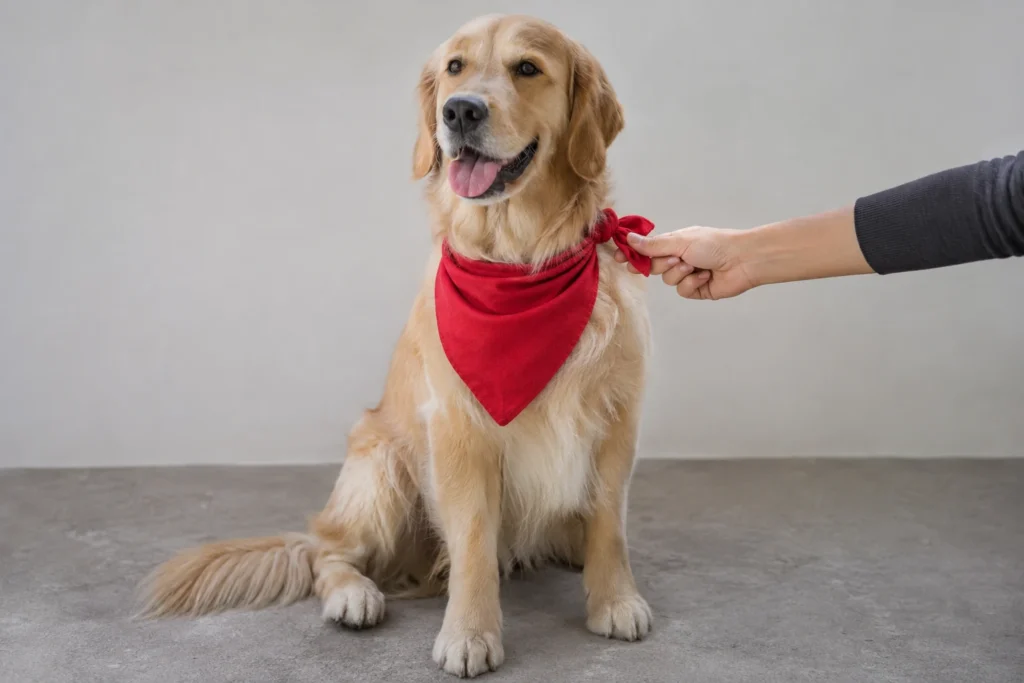
Bonus: on a dog
For dogs, use a triangle bandana sized to the neck and tie it loosely, with room for two fingers under the knot. A dog should not wear a bandana unattended. Our dog bandana size chart gives sizes from S to XL.
How do you keep a bandana from slipping?
Tie a double knot, keep the band flat and only as wide as you need, and choose cotton for head styles. Cotton grips hair and skin more than smooth satin.
- Double knot, not a bow, for head and neck styles; a bow loosens with movement.
- Flat folds. Press the band with your hand after each fold; twists make it roll.
- The right size. A bandana that is too small needs a tight knot and pulls itself off; take the next size.
- Cotton for the head. Cotton poplin holds a knot well; polyester satin is smoother and may need a hair pin.
- Washed once. A new cotton bandana is usually a little stiff and softens after the first washes. Wash bright colours separately at first; our care advice has the details.
For children, tie bandanas loosely, and do not add cords, toggles or small parts to kids’ bandanas. A kids’ bandana in 51 cm (20 in) is easier for small hands to tie.
How to choose a bandana for the way you will wear it
- Mostly on the head (headband, wrap): cotton poplin, 56 cm; 69 cm for wraps on thick hair.
- Mostly at the neck: cotton or polyester twill, 56 cm; polyester twill holds a neat knot.
- Hair, wrist and bag: 51 or 56 cm; satin or voile for a softer, lighter tie.
- Sport, running and cycling: a tube bandana, no knot to undo.
- A design that must stay visible: plan the artwork for the fold people will use, corner for triangles, edge for bands.
Ordering custom bandanas from Mr Balaclava
We make bandanas to order in Sialkot, Pakistan, from 50 pieces per design: fabrics from partner mills, cut, printed, hemmed, finished and branded in-house. Production takes approximately 14 days after sample approval, and Mr Balaclava’s name never appears on your products. For retail, bandanas can be folded and packed with your hang tag. Our bandana printing guide explains which print suits which fabric, and our custom bandana cost guide what changes the price.
What to send with your request
- Your artwork or logo, and where it should show when the bandana is folded
- Size (51, 56 or 69 cm, a tube, a pet size, or your own) and fabric
- Quantity per design (from 50 pieces)
- Your deadline
- Labels, hang tags or a folded retail pack with tying instructions
- Delivery country
Frequently asked questions
What is the easiest way to tie a bandana?
Around the neck with the knot at the back: fold it into a triangle, put the long edge at your throat and knot the ends behind. It takes about ten seconds.
How do you tie a bandana on your head so it stays?
Use a cotton bandana in the band fold, place it just behind the hairline and tie a double knot at the nape under your hair. Not too tight: a firm, flat band slips less than a tight one.
What size bandana do I need for a head wrap?
A 56 × 56 cm (22 in) bandana suits most adults; choose 69 × 69 cm (27 in) for thick or long hair, or if you want the ends to hang.
Can you tie a bandana as a headband with short hair?
Yes. Fold a narrow band of about 4–5 cm, place it across the forehead or at the hairline and knot it at the nape; a narrow band sits flatter on short hair.
Which side of a printed bandana should face out?
The printed side. Most bandanas are printed on one side, so fold with the print on the outside; on sublimated polyester the back is usually a little lighter.
Browse the bandana catalogue for styles to tie, or send your design for a quote.


