
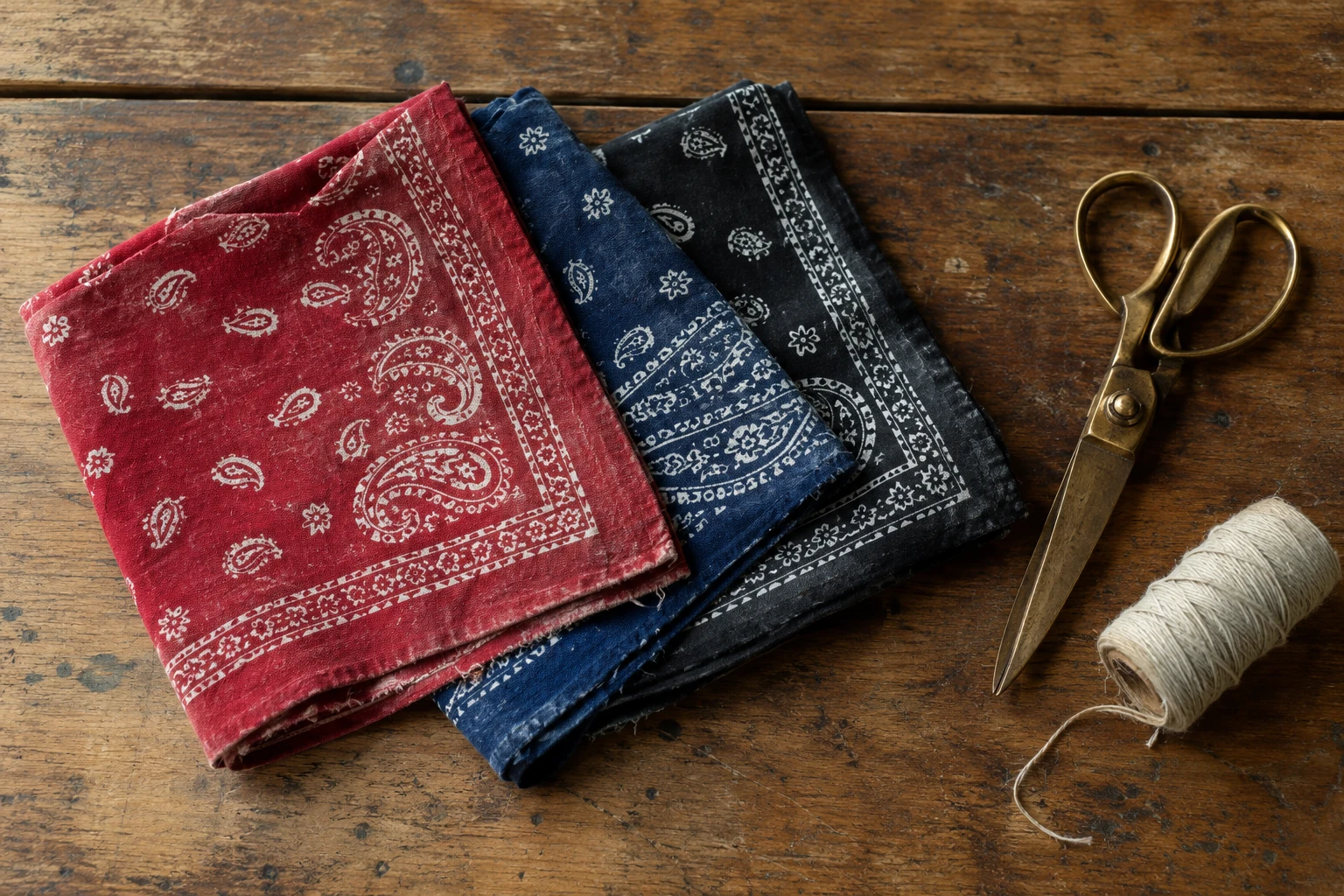
Ask someone to picture a bandana and they will usually describe a red cotton square with a white and black paisley pattern. That design is so familiar that it seems timeless, yet it brings together several separate stories: a motif from Persia and Kashmir, a weaving town in Scotland, a red dye for cotton and a chemical discovery that made light patterns on dark cloth possible. For the wider picture of types, sizes and uses, see our pillar guide, bandanas explained.
This article follows the paisley bandana from the boteh motif to today’s print workshops, including ours in Sialkot, where we print custom bandanas for brands, retailers and events. It ends with a practical part: how paisley is printed now and how to design a paisley bandana of your own.
What is a paisley bandana?
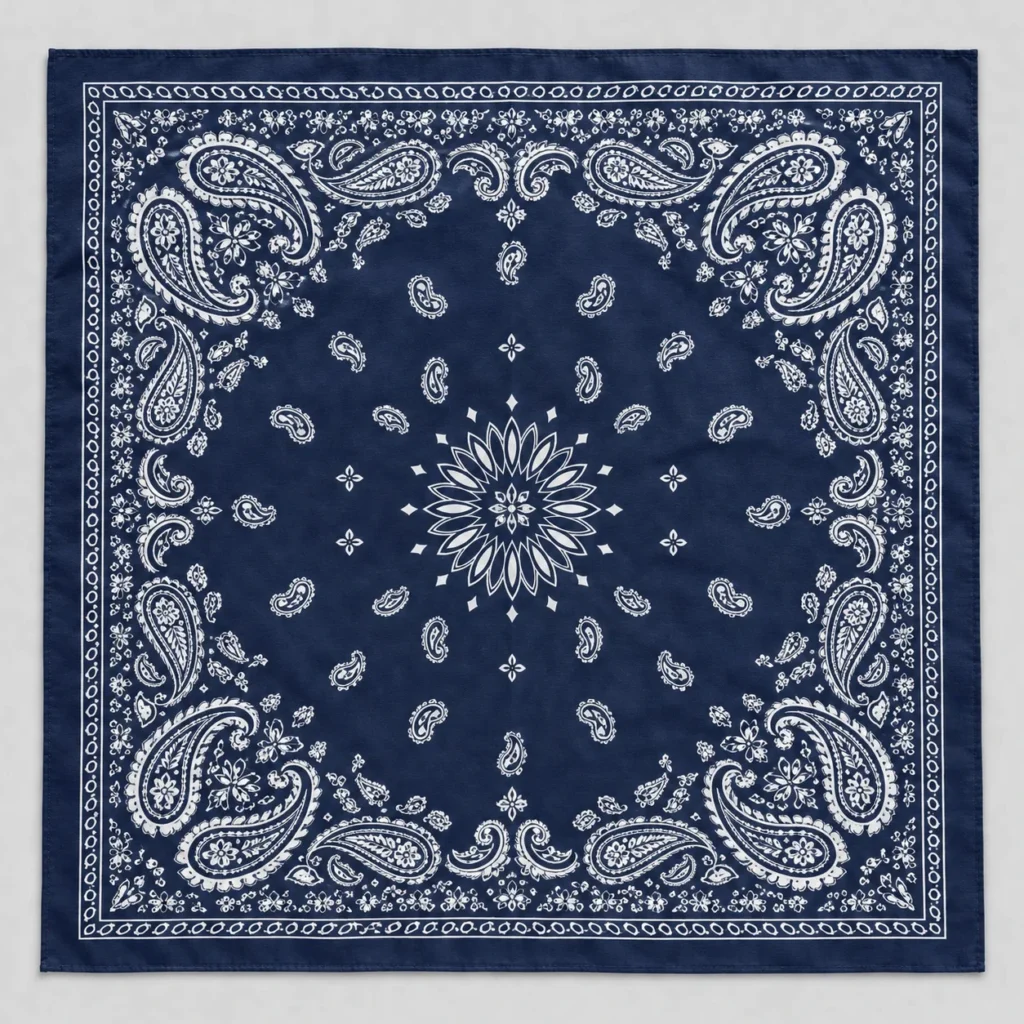
A paisley bandana is a square cotton kerchief printed with paisley, a curved teardrop motif with a curled tip, usually in white and black on a red, navy or black ground and framed by a border. The layout is typically mirrored around the centre, so the bandana looks the same from every corner.
The classic size is about 56 × 56 cm (22 in), and it is folded into a triangle or a band before it is worn. The design itself is the subject of this article; the bandana size chart covers the other sizes.
Where does the paisley motif come from?
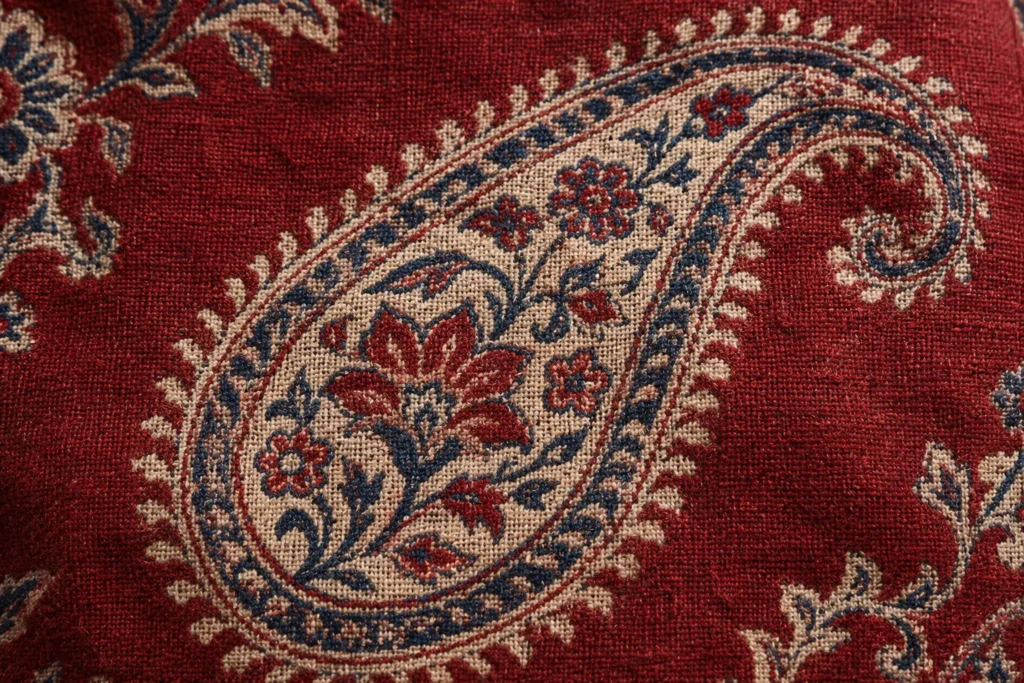
Paisley grew from the boteh (also called buta), a motif of Persian origin. Kashmir shawl weavers took it up, sources suggest from around the 15th century, and it later reached Europe on the shawls that traders brought from India.
In Kashmir the boteh became the signature of finely woven shawls, which were fashionable at the Mughal court under the emperor Akbar in the 16th century. Traders of the East India Company brought Kashmir shawls to Britain, where they became a fashion of their own. Before the word “paisley” took hold, English speakers often called the shape “pine and cone”.
Writers have suggested many meanings for the boteh, but there is no single agreed one. It is safest to treat it as what the records show it to be: a decorative motif that travelled a long way and changed shape on the journey.
Why is the pattern named after Paisley in Scotland?
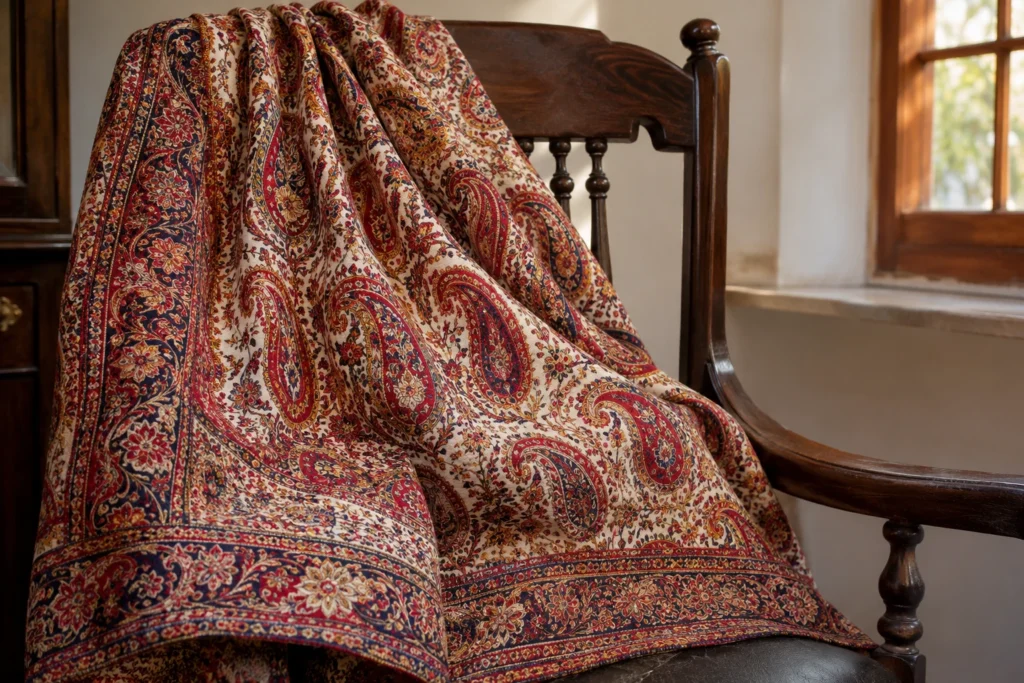
The pattern carries the name of Paisley, a weaving town in Renfrewshire, Scotland, because its weavers led European production of Kashmir-style shawls from about 1800 to 1850. The shawls were sold so widely that the town’s name became the name of the motif.
Paisley’s weavers adopted Jacquard weaving after 1820, which made complex repeat patterns easier to produce. According to the history of the design, they were weaving shawls in five colours when many rivals managed two, and in as many as 15 colours by around 1860. Printed paisley, cheaper than woven, came from Scotland and from Alsace in France. The fashion for paisley shawls reached its peak and then faded in the 1870s, but the motif itself stayed in use.
How did paisley end up on bandanas?
From the early 1800s, European printers put paisley on cotton handkerchiefs to imitate the costly Kashmir shawls. Two technical advances made the classic look possible: Turkey red, a bright and fast red dye for cotton, and discharge printing, which bleaches light patterns out of a dyed ground.
Where the word bandana comes from
The word comes through Hindi and Urdu from the Sanskrit bandhana, “a bond” or “tying”; the Hindi bāndhnū refers to tie-dyeing. Early bandanas were bright silk or cotton handkerchiefs with white spots on red or blue grounds, made by the tie-dye technique known as bandhani. Old spellings such as “bandannoes” and the variant “bandanna” are still seen.
Turkey red and discharge printing
Turkey red was a dyeing process that gave cotton a strong red that held its colour well, and European dyers mastered it in the 18th century. In 1789 the chemist Claude Louis Berthollet described the bleaching power of chlorine, which later allowed printers to remove the red in a pattern and leave white or light motifs on the dyed cloth. This discharge, or bleach-out, technique became the basis of red paisley handkerchiefs and bandanas.
Scotland became a major centre of Turkey red dyeing and printing. The United Turkey Red Company was formed there in 1898 and closed its last works in 1961. Today the same principle, removing colour from a dyed ground instead of printing on top, is what our guide to bandana printing methods calls discharge printing.
How did the bandana become American workwear?
In America, the printed cotton bandana became everyday working gear: cowboys and ranch hands tied it around the neck, and later factory and other blue-collar workers wore it as a neckerchief or headscarf. Paisley on red or blue cotton became a standard design.
It was cheap, light and useful: tied at the neck on a hot day, wiped across the face, worn under a hat or folded into a back pocket. Printed bandanas were common during both World Wars, and the wartime image of a woman factory worker with a red, white-spotted headscarf, known as Rosie the Riveter, helped make the bandana a symbol of work.
In the 1960s, paisley came back as a fashion motif, with a strong revival around 1967, and the bandana also moved from workwear into music and youth fashion. Since then it has stayed in both worlds, as a working accessory and as a style piece. Our guide on how to tie a bandana shows the neck, head and band styles that grew out of these uses.
What were campaign and commemorative bandanas?
Printed bandanas were also used to celebrate people and events. In the United States, campaign bandanas were popular from at least the 1840 presidential campaign of William Henry Harrison, and later campaigns, such as Harrison and Morton’s in 1888 and those of Theodore Roosevelt, issued them too.
These bandanas usually showed a portrait, a slogan and decorative borders, printed on cotton like other handkerchiefs of the time. Bandanas showing George Washington on horseback are also known from the period; one popular story links one to Martha Washington, but the evidence for it is thin. Commemorative bandanas for events, anniversaries and organisations follow the same idea today.
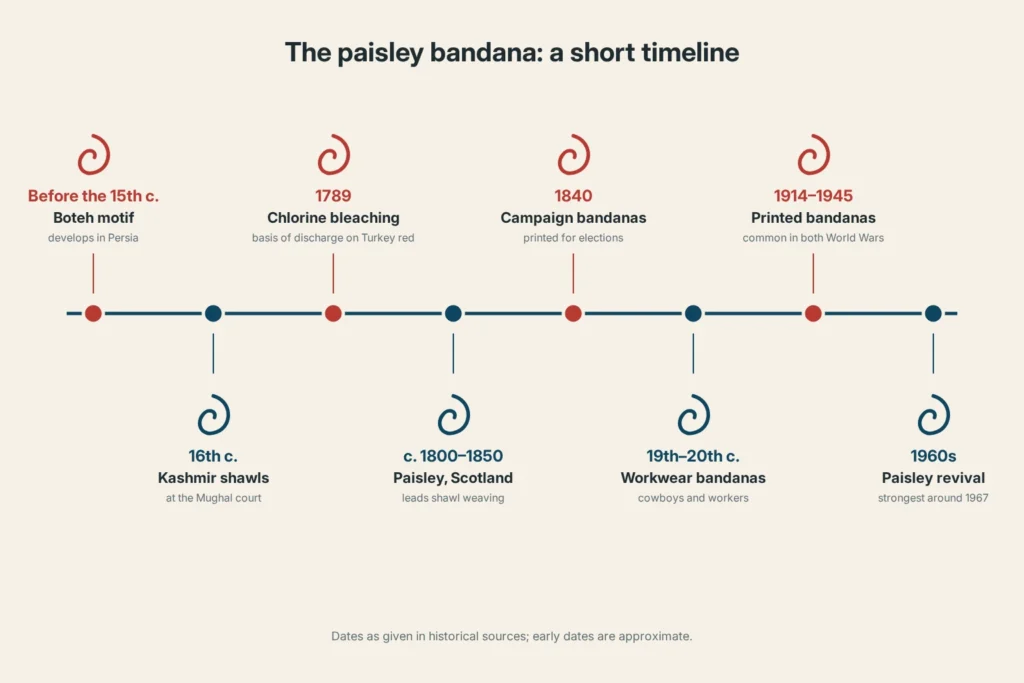
Timeline of the paisley bandana
| When | What happened |
|---|---|
| Before the 15th century | The boteh (buta) motif develops in Persia. |
| From around the 15th century (sources vary) | The boteh reaches Kashmir shawl weaving. |
| 16th century | Kashmir shawls are fashionable at the Mughal court under Akbar. |
| 18th century | European dyers master Turkey red on cotton. |
| 1789 | Berthollet describes chlorine bleaching, the basis of later discharge patterns on Turkey red. |
| About 1800–1850 | Weavers in Paisley, Scotland, lead European production of Kashmir-style shawls; paisley appears on European-made handkerchiefs and bandanas. |
| After 1820 | Jacquard weaving makes complex paisley shawls easier to produce. |
| 1840 | Campaign bandanas for William Henry Harrison. |
| 1870s | The fashion for paisley shawls fades. |
| 1898–1961 | The United Turkey Red Company operates in Scotland. |
| 19th and 20th centuries | Paisley cotton bandanas are worn by cowboys and later by blue-collar workers; printed bandanas are common in both World Wars. |
| 1960s | Paisley revival in fashion, strongest around 1967. |
How can you tell if a paisley bandana is vintage?
Look at the label marks and the edges. A “fast color” print mark points to roughly the 1920s or later, a US RN number means 1952 or later, and woven selvedge edges on two sides instead of hems often suggest an older bandana, made before about the 1950s.
These are clues rather than proof, and collectors usually combine several of them with the print style and the feel of the cotton. Most modern bandanas, including ours, have hemmed edges on all four sides.
How is a paisley bandana printed today?
Most paisley bandanas today are screen printed on cotton: the fabric is dyed in the ground colour and the paisley and border are printed on top, one screen per colour. On dark grounds, a light paisley is usually discharge printed, so the motif stays soft to the touch.
- Fabric: bandana cotton poplin, a light plain-weave cotton from partner mills, the traditional cloth for paisley.
- Ground: dyed red, navy, black or your own colour before printing.
- Screens: one mesh screen for each print colour; a classic white and black paisley on red needs two.
- Discharge: on dark grounds, a discharge paste takes the dye out where the motif goes, the modern version of the old bleach-out method.
- Digital printing: for paisley designs with many colours, shading or photographic detail.
- Finishing: each square is cut, then narrow-hemmed on all four sides.
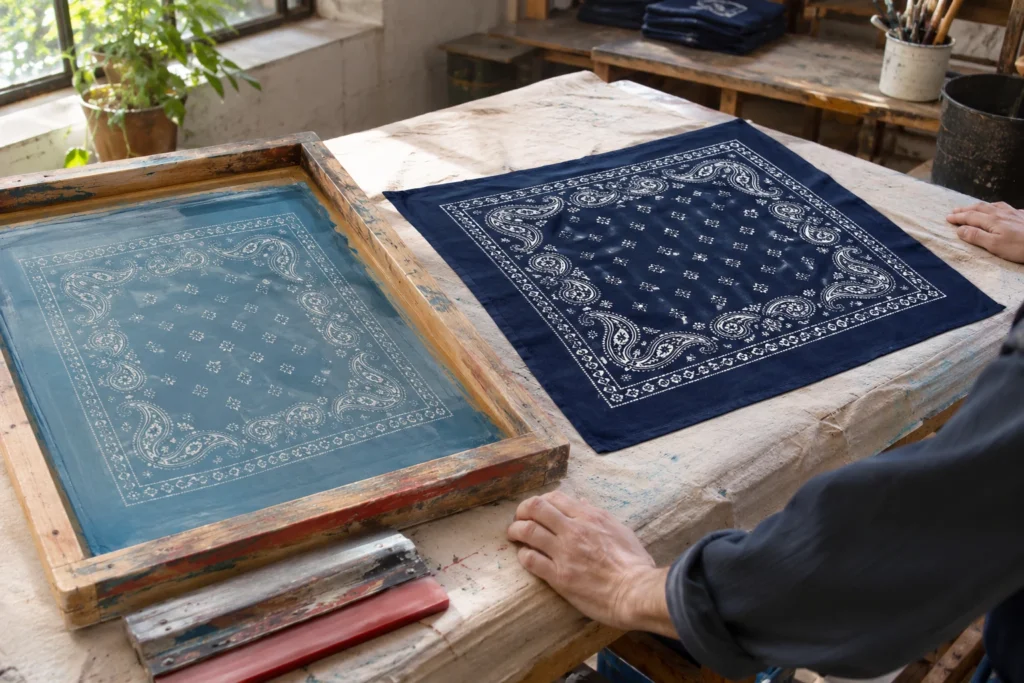
Our classic paisley cotton bandana is made this way at 56 cm, and the large paisley bandana at 69 cm (27 in) for head wraps and riders. Both can be made in your colours or with your own artwork.
How do you design your own paisley bandana?
Start with one boteh shape, build a quarter of the bandana around it, mirror the quarter four times and add a border. Keep to a few flat colours for screen printing, and check the design folded into a triangle before you finalise it.
- Draw the boteh as a teardrop with a curled tip, then fill it with lines, dots and small flowers. Vary the sizes, with larger shapes towards the centre and smaller ones in the border.
- Build one quarter of the square and mirror it horizontally and vertically, so the bandana looks the same from every corner.
- Frame it with a border about 25 mm inside the edge, the traditional bandana layout.
- Limit screen-printed designs to a few colours; for a soft light motif on a dark ground, plan for discharge printing.
- Make fine lines a little bolder than on paper, because ink spreads slightly into woven cotton.
- Hide a logo or a name inside one motif or one corner, a subtle way to brand a classic design.
The paisley motif is centuries old, but individual modern paisley prints can be under copyright as artwork, so use your own drawing, a design you have the rights to, or a traditional layout prepared by our design support team. Our bandana artwork guide gives the canvas sizes, bleed and safe zone for the file.
How to choose a paisley bandana for your range
- Classic look: white and black paisley on red cotton, 56 cm, screen printed.
- Dark grounds (navy, black): a light paisley, discharge printed for a soft feel.
- Head wraps and riders: the 69 cm (27 in) oversized size.
- Brand colourways: your own ground and motif colours, matched to Pantone references.
- Full-colour or shaded paisley: digital printing on cotton, or sublimation on polyester twill.
Ordering paisley bandanas from Mr Balaclava
We make paisley bandanas from 50 pieces per design, in our layout or yours, approximately 14 days after sample approval. Mr Balaclava’s name never appears on your products.
What to send for a paisley bandana quote
- Your paisley artwork, or the colours you want for our traditional layout.
- The size: 51, 56 or 69 cm, or your own size.
- The fabric: cotton poplin is the classic choice.
- The quantity per design and your deadline.
- Labels and packaging, if you need them.
- The delivery country.
Paisley bandana: frequently asked questions
Why are bandanas paisley?
In the 19th century European printers copied the fashionable paisley of Kashmir shawls onto cheaper cotton handkerchiefs, often in Turkey red with discharge patterns. The design stayed popular when the bandana became workwear, and it is still the classic look.
What does the paisley pattern mean?
The motif comes from the Persian boteh, and writers have linked it to many symbols, but there is no single agreed meaning. On a bandana it is a decorative pattern with a long history.
What is paisley called in other languages?
In French the pattern is usually called motif cachemire and in Spanish cachemir or cachemira, after Kashmir. In German it is generally called Paisley, as in English.
Can you print my own paisley design on bandanas?
Yes, from 50 pieces per design. Send your artwork or your colours for our traditional layout, and we confirm the colours and the print method with a mockup before production.
Is a paisley bandana screen printed or digitally printed?
Classic paisley bandanas are usually screen printed, with discharge printing for light motifs on dark grounds. Digital printing suits paisley designs with many colours or shading.
For the practical side, compare cloths in our bandana fabrics guide, see how screens work in our screen printing glossary, or ask for a paisley bandana quote.


