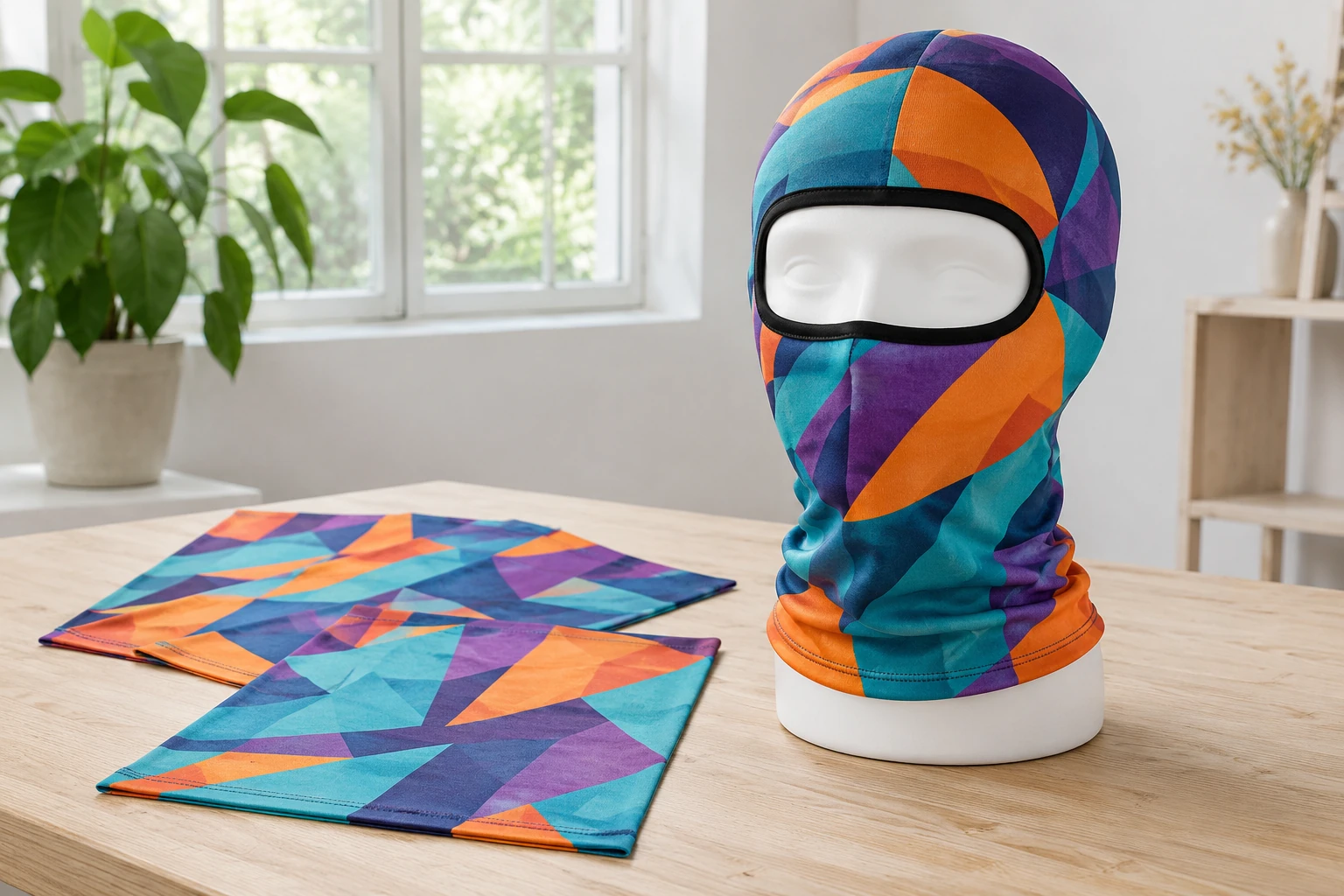
A sublimated balaclava looks simple once it is finished: a stretchy ski mask with a design that runs from the forehead to the neck, without a raised print layer you can feel. Getting there takes a chain of steps, from your artwork file to transfer paper, heat, cutting and sewing. This guide follows that chain in the order it happens in our factory, so you know what to expect when you order custom sublimated balaclavas from Mr Balaclava.
It is written for streetwear and fashion brands, festival and event teams, snowboard, ski and moto shops, merchandise companies and costume buyers. We sublimate in-house in Sialkot, Pakistan, on polyester-rich stretch fabrics, so every step below is one our team works with daily. If you are still choosing between decoration methods, our guide to balaclava logo and decoration methods compares sublimation with embroidery, knitted-in designs and small logo prints.
What is a sublimated balaclava?
A sublimated balaclava is a cut-and-sew balaclava whose fabric has been dyed with your design by heat, so the print covers the mask edge to edge and stays soft and stretchy. Photos, gradients, camo, animal faces and fine detail are all possible in one process.
In our catalogue, “sublimated” means an all-over design. “Printed” means a small logo print, usually by screen printing or heat transfer, placed on a plain balaclava. The difference matters when you compare quotes, because some sellers call a mask “sublimated” when only a forehead panel carries a print.
| Option | What it covers | How it feels | Typical use |
|---|---|---|---|
| Sublimated (all-over) | The whole mask, edge to edge, in full colour | Soft; the dye is inside the fibre | Streetwear, festival, ski and snowboard, merch, costume |
| Printed logo | One or a few placed logos | A thin ink or film layer on top | Brand marks on plain balaclavas |
| Knitted-in design | Patterns made by the yarn colours | Warm, textured knit | Winter knits, retro patterns |
| Embroidery | A small logo area | Raised stitches | Small logos on knits and fleece |
Knitted balaclavas are a different product altogether; knitted vs cut-and-sew balaclavas explains how the two are made and why only cut-and-sew balaclavas take all-over sublimation.
How does sublimation printing work?
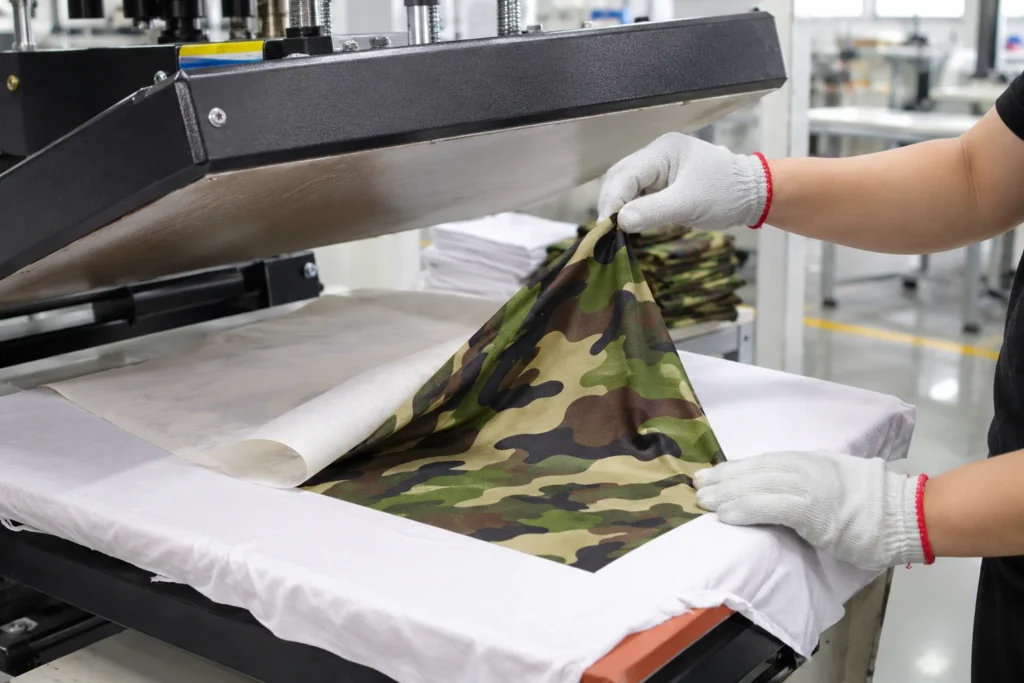
The design is printed in sublimation dye onto special transfer paper. Under heat and pressure the dye turns into a gas and moves into the polyester fibres, where it sets as the fabric cools, so the colour becomes part of the fibre.
This is why a sublimated print does not crack or peel like a printed layer can, and why it keeps the stretch of the fabric. Our sublimation glossary entry gives the short definition; the steps on the factory floor look like this:
- Transfer paper: a large-format printer prints the design, mirrored, onto coated paper in sublimation dye.
- Heat pressing: the printed paper and the fabric are pressed together with heat, so the dye moves into the polyester.
- Dye into fibre: the heat opens the polyester fibres and the dye, now a gas, enters them; the colour is set when the fabric cools.
- Paper off: the used paper is removed and the fabric shows the design the right way round.
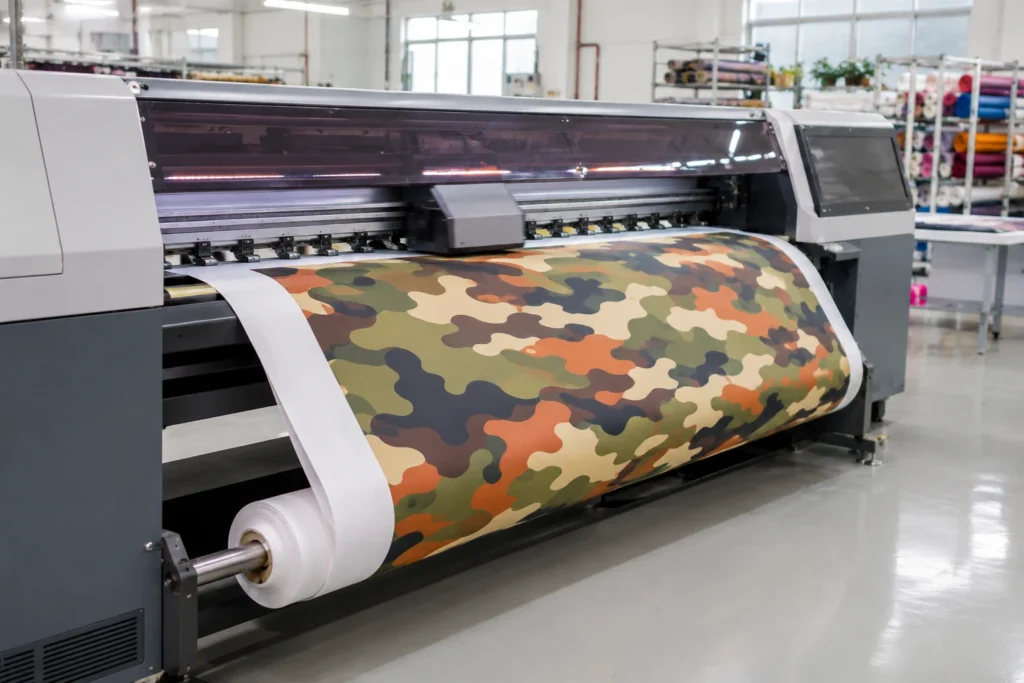
Heat, time and pressure are set for each fabric and usually checked on a test piece first, so the colours come out as planned.
Why does a sublimated balaclava need white or light polyester?
Sublimation dye only bonds with polyester and similar synthetic fibres, and it is transparent. It needs a white or light base fabric: black or dark base fabric cannot be sublimated, so black areas in a design are printed as dye on a white base.
The fabric therefore decides what is possible. Our main fabric is polyester/spandex stretch jersey, a soft four-way stretch knit that most of our sublimated balaclavas are made from. Cotton, wool and acrylic do not take sublimation, which is why a knitted acrylic ski mask cannot carry a photo print.
| Fabric | Feel and use | Sublimation |
|---|---|---|
| Polyester/spandex stretch jersey | Soft, close fit, all-year; our main fabric | Bright, sharp colours on a white base |
| Polyester microfibre knit | Smooth and light, lower stretch | Takes fine detail well |
| Polyester mesh (eye or mouth panel) | Open, airy panels | Usually left plain or printed lightly |
| Brushed polyester | Soft, brushed inside for colder days | The smooth outer face carries the print |
| Stretch velvet / velour | Plush, warm surface | Rich colour with a soft sheen |
| Fleece-lined | A printed outer layer with a fleece lining for warmth | The outer layer is printed; the lining usually stays plain |
Our guide to fabrics for sublimated balaclavas compares these in more depth, including which suit summer and winter ranges.
What are the steps from your artwork to a finished balaclava?
There are usually nine steps: brief and artwork, free digital mockup, sample, print set-up, transfer printing, heat pressing, cutting, sewing and finishing, then inspection and packing. Bulk production starts only after you approve the mockup and the sample.
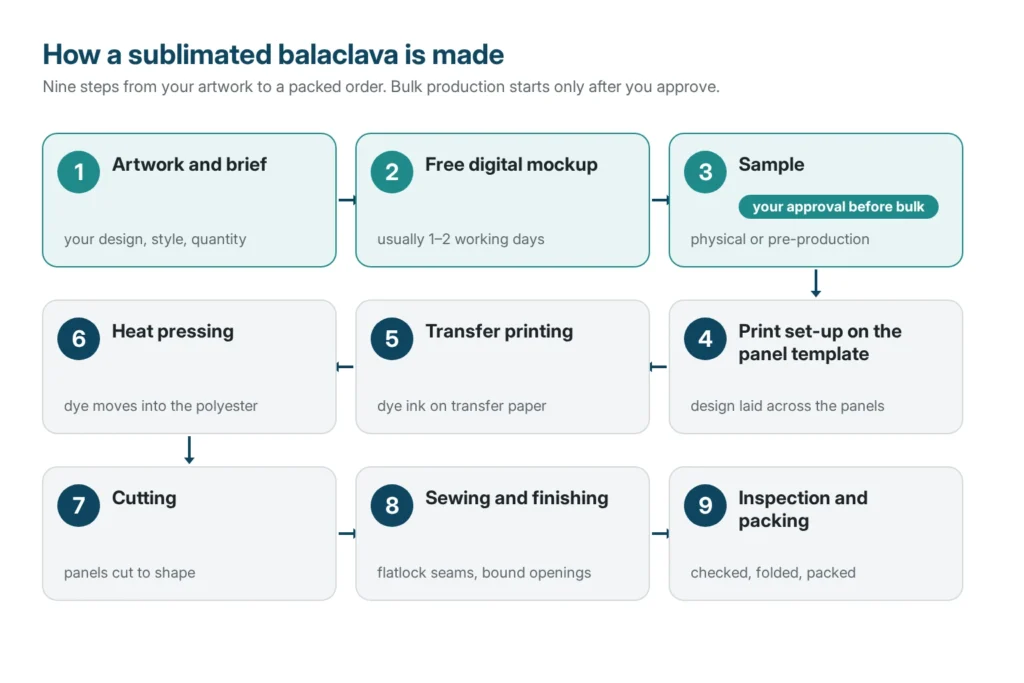
| Step | What happens | Your part |
|---|---|---|
| 1. Brief and artwork | You send the design, style, fabric, quantity and deadline | Send files you own or are licensed to use |
| 2. Free digital mockup | We place the design on the panel template and show the finished look | Approve or ask for changes |
| 3. Sample | A physical sample is made in your design | Check fit, colour and print; approve |
| 4. Print set-up | The artwork is laid out panel by panel and colour-managed | — |
| 5. Transfer printing | The panels are printed, mirrored, on transfer paper | — |
| 6. Heat pressing | Paper and fabric are pressed; the dye enters the fibres | — |
| 7. Cutting | Panels are cut along the pattern lines | — |
| 8. Sewing and finishing | Panels are joined, openings and neck are finished, labels added | — |
| 9. Inspection and packing | Each piece is checked, folded and packed to your specification | — |
Steps 1 to 3 are where your design takes shape. Send your artwork and we usually send a free digital mockup within 1–2 working days; our page on mockup approval explains what it shows. The sample is either a pre-paid sample, paid 100% in advance and ready in about 5–7 days (its cost is deducted from the order only at 1,000 pieces or more, and sample shipping is extra and non-refundable), or a free pre-production sample made after the order and the 30% advance, approved by photos or video.
Steps 4 to 9 are the bulk run. The panel layout is the same one our balaclava print template shows, so a design drawn on the template moves into production without being redrawn. The full factory flow, from cutting tables to packing, is on our manufacturing process page.
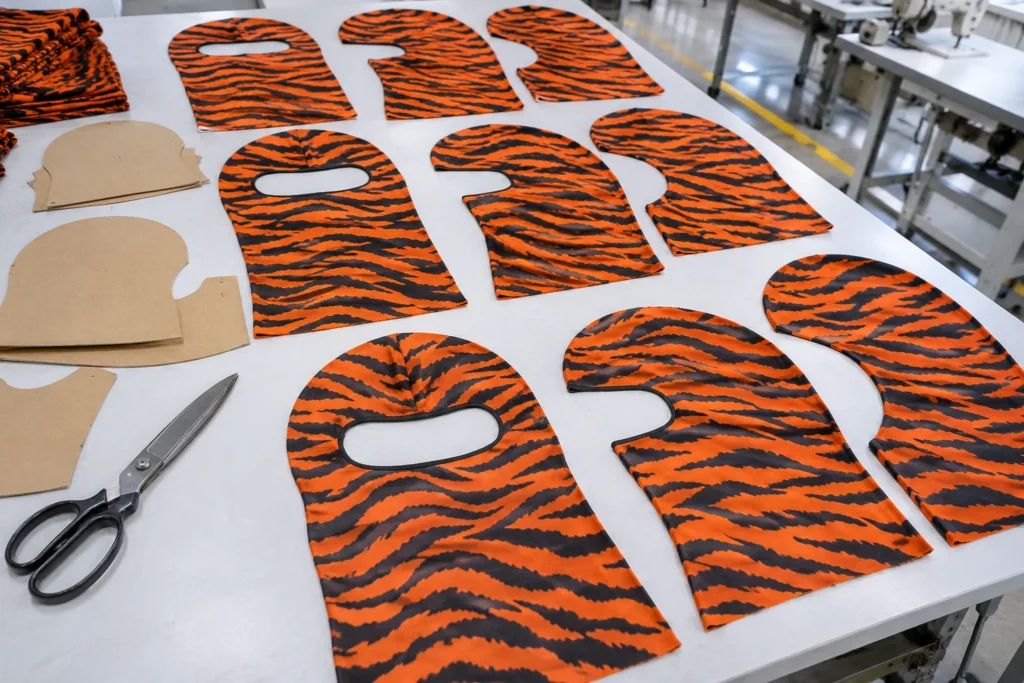
Why are sublimated balaclavas usually printed before they are sewn?
In most cases the design is printed on flat panels before sewing, so it runs across the seams and reaches every edge. Pressing a finished, sewn balaclava would usually leave white lines in the folds and around the seams, where the paper cannot touch the fabric.
A sewn balaclava is a rounded shape with a curved crown, eye and mouth openings and seams, so it cannot lie flat in a press. Printing the fabric first usually avoids those gaps.
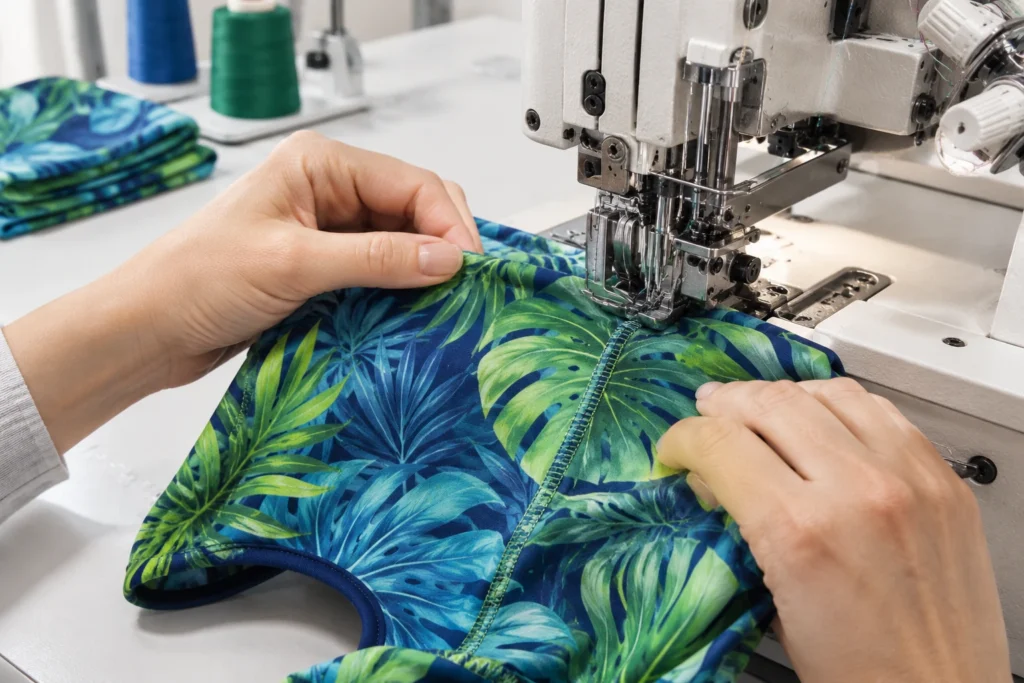
What happens to the design at the seams and openings?
Seams join separate panels, so a design that crosses a seam can shift by a few millimetres; the eye opening, the mouth opening and the neck take a binding or hem that covers a narrow strip of print. Logos, text and faces therefore belong inside the safe zones.
- Seams: stretch fabric moves a little while it is sewn, so lines and lettering that run across a seam may not meet exactly. All-over patterns, camo and textures hide this well; text across a seam does not.
- Eye and mouth openings: the edge is usually finished with a folded binding or an elastic trim, which covers a narrow band of the design. Keep eyes, letters and logos a little away from the opening.
- Neck hem: the lower edge is turned or bound, so the last strip of the design wraps inside.
- Crown: several panels meet at the top of the head, which is a poor place for a logo.
Animal faces and other realistic faces depend on these details more than any other design, which is why our animal balaclava styles place the eyes, nose and mouth on the front panel. Our print template marks the seam lines, the bleed and the safe zones around each opening, so you can plan for them from the start.

Why can a sublimated print look lighter when the balaclava is stretched?
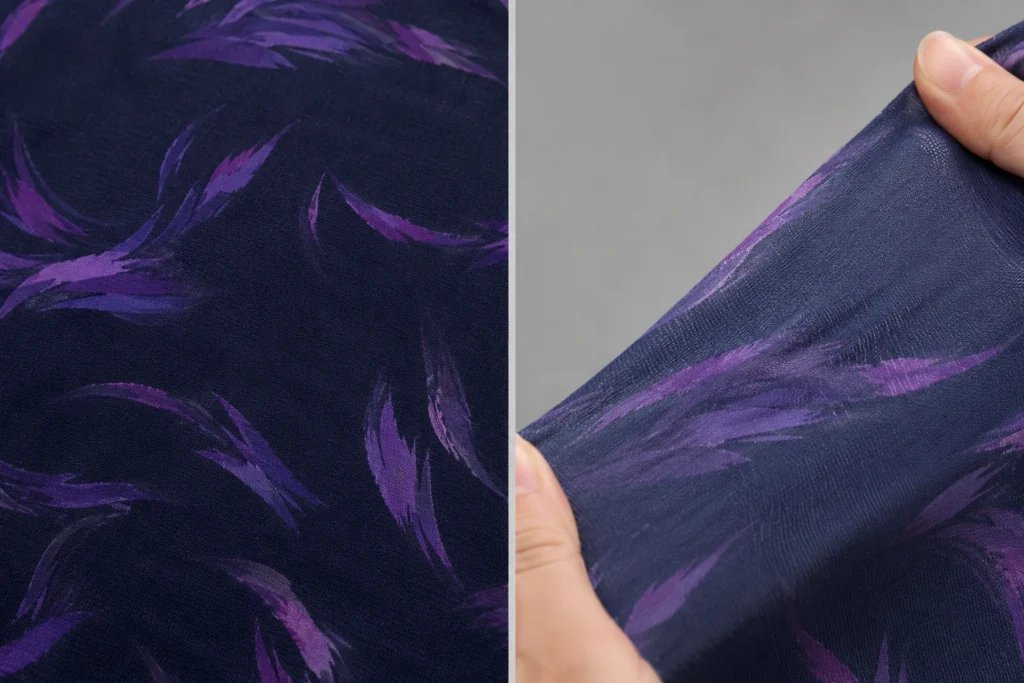
When the stretch fabric is pulled open, small amounts of the white base and the stretch yarn can show between the dyed fibres, so the colour looks slightly lighter. This is often called “grin-through”, and it shows most where the mask stretches most.
On a balaclava, those areas are usually the nose, the chin, the crown and the edges of the eye opening. A mask that fits tightly lightens more than one that fits easily. It is normal for printed stretch fabric, and you see it on the sample before bulk.
- Dark, solid colours show the effect most; patterns, camo and textures hide it.
- Keep important details, such as a logo, on areas that stretch less, such as the forehead or the cheeks.
- Check the sample on a real head, not only on a flat table.
How are colours matched on a sublimated balaclava?
Colours are matched as closely as possible and confirmed on the mockup and sample; neon and some brand colours cannot be matched exactly. Sublimation mixes its colours from a small set of dyes, so a few bright shades lie outside what it can print.
- Send your design in RGB or CMYK and add Pantone references for the colours that matter most, such as a logo.
- Neon shades print as bright colours, but not as fluorescent ones.
- Metallic, glitter and white ink effects are not part of sublimation; white parts of a design simply show the white fabric.
Our artwork files guide lists the file types we accept, and the print template guide explains resolution and colour set-up for each panel.
How long does it take to make sublimated balaclavas?
From approved artwork, the usual timeline is: a free digital mockup in about 1–2 working days, a sample in about 5–7 days, and bulk production in approximately 14 days after sample approval. Shipping is added on top, and the schedule is confirmed for each order.
| Stage | Usual time |
|---|---|
| Free digital mockup | Usually within 1–2 working days after we receive your artwork |
| Pre-paid physical sample | About 5–7 days |
| Bulk production | Approximately 14 days after sample approval |
| Express shipping | 3–6 working days; shipping is charged by weight, agreed for each order and confirmed before shipment |
Our capacity is around 100,000 pieces a month, and every order passes our quality control before it is packed. Payment is 30% in advance, 30% during production and 40% after quality control, when the order is ready for shipment.
How do you care for a sublimated balaclava?
A sublimated balaclava is usually washed cold, inside out, with no bleach, no tumble drying and no ironing on the print. Because the dye is inside the fibre, the design typically holds up well to washing when it is cared for this way.
How to choose the right options for your sublimated balaclavas
- A bold all-over design, photo or animal face: polyester/spandex stretch jersey, with the main details on the front panel.
- Ski, snowboard or winter ranges: brushed polyester, stretch velvet or a fleece-lined build for warmth, with a wide eye opening for goggles.
- Festival and costume: a mesh eye or mesh mouth, or a closed printed face with no mouth opening.
- Moto and cycling: a thin jersey with flat seams that many riders wear under a helmet.
- Lettering and logos: place them inside the safe zones, away from seams, openings and the most stretched areas.
- Kids ranges: kids sizes are available alongside the adult size; the opening and fit are confirmed on the sample.
For ideas on what to print, see our custom balaclava design ideas. Catalogue sublimated balaclavas start at about $4.99–9.50 per piece at 50 pieces, depending on style, fabric and print; prices usually fall at larger quantities, and our team confirms the price for every custom order. Our guide to what custom printed balaclavas cost explains the price factors.
Ordering sublimated balaclavas from Mr Balaclava
We make sublimated balaclavas from 50 pieces per design, with your branding and labels; Mr Balaclava’s name never appears on your products. We print only designs you own or are licensed to use. Our step-by-step guide on how to order custom printed balaclavas walks through the order itself.
What to send us
- Your artwork (AI, PDF, SVG or a 300 dpi file), or a sketch and references for our design team.
- The style and opening: 1-hole, 2-hole, 3-hole, open face, mesh eye or mouth, or a closed printed face.
- The fabric, or the season and feel you want.
- The quantity per design and the sizes (adult, kids).
- Labels and packaging, if you need them.
- Your deadline and the delivery country.
Frequently asked questions
Can you sublimate a black balaclava?
No. Sublimation dye is transparent, so it needs a white or light base fabric. A “black” sublimated balaclava is white polyester printed black, and the design can include as much black as you like.
Will a sublimated print crack or peel?
Sublimation dyes the design into the polyester fibres, so there is no layer on top that could crack or peel. The colour can still soften over time with heavy washing, which is why cold, inside-out washing is recommended.
Is the print on the back and the top of the head too?
It can be: all-over designs run edge to edge across the front, sides, back and crown. Some designs keep the back or the crown plain on purpose; you choose this on the mockup.
Do the patterns line up across the seams?
They are laid out to continue across the seams, and in most cases they line up closely. Because stretch fabric moves a little during sewing, a small shift can occur, so lettering and logos should stay away from seams.
Can I see the design before production?
Yes. We usually send a free digital mockup within 1–2 working days of receiving your artwork, and production starts only after you approve the mockup and the sample.
See finished work in our sublimated animal face mask project and our streetwear camo balaclava project, browse the sublimated balaclava catalogue, or send your artwork for a free mockup.