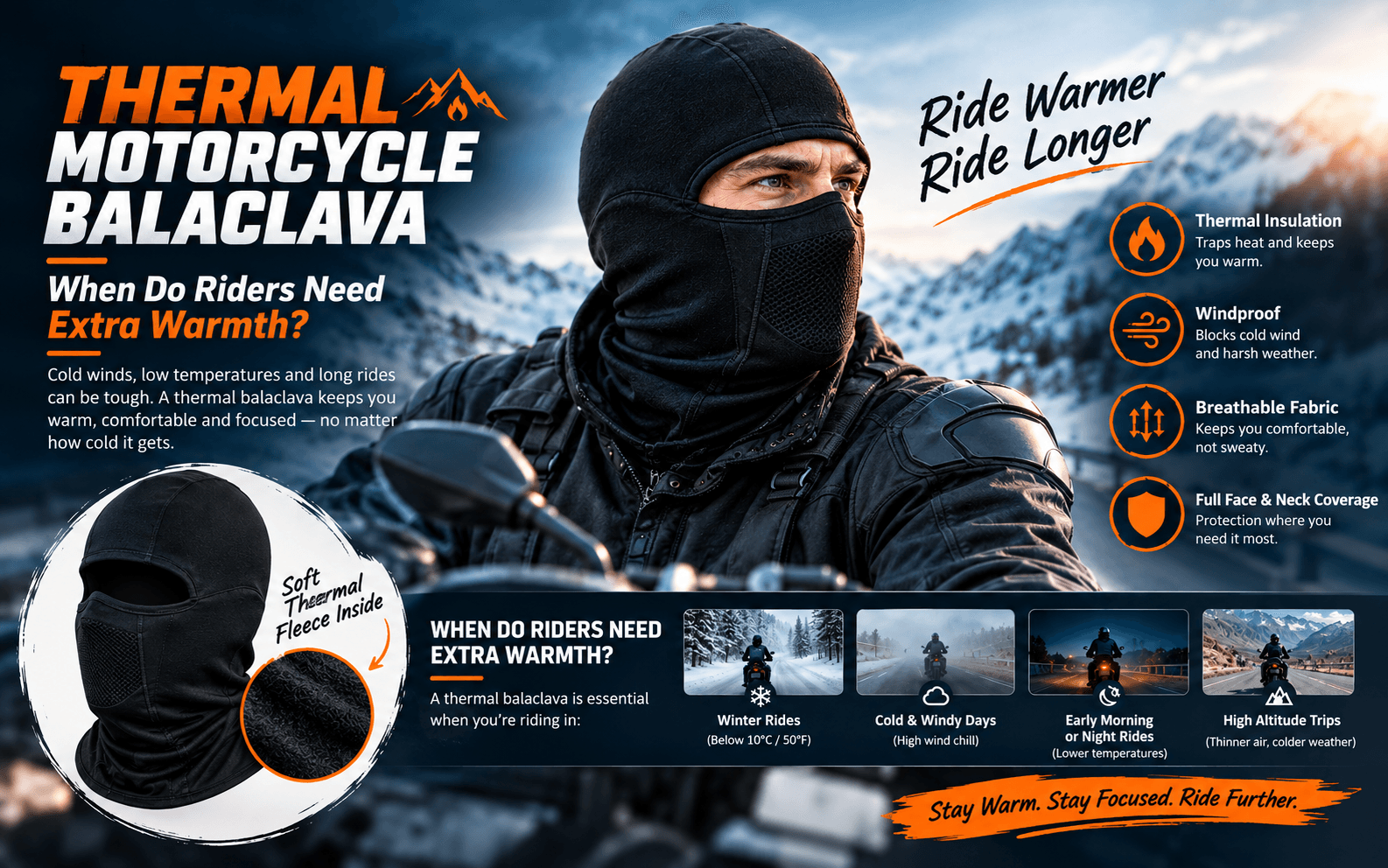
A thermal motorcycle balaclava adds an additional layer of insulation to the head, face, ears and neck when riding in cold conditions. It can be even more useful when standard lightweight helmet liners are not sufficient when temperatures drop and the wind is constantly blowing.
But there’s a downside to more insulation. When it comes to a motorcycle helmet, it must be able to fit as it was designed, which means that a thermal balaclava should not be too bulky. When selecting one, riders should take into account the temperature, wind exposure, length of the ride, moisture management, thickness of the fabric, and compatibility with helmets. The aim is straightforward: to be warmer without exertion, overheating or having to struggle to move around under the cap.
So what is a thermal motorcycle Balaclava?
Thermal motorcycle balaclava is a form of cold weather, close-fitting face and head covering that is made to be able to keep more body heat in than a lightweight balaclava.
It typically is applied on the scalp, ears, cheeks, chin, and neck, but does not cover the eye area or face. Fleece backed polyester, merino blends, brushed synthetics or other insulating fabrics can be used for thermal designs.
Some specialized thermal balaclavas combine fleece-lined construction with breathable sections and stretch to provide warmth without relying entirely on thick material.
When Do Motorcycle Riders Need Extra Warmth?
The temperature at which everybody requires thermal headwear differs. The factors influencing comfort are wind speed, humidity, the duration of the ride, the type of motor cycle, the ventilation of the helmet, the speed at which the bike is ridden, and the personal cold tolerance.
If it’s a cool winter day in the city, just a lightweight balaclava might be needed for a short trip. The rider’s temperature can seem much cooler during a long ride at the same temperature since there is constant airflow.
Additional insulation is helpful when it gets colder around the ears, neck, cheeks or scalp and they start to distract you from riding.
This presentation will cover the reasons why wind makes cold riding difficult.
Moving air flows around the rider at all times when on a motorcycle. This may lead to higher heat loss from uninsulated or unprotected surfaces.
This will include the very small space between the helmet and the jacket, which is especially relevant. Air that gets into the upper body around the neck can make the whole upper body feel uncomfortable.
A thermal Balaclava with extended neck coverage will provide a more seamless layer between the helmet and riding jacket.
Thermal vs Regular Motorcycle Balaclava
The basic motorcycle balaclava typically focuses on lightness, sweat control, and cleanliness of the helmet. Can be helpful all year long.
A thermal version adds greater insulation for colder conditions.
For example, a lightweight motorcycle balaclava may prioritize breathability, stretch, and moisture management for use beneath a helmet, while a thermal model places more emphasis on retaining warmth.
Neither design is automatically better. The correct choice depends on the riding environment.
Insulation Without Excessive Bulk
A big problem with the thermal motorcycle balaclava is getting the right balance between warmth and thickness.
Motorcycle helmets should be tight-fitting. When a thick layer is under the padding, it can exert pressure in the forehead, temples, ears or cheeks.
Riders don’t need the heaviest material on the market but should opt for efficient insulation that has a relatively low bulk. Thin, lightweight fabric constructions like fleece, brushed performance fabrics and fine merino blends can offer warmth without being excessively thick.
What is the reason for the coverage of the neck?
One of the most vulnerable spots when it comes to winter riding is the neck. Cold air can also enter between the bottom of the helmet and the bottom of the jacket collar even if a full face helmet is worn.
The longer the thermal balaclava, the further it can reach under the jacket and help seal the gap.
A neck gaiter can sometimes be enough to keep the neck warmer without needing a second thermal layer under the helmet for those who have a more limited thermal need only to the lower part of the head.
Moisture Management Is Still Important
Cold weather suits must also deal with sweat.
If you are riding for extended periods of time, the head can heat up inside a insulated helmet. If the balaclava gets wet, it can start to feel cold when the rider slows down or stops riding.
Thermal textiles that can transport moisture from the body can help to keep the level of thermal comfort stable. Certain types of thermal balaclava also feature moisture wicking materials in addition to as much insulation as they can contain.
Breathability at the mouth and nose
Fabric which is too tight around the nose and mouth can cause discomfort if it is too full faced.
When you exhale warm air, it has moisture in it. If it doesn’t get out well, then the lower face may be wet, and additional warm air can be blown upward into the visor of the helmet.
Breathable panels around mouth and nose can help. Riders should be able to breathe normally without straining the material of the mask from their face.
Visor Fogging in Cold Weather
Fogging on visors is particularly noticeable when warm, moist breath meets a cool visor.
A poorly positioned balaclava can be a factor that can cause the problem because it can send the exhaled air up. After the helmet is on, the face opening and nose area should, therefore, remain unchanged.
The Balaclava is just one aspect of fog management. Conditions such as helmet ventilation, anti-fog visor systems, weather conditions, and the placement of the face covering around the nose can all impact condensation.
The flat seams increase the comfort of the helmet.
With thermal fabrics, constructing a seam can be especially significant, as the cloth can be thicker than a summertime helmet liner.
Seam lines that are raised around the forehead, ears or scalp may leave an apparent pressure after compression by helmet padding.
Smooth seams or strategically placed stitches contribute to a sleek finish. Try on the actual balaclava you will be wearing.
Stretch and Shape Recovery
The ideal thermal balaclava should be snug yet not too tight.
Loose fabric can fold under the helmet, and a too tight fit can pull around the jaw line, nose or neck. Stretch also makes it easier for riders to put on the balaclava without putting strain on seams.
After repeated use and washing the material should not loosen, but should return to its original shape.
What Fabric Works Best?
There are a couple of materials that are suitable for use under certain conditions.
Lightweight fleece is an excellent insulation material but becomes cumbersome when thicker than it should be. Thermal polyester may provide thermal insulation as well as relatively rapid drying. Merino wool offers natural fitability, moisture management and insulation, whereas synthetic stretch blends can offer a closer fit to the helmet.
The warmest fabric is thus not necessarily the best fabric. It should be a balance of insulation, moisture control, breathability, stretch and thickness.
Need Thermal Balaclava for all riders?
It may be more comfortable for No. to wear a lightweight helmet liner all year long if they are living in a mild climate.
Thermal models are more useful to winter commuters, to early-morning riders, to touring motorcyclists, to riders travelling at highway speed and to riders who are frequently exposed to cold wind.
Terminology can also vary by region. In the United States, people may use terms such as ski mask for garments that are also described as balaclavas. This American terminology can be useful to understand when comparing products sold under different names.
Thermal Balaclava vs Neck Gaiter
A neck gaiter can be used to cover the lower face and neck to a large extent, while a balaclava will cover the head more continuously.
If the rider’s helmet is already warm, but cold air is getting in around the collar, a thermal neck gaiter might suffice.
A thermal motorcycle balaclava will usually offer better coverage if all four areas (ear, scalp, cheeks, and neck) are cold.
What is too hot to wear a thermal balaclava?
When it starts to get hot or the conditions get different, thermal gear can get uncomfortable.
Excessive sweating, damp fabric, uncomfortable heat around the head and needing to make adjustments or remove the balaclava are all indicators of too much insulation.
If weather is changing, it may be better to have two – one for light conditions and one for thermal conditions – than one that you can rely on for all seasons.
Quick Buying Checklist
Before choosing a thermal balaclava, check:
- Low-bulk insulation
- Helmet compatibility
- Wind-resistant coverage
- Extended neck length
- Breathable mouth and nose area
- Moisture-wicking performance
- Flat seams
- Comfortable stretch
- Stable face opening
- Unrestricted peripheral vision
- Quick-drying fabric
- Easy washing and care
Common Buying Mistakes
The worst thing that can happen is to think that thicker will mean faster. A large-sized balaclava can be warm enough to wear by itself but cumbersome if worn with a tight-fitting helmet.
Another error is failing to pay attention to moisture management. Sweat-soaked insulation can result in less ride comfort.
Another thing that riders need to avoid is balaclava hats that ride towards the eyes, make it hard to breathe, or change the fit of the helmet considerably.
Conclusion
A thermal motorcycle hat will prove useful when you’ve run out of lightweight headwear to keep your head warm when the weather is cold and the wind is blowing constantly. These groups are likely to benefit most from extra insulation: Winter commuters, tourists on bikes, and those motorcyclists riding faster.
Ideally, it should be warm but not so thick. Pay attention to low-bulk thermal fabric, moisture management, breathable facial panels, flat seams, breathability, and adequate neck coverage.
The key factor in a successful thermal motorcycle balaclava is that it fits with the rider’s helmet. It’s only useful when it doesn’t make the helmet unwearable, affect the wearer’s vision, breathing, or concentration on the road.
FAQs
When should I wear a thermal motorcycle balaclava?
Wear one when cold air around the head, ears, face, or neck begins affecting riding comfort, especially during winter, highway travel, or longer rides.
Is fleece good for motorcycle riding?
Lightweight fleece can provide useful insulation, but very thick fleece may create excessive bulk underneath a helmet.
Can I wear a thermal balaclava under a full-face helmet?
Yes, provided it is thin enough that the helmet still fits as intended and the balaclava does not interfere with vision or breathing.