Deep cold changes how you dress for the mountain. On a mild resort day almost any face cover will do, but on a high, windy run in mid-winter the balaclava becomes one of the pieces that decides whether you stay out or head for the lodge. If you are planning ahead for this season, it pays to know what actually matters before you buy.
This guide is for skiers and snowboarders, and for the shops, ski schools, resorts and brands that equip them. It covers layering, fabric, coverage, breathing, goggle fogging and helmet fit. For milder days, our guide to a ski balaclava for ordinary cold weather covers the basics, and the overview of balaclava types and styles explains the wider family.
What makes a ski balaclava suitable for extreme cold?
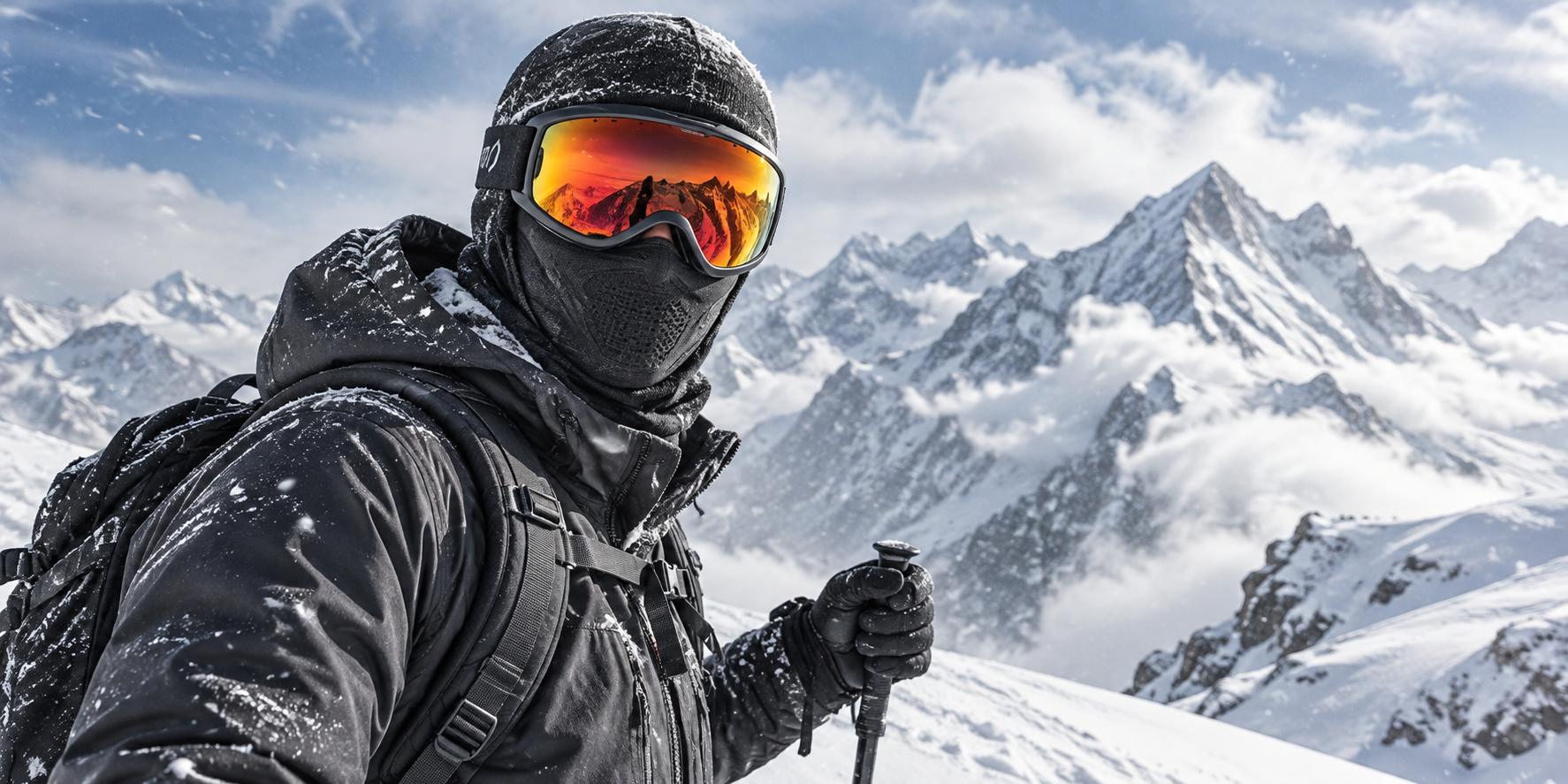
A balaclava for deep cold usually combines three things: a warm inner fabric, wind-resistant coverage over the face and neck, and a way for moist breath to escape. Fit with the helmet and goggles matters just as much as the fabric itself.
Wind strips heat from the face faster than still air, and breath turns to frost inside the fabric if it has nowhere to go. A thick balaclava that ices up at the mouth or pushes your goggles out of place can feel colder than a thinner one that fits well. That is why the checks below go beyond “how warm is the fabric”.
- Insulation: a fabric that holds warmth even when slightly damp, such as merino or fleece.
- Wind resistance: a denser knit or a second, wind-resistant layer over the most exposed areas.
- Coverage: full head, ears, chin and a long neck that tucks into the jacket collar.
- Breathing: a mesh or perforated mouth zone, or a mouth panel that folds down.
- Fit: a thin crown under the helmet and a clean edge around the goggles.
Why do ordinary balaclavas fall short in deep cold?
Most everyday balaclavas are designed for comfort on moderate winter days, not for long exposure to strong wind and low temperatures. They tend to be single-layer, fairly open and short in the neck.
A thin single layer often lets wind through on chairlifts and exposed ridges. A short neck leaves a gap at the collar, and an open weave at the mouth can freeze stiff once it gets wet from breathing. None of this makes a light balaclava a bad product; it simply means it was made for a different job.
How should you layer for extreme cold?
Think of the balaclava as the base layer for your head: close to the skin, moving moisture away, with the helmet, hood and jacket collar on top. In very cold conditions a second piece, such as a neck gaiter, can add warmth where it is needed.
Layering usually works better than one very thick balaclava, because thin layers trap air between them and you can remove one when you warm up. A common combination is a fitted merino or fleece balaclava under the helmet, with a neck gaiter or the jacket’s high collar over the lower face on the coldest lifts. Some balaclavas for deep cold are made in two layers: a soft thermal inner and a wind-resistant outer, often only on the front and neck.
Keep the layers fairly thin at the crown. Extra bulk on top of the head tends to push the helmet up and open a gap at the forehead, which is exactly where cold air gets in.
Which fabrics work well in severe cold?
Merino wool and fleece are the most common choices for deep cold, often combined with a wind-resistant outer panel. Each fabric has trade-offs in warmth, moisture handling, stretch and bulk.
Merino wool jersey is soft next to the skin, usually stays warm when slightly damp and tends to resist odour over several days. Merino blends mix wool with synthetic fibres, which typically adds strength and helps the fabric hold its shape after washing. Our guide to merino ski balaclavas covers this fabric in more detail.
Polar fleece is lofty and warm and usually dries quickly, while polyester microfleece is thinner and fits more easily under a helmet. Knitted options such as an acrylic and wool blend knit feel familiar to many buyers and work well for lift queues and après-ski. For the most exposed areas, a softshell bonded fabric can add a wind-resistant layer over the mouth and neck.
| Fabric | Typical strengths | Things to weigh up |
|---|---|---|
| Merino wool / merino blend | Soft, usually warm when slightly damp, tends to resist odour | Lighter merino needs care when washing; blends tend to last longer |
| Polar fleece | Lofty and warm, usually dries quickly | Bulkier under a helmet; often used on the neck and lower face |
| Polyester microfleece | Thinner, stretchy, fits under helmets | Less loft than polar fleece; pairs well with a wind-resistant panel |
| Acrylic or acrylic–wool knit | Warm, familiar knitted look, easy to brand | Knits let more wind through unless lined or densely knitted |
| Softshell / bonded outer | Wind-resistant, often water-resistant | Breathes less, so usually kept to exposed zones |
For a side-by-side look at more fabrics, see balaclava materials compared.
Fabrics to think twice about
Cotton-heavy fabrics tend to hold moisture against the skin, and wet fabric usually feels much colder in wind. Cotton is pleasant for short, casual wear, but for long days in deep cold, merino, fleece and synthetic blends are generally the safer choice.

How much coverage do you need?
In deep cold, more coverage usually helps: the head, ears, chin and a long neck that tucks into the jacket. The nose and mouth need cover too, but in a way that still lets you breathe freely.
Half-face covers and short gaiters suit milder days, while a full balaclava with a longer neck or a bib tends to suit cold, windy conditions far better. The face opening matters as well: an open-face or single-opening style that frames the goggles usually leaves less bare skin than three separate holes. Our guide to balaclava face openings compares the options.
Hinged and fold-down styles
A hinged or fold-down mouth panel lets you pull the face cover down on the lift or when you stop for a drink, and back up for the descent. For changeable days this is often more practical than one fixed shape.
How do you stop the balaclava icing up and the goggles fogging?
Give your breath somewhere to go. A mesh or perforated panel at the mouth lets warm, moist air escape forwards instead of rising into the goggles or freezing in the fabric.
Goggle fogging often starts at the top edge of the face cover. If the balaclava rides up over the nose and sits under the goggle frame, breath is pushed straight into the lens. A shaped nose area, a clear gap at the bottom of the goggle frame and a fabric that stays in place all help. More tips are in our article on balaclavas and goggles.

How should an extreme cold balaclava fit under a helmet?
Snug but not tight, with a thin crown and flat seams so the helmet still sits at its normal height. Put the warmth on the neck and lower face rather than on top of the head.
Try the balaclava on with your own helmet and goggles before a trip. The helmet should not feel tighter, the chin strap should close as normal, and the goggle strap should sit flat. Flatlock seams, which lie flat against the skin, usually feel more comfortable under pressure points. For a full walkthrough, see how to wear a ski balaclava under a helmet.
Size matters too. Our adult size runs for a head of about 54–61 cm and our kids’ size for about 49–54 cm (roughly 4–12 years). The balaclava size guide shows how to measure head circumference.
How to choose: a quick checklist
Match the balaclava to the conditions you actually expect. This checklist covers the points that usually make the biggest difference in deep cold.
| Check | What to look for |
|---|---|
| Conditions | Long days, high lifts and wind usually call for two layers or a heavier fabric |
| Fabric | Merino, merino blend or fleece next to the skin; avoid cotton-heavy fabrics |
| Coverage | Ears, chin and a long neck or bib that tucks into the collar |
| Breathing | Mesh or perforated mouth zone, or a fold-down mouth panel |
| Goggles | Shaped nose area and a clean edge under the goggle frame |
| Helmet | Thin crown, flat seams, helmet still fits as normal |
| Size | Measured head circumference matched to the size chart |
Still deciding between styles for different days? Our broader guide on how to choose a ski balaclava covers mild, cold and spring conditions too.
How do you care for a cold-weather balaclava?
Wash it gently, skip fabric softener and let it air dry. Always follow the care label, because merino and fleece need different treatment.
Fabric softener can coat fibres and reduce how well they move moisture. High heat in a dryer tends to shrink wool and flatten fleece, so lay the balaclava flat to dry and store it dry between trips. Our article on when to wash a balaclava gives more detail.
For shops, schools and brands: ordering cold-weather ski balaclavas
Mr Balaclava makes ski balaclavas to order for shops, ski schools, resorts, clubs and brands, from 50 pieces per design. We work from your brief or from one of our existing styles, in your fabrics, colours and branding.
Our page on made-to-order extreme cold balaclavas shows the options: two-layer builds with a thermal inner and a wind-resistant outer, mesh or perforated mouth zones, long necks, hinged mouth panels and helmet-thin crowns. You can also browse our ski and snowboard balaclava catalogue for developed styles. Standard production takes approximately 14 days after sample approval, and the step-by-step process is explained in how to order custom balaclavas.
What to send with your request
- The style or a reference photo, and the conditions your customers ski in
- Preferred fabrics (inner and outer), colours and any mouth or neck details
- Your logo and where it should go, plus labels and packaging
- Quantities per design and sizes (adult, kids or your own size chart)
- Your target delivery date, so the sample and production can be planned before the season
Frequently asked questions
What is the best balaclava for extreme cold?
There is no single answer, because it depends on your helmet, goggles and how cold and windy it gets. In general, look for a merino or fleece inner, wind-resistant coverage on the face and neck, a breathable mouth zone and a thin crown. A balaclava that fits well with your own gear usually matters more than the thickest fabric.
Is merino or fleece warmer for a ski balaclava?
Both are warm. Fleece tends to feel warmer when dry and dries quickly, while merino usually stays comfortable when slightly damp and resists odour on multi-day trips. Many cold-weather designs use merino against the skin and fleece or a wind-resistant layer on the neck.
How do I keep my balaclava from freezing at the mouth?
Choose a style with a mesh or perforated mouth panel, or one with a fold-down mouth so you can uncover it on the lift. Keeping the mouth area separate from the nose also helps breath escape forwards. A spare balaclava for long days is another simple fix.
Does a balaclava help protect against frostbite?
A balaclava helps protect the face, ears and neck against wind and cold by covering skin that would otherwise be exposed. It is one part of a layered system, alongside a helmet, goggles and a high collar. In severe conditions, follow local mountain safety advice and limit time in the wind.
Can I wear a thick balaclava under a ski helmet?
Usually only if the crown is thin. A bulky top pushes the helmet up and can affect its fit, so cold-weather balaclavas for helmets typically keep the top thin and put the warmth on the neck and lower face. Always check the fit with your own helmet.
Can I order extreme cold ski balaclavas with my own logo?
Yes. We make them to order from 50 pieces per design, with your logo embroidered, printed or knitted in, plus your own labels and packaging. Mr Balaclava’s name never appears on your products. Send your brief through the quote request page and we will confirm fabrics, price and timing with your quote.